

Devil'S Dipstick
mutinus elegans
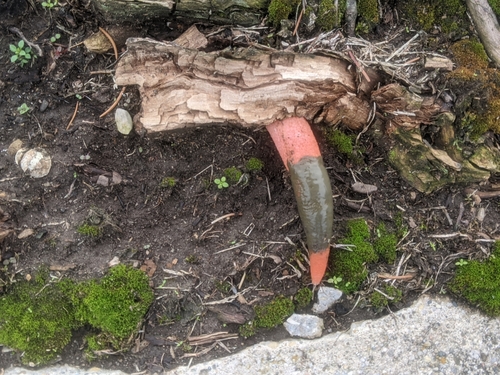
The Devil's Dipstick, scientifically known as Mutinus elegans, is a fascinating and bizarre member of the stinkhorn family of fungi. Emerging from a gelatinous, egg-like sac, this fungus rapidly grows into a vibrant, slender, pink-to-orange stalk. It is famous for its foul-smelling, olive-brown slime at the tip, which emits an odor of rotting meat to attract flies and beetles that aid in dispersing its spores. Despite its unsettling appearance and scent, it plays a vital ecological role as a decomposer, turning tough woody material back into rich nutrients for the soil. It is a common and surprising find in suburban gardens, hardwood forests, and landscaped yards, often appearing overnight after warm summer rains.
Habitat: Found in mulched garden beds, parks, lawns, and deciduous woodlands, typically growing on decaying wood chips or rich organic soil.
This fungus features a slender, hollow, spongy stalk that grows up to 18 cm tall and about 1.5 cm thick, tapering towards a pointed tip. The stalk ranges in color from bright reddish-orange to pale pinkish-red near the base. The upper third of the stalk is covered in a sticky, slimy, olive-green to dark brown spore mass known as the gleba, which has a distinctively foul, carrion-like odor. It emerges from a whitish, egg-like cup at the soil surface, with white rhizomorphs anchored in the substrate.
Category
FungiRarity
Common
Danger
1/5 · Very low
Snaps
1
Its spores are not dispersed by wind like most other fungi; they rely entirely on the digestive tracts and feet of insects to spread.
The genus name Mutinus is derived from Mutunus Tutunus, a Roman phallic marriage deity, referencing the fungus's suggestive shape.
While the mature stinkhorn smells terrible, the immature 'egg' stage is technically edible and lacks the foul odor, though it is not considered choice.
Produces a chemical cocktail that perfectly mimics the odor of decaying flesh to lure carrion insects for spore dispersal.
Can expand from its subterranean egg-like state to a full-sized stalk in just a few hours using hydraulic pressure.
Possesses powerful extracellular enzymes that break down complex lignin and cellulose in woody materials.
As a saprobic fungus, it breaks down and absorbs complex organic compounds from decaying wood, mulch, and leaf litter.
Lucilia caesar
Attracted by the putrid scent, this fly consumes the spore-laden gleba and disperses the spores to new habitats via its feet and droppings.

Acer saccharum
Serves as a primary food and substrate source, with the fungus actively decomposing its fallen wood debris.
No trait badges are assigned for this object yet.
No aliases listed yet.
Collections for this object will appear here as more themes are added.
Danger
1/5 · Very low
No special safety notes yet.
Compare the cap shape, the underside, the stem and base, and whether the fungus grows on wood or soil. Some fungi have gills, others pores or teeth. A cap seen only from above often hides the most useful features. Mushroom Identifier: upload a photo and compare the visible details.
6-18 cm
0.01-0.05 kg
As a saprobic fungus, it breaks down and absorbs complex organic compounds from decaying wood, mulch, and leaf litter.
Found in mulched garden beds, parks, lawns, and deciduous woodlands, typically growing on decaying wood chips or rich organic soil.
Zoom in to split clusters and explore where this object has been snapped.
Take the discovery with you
Snap it with Snappit to identify it, learn what makes it special, and add the discovery to your collection.