

Drummond'S Milkvetch
astragalus drummondii
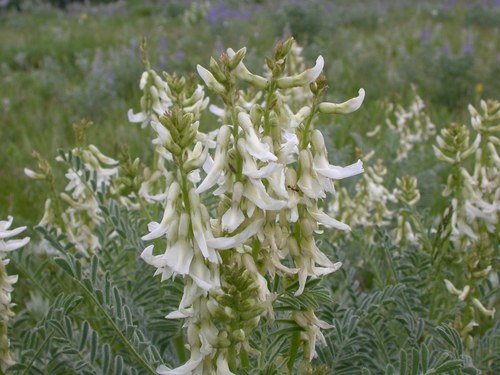
Drummond's Milkvetch (Astragalus drummondii) is a striking perennial herb belonging to the legume family, native to the prairies and foothills of western North America. Like many of its relatives in the vast Astragalus genus, it plays a vital role in its ecosystem by enriching the soil through nitrogen fixation, thanks to a symbiotic relationship with specialized root bacteria. With its soft, hairy foliage and elegant clusters of creamy-white to pale yellow flowers, it brings a subtle beauty to rugged, arid landscapes. While it provides essential nectar for native pollinators like bumblebees, Drummond's Milkvetch is often avoided by grazing livestock due to the presence of mild toxins typical of plants commonly known as "locoweeds." This hardy plant thrives in dry, open environments, perfectly adapted to the sun-drenched plains it calls home.
Habitat: Found in dry prairies, sagebrush steppes, and the open rocky slopes of foothills across western North America.
Drummond's Milkvetch is an upright to sprawling perennial plant that typically reaches 30 to 70 centimeters in height. Its thick stems and compound leaves are covered in fine, soft hairs, giving the plant a distinctively grayish-green, woolly appearance. The leaves are pinnately compound, consisting of numerous small, narrowly elliptical leaflets arranged along a central stalk. In late spring and early summer, it produces dense, elongated clusters (racemes) of creamy white to pale yellow, pea-like flowers. After pollination, these flowers develop into smooth, drooping seed pods that become pendulous and slightly curved as they dry and mature.
Category
PlantsRarity
Common
Danger
1/5 · Very low
Snaps
Be the first to snap!
Like several other milkvetches, it is sometimes grouped with 'locoweeds' because it can be toxic to cattle, horses, and sheep if eaten in large quantities over time.
Many species of milkvetch, including Drummond's, are known as 'rattleweeds' because their dry seeds rattle inside the mature pods when shaken by the prairie wind.
The genus Astragalus is one of the largest genera of flowering plants in the world, containing over 3,000 different species.
The plant gets its distinctive grayish tint from tiny, soft hairs that cover its leaves and stems, which help reflect harsh sunlight and reduce moisture loss.
Partners with rhizobia bacteria in its root nodules to convert atmospheric nitrogen into a usable form, enriching the surrounding soil.
Utilizes a deep taproot to access water far below the surface, allowing it to thrive in arid and semi-arid environments.
Produces specific alkaloids that act as a deterrent to grazing herbivores and livestock.
As a photosynthetic plant, Drummond's Milkvetch produces its own energy using sunlight, water, and carbon dioxide.
Bombus huntii
Pollinates the flowers while foraging for nectar.
Erynnis afranius
Uses the plant as a larval host for caterpillars.
Rhizobium leguminosarum
Forms a symbiotic relationship in the root nodules to fix nitrogen.
No trait badges are assigned for this object yet.
No aliases listed yet.
Collections for this object will appear here as more themes are added.
Danger
1/5 · Very low
No special safety notes yet.
Start with the whole plant, then compare leaf arrangement, leaf edges, stems and any flowers or fruit. Opposite leaves grow in pairs; alternate leaves come one at a time along the stem. These details tell you far more together than a single green leaf does. Plant Identifier: upload a photo and compare the visible details.
30-70 cm
3-10 years
As a photosynthetic plant, Drummond's Milkvetch produces its own energy using sunlight, water, and carbon dioxide.
Found in dry prairies, sagebrush steppes, and the open rocky slopes of foothills across western North America.
5-20
14-28 days
Zoom in to split clusters and explore where this object has been snapped.
Recent snaps will appear here as new observations are added.
Take the discovery with you
Snap it with Snappit to identify it, learn what makes it special, and add the discovery to your collection.