

Dysidea Etheria
dysidea etheria
Dysidea etheria, commonly known as the ethereal sponge or heavenly blue sponge, is a striking marine invertebrate that brings a vibrant splash of color to tropical coral reefs and seagrass beds. As a member of the class Demospongiae, it lacks the hard calcareous or glass spicules found in some sponges, instead relying on a network of flexible spongin fibers that are cleverly reinforced with incorporated sand grains and debris from the ocean floor. This species is particularly noted for its soft, lobed structure and remarkable chemical defenses, which deter most of the hungry predators prowling the reef. Beyond its aesthetic appeal, Dysidea etheria plays a crucial role in its ecosystem as a highly efficient filter feeder, constantly drawing in water to extract microscopic nutrients and significantly improving local water clarity.
Habitat: Typically found in shallow, warm tropical marine environments, anchoring itself to hard substrates on coral reefs, mangrove roots, and within seagrass beds.
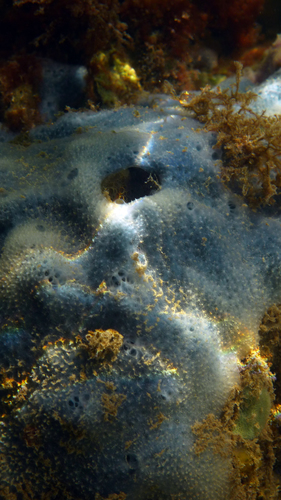
Dysidea etheria typically presents as a massive, lobate, or encrusting sponge with a soft, somewhat fragile, and compressible texture. Its most defining visual characteristic is its vivid coloration, which ranges from a celestial light blue to a pale purple or lavender. The surface is conulose, meaning it is covered in small, cone-like projections, and it features prominent, scattered oscula (exhalant openings) that are sometimes slightly elevated. Under close inspection, one might notice fine grains of sand incorporated directly into its spongin skeleton, giving its vibrant surface a slightly textured, granular appearance.
Category
AnimalRarity
Common
Danger
1/5 · Very low
Snaps
Be the first to snap!
Due to its potent and unique chemical defenses, medical researchers have extensively studied Dysidea sponges for naturally occurring compounds that could be adapted into novel antibiotics and cancer-fighting drugs.
Dysidea etheria does not secrete its own solid mineral skeleton; instead, it scavenges loose sand grains and discarded sponge spicules from the water and weaves them into its protein fibers for structural support.
The vibrant, heavenly blue color of the sponge fades quickly to white or dull grey once it is removed from the water or dies, as its delicate pigments rapidly degrade.
Synthesizes unique secondary metabolites, such as dysidenin, which make it toxic and highly unpalatable to most reef predators like fish and turtles.
Utilizes a complex internal aquiferous system powered by flagellated cells called choanocytes to filter immense volumes of water and capture microscopic plankton.
Possesses an extraordinary ability to regenerate lost tissue, allowing it to recover from physical damage or even reform an entirely new sponge from a tiny cluster of surviving cells.
It actively draws in surrounding seawater through microscopic pores to filter out microscopic life and floating organic particles.
Felimare zebra
Specialized nudibranchs are immune to the sponge's chemical defenses and actively feed on its tissue.
Synalpheus fritzmuelleri
Small marine invertebrates use the sponge's internal canals and crevices as a safe habitat.
Orbicella annularis
The sponge competes directly for hard substrate space with reef-building corals.
No trait badges are assigned for this object yet.
No aliases listed yet.
Collections for this object will appear here as more themes are added.
Danger
1/5 · Very low
No special safety notes yet.
Look for fins, arms, tentacles, shells and body symmetry. Underwater light shifts colors, so structure and markings usually matter more than shade. Sea Creature Identifier: upload a photo and compare the visible details.
5-30 cm
0.1-2 kg
5-20 years
It actively draws in surrounding seawater through microscopic pores to filter out microscopic life and floating organic particles.
Typically found in shallow, warm tropical marine environments, anchoring itself to hard substrates on coral reefs, mangrove roots, and within seagrass beds.
Filtering
Zoom in to split clusters and explore where this object has been snapped.
Recent snaps will appear here as new observations are added.

US
You might spot Great Barracuda, Gray Snapper, and Red Mangrove.
View guide →

US
You might spot Great Barracuda, Gray Snapper, and Atlantic Sergeant Major.
View guide →
Take the discovery with you
Snap it with Snappit to identify it, learn what makes it special, and add the discovery to your collection.