
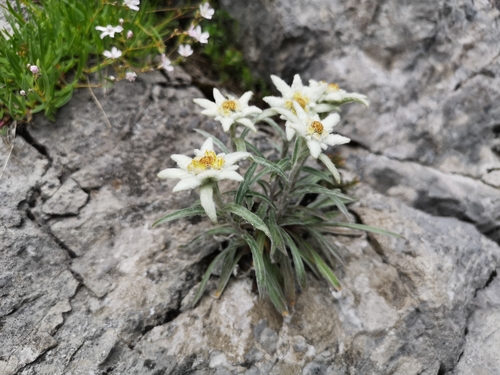



Edelweiss
leontopodium nivale
The Edelweiss (Leontopodium nivale) is a legendary mountain flower that has long captured the hearts of mountaineers, poets, and nature lovers. Nestled high in the rugged limestone crags of the European Alps, Carpathians, and Apennines, this resilient perennial plant is the ultimate symbol of alpine purity and survival. Its star-like felted white bracts and tiny yellow flower heads evoke the dramatic, pristine beauty of high-altitude wilderness.
Habitat: Found in high-altitude alpine meadows and rocky limestone crevices, often clinging to sheer cliff faces and rugged scree slopes.
Edelweiss is easily identified by its unique double-star pattern, composed of 5 to 15 woolly white floral leaves (bracts) surrounding clusters of tiny, dense yellow-green flower heads. The entire plant, especially the bracts and foliage, is densely covered in fine, white, wool-like hairs that give it a silver-grey or velvety appearance. It typically grows low to the ground in small, tufted clumps, reaching heights of 5 to 30 centimeters.
Category
PlantsRarity
Common
Danger
1/5 · Very low
Snaps
Be the first to snap!
In Victorian times, young men would climb dangerous alpine cliffs to pick Edelweiss flowers as proof of their bravery and devotion to their sweethearts.
The flower's white hair acts as a highly efficient UV filter, which has inspired researchers to develop natural sunscreens based on its molecular structure.
The name 'Edelweiss' comes from the German words 'edel' (noble) and 'weiss' (white).
The dense, woolly hairs covering the bracts and leaves absorb harmful ultraviolet radiation, protecting the plant from the intense high-altitude sun.
The compact growth form and protective hairy layer trap heat and moisture close to the plant's surface, acting as a natural insulator against freezing temperatures and dry winds.
Its deep, fibrous root system allows the plant to anchor securely into narrow rocky crevices and withstand the physical forces of erosion.
As a photoautotrophic plant, Edelweiss generates its own energy through photosynthesis, utilizing sunlight, carbon dioxide, water, and soil minerals.
Parnassius apollo
The Apollo Butterfly feeds on the nectar of Edelweiss flowers, serving as an important high-altitude pollinator.

Capra ibex
The Alpine Ibex grazes on alpine vegetation, occasionally consuming Edelweiss along with other high-altitude grasses and herbs.
No aliases listed yet.
Collections for this object will appear here as more themes are added.
Danger
1/5 · Very low
No special safety notes yet.
Start with the whole plant, then compare leaf arrangement, leaf edges, stems and any flowers or fruit. Opposite leaves grow in pairs; alternate leaves come one at a time along the stem. These details tell you far more together than a single green leaf does. Plant Identifier: upload a photo and compare the visible details.
5-30 cm
3-10 years
As a photoautotrophic plant, Edelweiss generates its own energy through photosynthesis, utilizing sunlight, carbon dioxide, water, and soil minerals.
Found in high-altitude alpine meadows and rocky limestone crevices, often clinging to sheer cliff faces and rugged scree slopes.
Zoom in to split clusters and explore where this object has been snapped.
Recent snaps will appear here as new observations are added.
Take the discovery with you
Snap it with Snappit to identify it, learn what makes it special, and add the discovery to your collection.


















