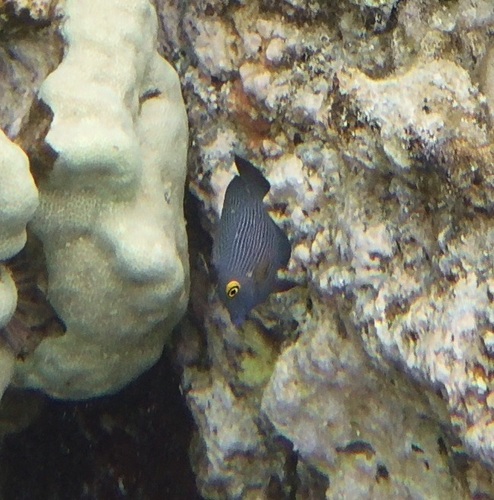


Goldring Surgeonfish
ctenochaetus strigosus
The Goldring Surgeonfish, also widely known as the Kole Tang, is a vibrant and essential resident of Hawaiian coral reefs. Belonging to the surgeonfish family Acanthuridae, this active swimmer is famous for its specialized feeding habits and its contribution to reef health. By scraping turf algae and organic detritus from rocky surfaces, it prevents algae from smothering delicate corals, acting as a natural caretaker of the marine ecosystem. Highly prized by marine hobbyists and snorkelers alike, this fish exhibits a fascinating blend of constant activity and territorial curiosity, making it a true icon of shallow reef flats.
Habitat: Typically found in shallow, wave-swept coral reefs and rocky basalt structures, particularly in areas rich in turf algae and detritus.
This species features an oval, laterally compressed body with a deep reddish-brown to purplish-gray base color, decorated with numerous fine, light-blue to yellow horizontal pinstripes. Its most distinctive feature is a vibrant, bright yellow ring encircling each eye, giving rise to its common name. The head is covered in small yellow-gold spots, and like other surgeonfish, it possesses a sharp, retractable spine on each side of the caudal peduncle, which is used for defense.
Category
FishRarity
Common
Danger
1/5 · Very low
Snaps
1
Their genus name, Ctenochaetus, translates to 'comb-hair' in Greek, referring to their unique comb-like teeth.
They are highly territorial grazers and will actively chase other herbivores away from their preferred feeding patches.
Unlike other surgeonfish that have rigid teeth for cutting macroalgae, the Goldring Surgeonfish's flexible teeth allow it to vacuum up fine films of organic debris.
When stressed or sleeping, their coloration can temporarily change or fade, allowing them to blend into the shadows of reef caves.
Possesses specialized, bristle-like teeth that act like tiny combs to scrape fine algae and detritus from uneven rocky surfaces.
Features a sharp, modified scale on the caudal peduncle that can be flipped out to defend territory or deter predators.
Produces a protective mucus coat that helps ward off external parasites and assists in streamlining their movement through reef crevices.
Feeds primarily on organic detritus, unicellular algae, and diatoms scraped from coral rubble and rocks using its flexible teeth.
Age differences: Juveniles consume a higher ratio of macroalgae and microalgae, transitioning to a predominantly detritus-based diet as their comb-like teeth fully develop.
Labroides phthirophagus
Cleans ectoparasites and dead skin from the body and gills of the Goldring Surgeonfish.
Porites compressa
Provides essential shelter and hiding spots from predators while the fish cleans algae off its base.
Epinephelus merra
Preys upon smaller or juvenile Goldring Surgeonfish sheltering in reef crevices.
No trait badges are assigned for this object yet.
No aliases listed yet.
Collections for this object will appear here as more themes are added.
Danger
1/5 · Very low
No special safety notes yet.
Look at body shape, where the fins sit and their outline, mouth position, stripes and spots. Young fish and breeding adults can wear different patterns, and aquarium color varieties can look nothing like wild fish. Fish Identifier: upload a photo and compare the visible details.
10-18 cm
0.1-0.3 kg
10-35 years
Feeds primarily on organic detritus, unicellular algae, and diatoms scraped from coral rubble and rocks using its flexible teeth.
Typically found in shallow, wave-swept coral reefs and rocky basalt structures, particularly in areas rich in turf algae and detritus.
Grazing
20000-80000
Zoom in to split clusters and explore where this object has been snapped.
Take the discovery with you
Snap it with Snappit to identify it, learn what makes it special, and add the discovery to your collection.