
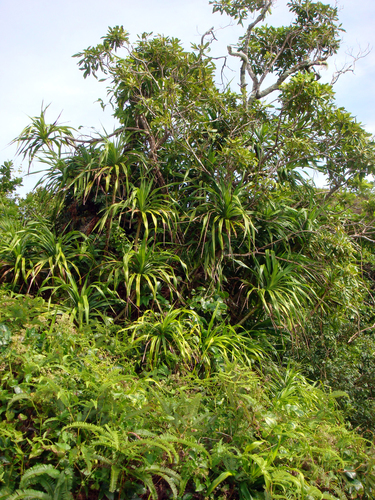


'Ie'Ie
freycinetia arborea
'Ie'Ie (Freycinetia arborea) is an iconic native Hawaiian climbing plant, a prominent member of the understory and mid-canopy of Hawaiian wet forests. Its striking red inflorescences and unique growth habit make it easily recognizable. As a member of the Pandanaceae family, it showcases fascinating adaptations to its island environment, playing a vital role in the ecosystem, particularly through its interaction with native Hawaiian birds. This species contributes significantly to the biodiversity and cultural heritage of the islands, with its fruit and leaves historically used by native Hawaiians.
Habitat: Found in moist to wet forests and often on older lava flows, climbing on trees, rocks, or growing terrestrially in shaded, humid environments across the Hawaiian Islands.
This woody vine typically scrambles or climbs using numerous sturdy aerial roots, often reaching considerable lengths. Its leaves are spirally arranged along the stems, linear to lanceolate with finely toothed margins, growing up to 1 meter long. The most distinguishing feature is its bright red inflorescence, composed of three prominent, petal-like bracts (spathes) that enclose a cluster of small flowers. After pollination, these develop into a composite fruit resembling a small, red-orange pineapple, approximately 5-10 cm long.
Category
PlantsRarity
Common
Danger
1/5 · Very low
Snaps
Be the first to snap!
Despite being primarily a climbing plant, 'Ie'Ie can also grow terrestrially (on the ground) or as an epiphyte (on other plants without parasitizing them), showcasing its remarkable adaptability to various forest niches.
Historically, the long, durable leaves and aerial roots of 'Ie'Ie were skillfully woven by native Hawaiians into intricate baskets, mats, and other useful items.
The large, pineapple-like fruit of 'Ie'Ie is edible and was traditionally consumed by Hawaiians, although it has a distinctive, somewhat astringent taste.
The vibrant red bracts that surround the 'Ie'Ie flowers are thought to be an evolutionary adaptation to attract native bird pollinators, particularly the 'I'iwi, whose curved bill is perfectly suited for accessing its nectar.
Possesses numerous sturdy aerial roots that enable it to firmly anchor itself and climb high into the forest canopy, providing essential structural support for its vine-like growth.
Its vibrant red bracts and nectar-rich flowers are specifically adapted to attract native Hawaiian honeycreepers, primarily the 'I'iwi, which act as its main pollinators.
Can grow as an epiphyte, rooted on other plants, or as a terrestrial plant, directly rooted in the ground, showcasing remarkable adaptability to various substrate availability within its habitat.
As a photosynthetic plant, 'Ie'Ie produces its own food by converting sunlight, carbon dioxide, and water into sugars, utilizing nutrients absorbed from the soil or host substrate through its root system.
Drepanis coccinea
Primary pollinator, attracted to its vibrant red bracts and nectar, playing a crucial role in the plant's reproduction.
Metrosideros polymorpha
Often provides structural support for the climbing vine, as 'Ie'Ie uses its trunk and branches to ascend into the canopy.

Rattus rattus
Consumes the fleshy fruit and can inadvertently aid in seed dispersal through its droppings, though it also preys on seeds.
Myadestes obscurus
Consumes the fruit, contributing to seed dispersal across its habitat.
No trait badges are assigned for this object yet.
No aliases listed yet.
Collections for this object will appear here as more themes are added.
Danger
1/5 · Very low
No special safety notes yet.
Start with the whole plant, then compare leaf arrangement, leaf edges, stems and any flowers or fruit. Opposite leaves grow in pairs; alternate leaves come one at a time along the stem. These details tell you far more together than a single green leaf does. Plant Identifier: upload a photo and compare the visible details.
200-1500 cm
0.5-20 kg
20-100 years
As a photosynthetic plant, 'Ie'Ie produces its own food by converting sunlight, carbon dioxide, and water into sugars, utilizing nutrients absorbed from the soil or host substrate through its root system.
Found in moist to wet forests and often on older lava flows, climbing on trees, rocks, or growing terrestrially in shaded, humid environments across the Hawaiian Islands.
Zoom in to split clusters and explore where this object has been snapped.
Recent snaps will appear here as new observations are added.
Take the discovery with you
Snap it with Snappit to identify it, learn what makes it special, and add the discovery to your collection.


















