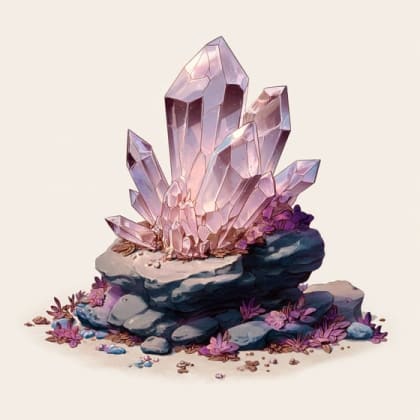




Ilmenite
Ilmenite is a shiny black mineral found in rocks and sands. It is often used to make titanium, a strong and lightweight metal used in airplanes and sports equipment.
The Ilmenite is a heavy, dark mineral, typically appearing as iron-black to brownish-black crystals. It often has a striking submetallic to metallic luster, making it look like dull metal. Its dark hue and density distinguish it from lighter minerals.
Category
MineralRarity
Rare
Danger
1/5 · Very low
Snaps
Be the first to snap!
Deep Earth Clues: Scientists study ilmenite to understand processes happening deep inside our planet!
Heavy Sand: Its dense, dark grains can form black 'heavy mineral' sands on beaches worldwide!
Invisible Protector: The super-tough titanium from ilmenite is also used in medical implants!
Moon Rock Miner: Ilmenite is so important, it has even been found in rocks brought back from the Moon!
Ilmenite has weak magnetic properties that allow it to be gently attracted by a magnet.
Ilmenite contains titanium, making it the primary source for this strong, lightweight, and corrosion-resistant metal.
Ilmenite can be processed into titanium dioxide, creating brilliant white pigments for paints, paper, and even sunscreens.
Metallic refers to substances, materials, or objects possessing properties characteristic of metals, such as luster and conductivity.
Metallic luster describes a mineral's appearance when reflecting light, resembling polished metal, often opaque.
An artifact is an object made or modified by human culture, typically of historical or archaeological interest.
Magnetic geological traits refer to minerals or rocks that exhibit natural magnetism, attracting or repelling other magnetic substances.

Natural refers to organisms, materials, or phenomena existing or produced by nature, not artificially created.
No aliases listed yet.
Danger
1/5 · Very low
Ilmenite is a mineral and safe to observe, but avoid ingesting it as it is not meant for consumption.
The easiest way to identify Ilmenite is to use the Snappit nature identifier app.
iron-black, brownish-black, steel-gray
5.5
submetallic to metallic
4.7
trigonal
Zoom in to split clusters and explore where this object has been snapped.
Recent snaps will appear here as new observations are added.
Take the discovery with you
Snap it with Snappit to identify it, learn what makes it special, and add the discovery to your collection.