
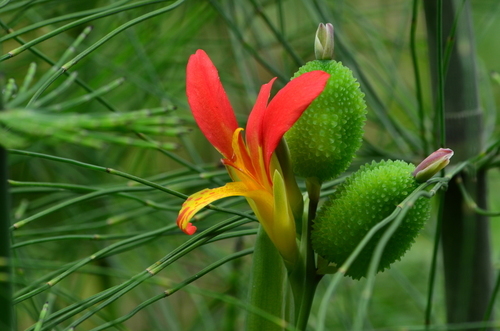


Indian Shot
canna indica
The Indian Shot (Canna indica) is a striking perennial plant renowned for its bold foliage and vibrant, asymmetrical flowers that paint tropical and subtropical landscapes with brilliant hues of red, orange, and yellow. Native to the neotropics, this versatile plant has captured the hearts of gardeners worldwide, earning its place as a staple ornamental in public parks and private gardens alike. Beyond its aesthetic appeal, Canna indica holds deep ethnobotanical value, with roots historically used for food and starch, and incredibly hard seeds traditionally utilized as beads, musical instruments, and even makeshift ammunition.
Habitat: Typically found in moist, sunny areas such as riverbanks, wetlands, forest edges, and cultivated gardens across tropical and subtropical regions.
This robust herb stands between 90 to 250 cm tall, featuring large, banana-like leaves that are rich green or occasionally dark bronze-purple. The flowers, which bloom in terminal spikes, are actually composed of highly modified, colorful stamens called staminodes that mimic true petals, ranging from bright scarlet to golden yellow. Following pollination, it produces bumpy, papery seed capsules that split open to reveal exceptionally round, shiny black seeds that feel as hard as lead shot.
Category
PlantsRarity
Common
Danger
1/5 · Very low
Snaps
Be the first to snap!
In the Andes, the rhizomes are harvested and processed into 'Achira' starch, a highly digestible gluten-free flour used to make traditional biscuits.
The common name 'Indian Shot' comes from the seeds' resemblance to lead shotgun pellets, being so hard and heavy they were reportedly used as ammunition during mutinies.
The shiny, perfectly round black seeds are widely used as beads in jewelry, rosaries, and inside the gourd rattles (kayamb) of Reunion island music.
This plant is highly effective at phytoremediation, absorbing and neutralizing heavy metals like lead and zinc from contaminated soil and wastewater.
Its seeds possess an incredibly dense, impermeable coat that protects the embryo for years, allowing them to survive fire and pass undamaged through animal digestive tracts.
It spreads rapidly through thick, underground rhizomes that store nutrients, enabling the plant to quickly bounce back after cold snaps or physical damage.
As a photoautotrophic plant, Indian Shot produces its own energy via photosynthesis, absorbing water and vital minerals from the soil through its extensive rhizome system.
Calpodes ethlius
The caterpillars of this butterfly feed extensively on Canna leaves, rolling them into protective tubes.
Amazilia tzacatl
Hummingbirds are primary pollinators of Canna indica, attracted to the bright red tubular flowers and abundant nectar.
Apis mellifera
Bees frequently visit the flowers to gather pollen and nectar, assisting in the pollination process.
No trait badges are assigned for this object yet.
No aliases listed yet.
Collections for this object will appear here as more themes are added.
Danger
1/5 · Very low
No special safety notes yet.
Start with the whole plant, then compare leaf arrangement, leaf edges, stems and any flowers or fruit. Opposite leaves grow in pairs; alternate leaves come one at a time along the stem. These details tell you far more together than a single green leaf does. Plant Identifier: upload a photo and compare the visible details.
90+ cm
As a photoautotrophic plant, Indian Shot produces its own energy via photosynthesis, absorbing water and vital minerals from the soil through its extensive rhizome system.
Typically found in moist, sunny areas such as riverbanks, wetlands, forest edges, and cultivated gardens across tropical and subtropical regions.
Zoom in to split clusters and explore where this object has been snapped.
Recent snaps will appear here as new observations are added.
Take the discovery with you
Snap it with Snappit to identify it, learn what makes it special, and add the discovery to your collection.

















