





jimsonweed
Datura stramonium
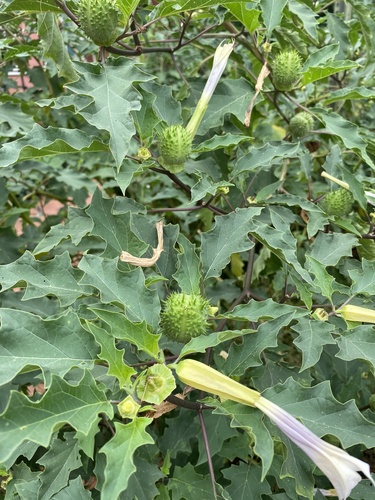
Jimsonweed is a tall plant with big, trumpet-shaped flowers that can be white or purple. It grows in sunny places and has spiky seed pods that look like little green balls.
Habitat: Urban areas
The jimsonweed has large, ovate, dark green leaves with irregular wavy margins. It produces distinctive trumpet-shaped flowers, typically white or pale lavender, that stand upright. Its most unique feature is its spherical, prickly seed pods, resembling a thorny apple.
Category
PlantsRarity
Common
Danger
5/5 · Extreme
Snaps
11
Ancient cultures sometimes used jimsonweed in spiritual rituals, but it's super dangerous!
Jimsonweed is related to tomatoes and potatoes, but unlike them, every part of it is poisonous.
Some farmers call it 'devil's snare' because it can quickly take over disturbed farm fields.
The plant's scientific name, *Datura*, comes from a Hindi word, hinting at its old cultural uses.
Jimsonweed has spiky seed pods that help protect its developing seeds from hungry animals.
Its beautiful flowers open at night and release a sweet scent, which helps it attract nocturnal moths for pollination.
Jimsonweed produces powerful natural chemicals, making it poisonous to most animals that might try to eat it.
Jimsonweed seeds can stay dormant and alive in the soil for many years, waiting for the right conditions to sprout.
Manduca sexta
Adult moths visit the flowers at night
Manduca sexta
The larvae feed on its leaves
Epilachna straminea
Both larvae and adults feed on its foliage
Bell-shaped flowers possess petals fused or arranged to form a cup-like or campanulate structure resembling a bell.
Flowering plants are any plants that produce flowers as part of their reproductive cycle.
Fragrant flowers emit a pleasant aroma, often to attract pollinators or for defense.
Medicinal plants possess chemical compounds that can be used for therapeutic purposes to treat illnesses or maintain health.

Night blooming plants open their flowers after sunset, often to attract nocturnal pollinators with their scent and appearance.

Possessing sharp, pointed projections or spines on the body or surface.

Poisonous organisms produce toxins that can cause harm when ingested, inhaled, or absorbed through contact.

This habitat trait indicates species that can coexist with humans in urban and suburban environments, utilizing man-made structures and green spaces.

Invasive species are non-native organisms that cause harm to the environment, economy, or human health.
Danger
5/5 · Extreme
Do not touch or eat any part of this plant, as it can be harmful.
The easiest way to identify jimsonweed is to use the Snappit nature identifier app.
60-150 cm
30-90 cm
7-12 cm
Summer to fall
No
Deadly
Annual
Zoom in to split clusters and explore where this object has been snapped.
Aug 13, 2020
Capitol HillPhoto attribution
(c) Frederick Nunley, some rights reserved (CC BY)
License: CC BY 4.0 ↗
Image may be shown cropped inside the card frame.

New York, US
You might spot Common Eastern Bumble Bee and Ground-Ivy.
View guide →

Alabama, US
You might spot Anole, Bee, and Bristle Thistle.
View guide →

Alabama, US
You might spot Anole, Bee, and Bristle Thistle.
View guide →

Rhode Island, US
You might spot White-Tailed Deer, Great Egret, and Duck.
View guide →

New Jersey, US
You might spot Eastern Gray Squirrel and House Sparrow.
View guide →

Virginia, US
You might spot Garlic Mustard, Spotted Lanternfly, and Bloodroot.
View guide →
Take the discovery with you
Snap it with Snappit to identify it, learn what makes it special, and add the discovery to your collection.








.jpg&width=800)

_001.jpg&width=800)




