

Kangaroo-Apple
solanum laciniatum
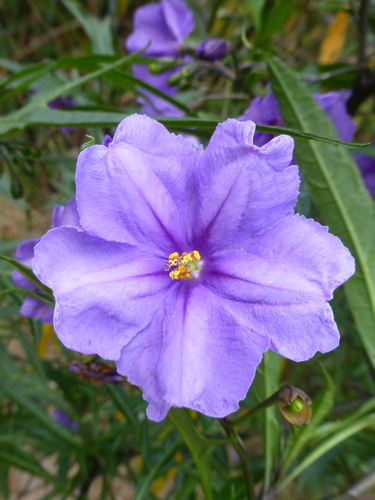
Kangaroo-Apple (Solanum laciniatum) is a striking, fast-growing shrub native to the temperate regions of southeastern Australia and New Zealand. Belonging to the nightshade family (Solanaceae), this resilient plant is famous for its deeply lobed, dark green leaves that resemble the footprint of a kangaroo. During the warmer months, it produces a profusion of beautiful violet-purple flowers with bright yellow centers, which later develop into egg-shaped berries. While these berries are highly toxic when green, they turn a vibrant orange when fully ripe and split open, at which point they historically served as a traditional food source for Indigenous peoples. Kangaroo-Apple acts as a pioneer species, quickly colonizing disturbed soils, forest margins, and coastal areas, providing vital shelter and food for local wildlife while showcasing the incredible adaptability of the Solanaceae family.
Habitat: Found in coastal areas, wet forest margins, shrublands, and disturbed sites such as roadsides throughout southeastern Australia and New Zealand.
Kangaroo-Apple is a large, spreading shrub that typically grows 100 to 400 centimeters tall, featuring smooth, purplish-green stems. Its most distinctive feature is its foliage: the lower leaves are large and deeply divided into 3 to 9 lance-shaped lobes, resembling a kangaroo's footprint, while upper leaves may be simpler and unlobed. It bears clusters of star-shaped, five-lobed flowers that are intense violet or blue-purple, measuring about 3 to 5 cm across, with prominent yellow anthers at the center. The fruit is an oval, berry-like drupe, roughly 2 to 3 cm long, transitioning from a smooth green to a bright yellow-orange as it matures.
Category
PlantsRarity
Common
Danger
1/5 · Very low
Snaps
Be the first to snap!
Historically, Indigenous Australians used the ripe orange fruits as a food source, but they carefully avoided the green fruits, which are dangerously toxic.
The green, unripe fruits contain high levels of solasodine, a toxic alkaloid used as a base precursor in the manufacture of steroid contraceptives.
The plant's common name comes from the shape of its deeply lobed leaves, which bear a striking resemblance to the three-toed footprint of a kangaroo.
Quickly establishes in disturbed soils, using fast growth to outcompete other plants for sunlight and nutrients after fires or land clearing.
Produces high concentrations of toxic glycoalkaloids, like solasodine, in its unripe fruits and leaves to deter herbivores from consuming them before the seeds are mature.
Produces hardy seeds that can remain dormant in the soil seed bank for years, waiting for a disturbance event to trigger germination.
As a photoautotrophic plant, the Kangaroo-Apple produces its own food through photosynthesis, utilizing sunlight, carbon dioxide, water, and soil nutrients.
Zosterops lateralis
Feeds on the ripe fruit and disperses the seeds across the landscape.
Phthorimaea operculella
Feeds on the foliage, occasionally causing leaf damage.
Bombus terrestris
Visits the violet flowers for pollen collection, facilitating pollination.
No trait badges are assigned for this object yet.
No aliases listed yet.
Collections for this object will appear here as more themes are added.
Danger
1/5 · Very low
No special safety notes yet.
Start with the whole plant, then compare leaf arrangement, leaf edges, stems and any flowers or fruit. Opposite leaves grow in pairs; alternate leaves come one at a time along the stem. These details tell you far more together than a single green leaf does. Plant Identifier: upload a photo and compare the visible details.
100-400 cm
5-10 years
As a photoautotrophic plant, the Kangaroo-Apple produces its own food through photosynthesis, utilizing sunlight, carbon dioxide, water, and soil nutrients.
Found in coastal areas, wet forest margins, shrublands, and disturbed sites such as roadsides throughout southeastern Australia and New Zealand.
Photosynthesis
Zoom in to split clusters and explore where this object has been snapped.
Recent snaps will appear here as new observations are added.
Take the discovery with you
Snap it with Snappit to identify it, learn what makes it special, and add the discovery to your collection.