





Knob-billed Duck
Sarkidiornis melanotos
The Knob-billed Duck is a unique bird with a big, funny knob on its bill! It loves to swim in lakes and rivers, and its beautiful feathers can be black and white.
Habitat: Wetlands
The Knob-billed Duck has an iridescent black back and head, contrasting with a clean white belly and grey flanks. Males feature a large, prominent black knob atop their bill, which is noticeably larger during the breeding season. Its large size and unique bill knob make it easily identifiable among other waterfowl.
Category
BirdsRarity
Common
Danger
1/5 · Very low
Snaps
Be the first to snap!
Males develop a dramatic, oversized knob on their bill when it's time to find a partner!
Sometimes, multiple female Knob-billed Ducks will share one giant nest for their eggs!
Their feathers shimmer with beautiful green and purple colors in the bright sunlight.
These ducks often lay their eggs in tree hollows, a very unusual nesting spot for ducks.
Knob-billed Ducks can dive deep underwater to find food because of their strong, webbed feet that help them propel through the water.
The male Knob-billed Duck has a prominent fleshy knob on its bill that grows larger in breeding season, which helps attract a mate.
Knob-billed Ducks possess strong wings and streamlined bodies that enable powerful, swift flight, helping them travel between wetland habitats.
They eat mostly plants, seeds, and aquatic insects found in wetland areas.
Crocodylus niloticus
Large crocodiles sometimes prey on adult ducks or ducklings.
Haliaeetus vocifer
Fish eagles are powerful raptors that hunt ducks.
Nymphaea lotus
Ducks consume seeds and parts of this common water plant.
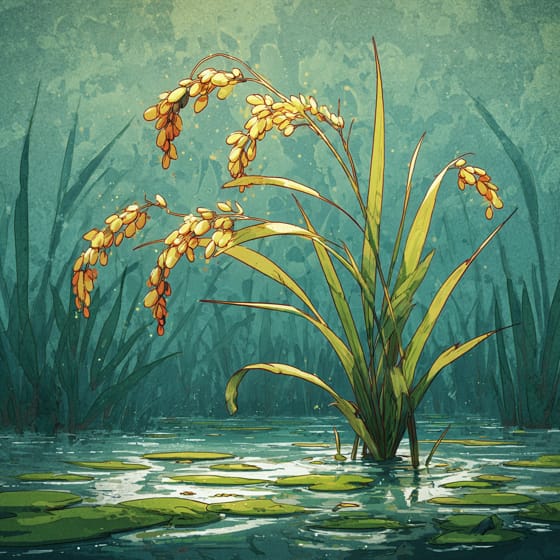
Oryza sativa
Found feeding on rice grains and sprouts in paddies.
Feathered describes animals, primarily birds, possessing a covering of feathers.
Characterized by having toes connected by a membrane, typically aiding in swimming.
Social animals live in organized groups, cooperating for survival benefits such as foraging, defense, and raising offspring.
Colorful describes organisms or objects displaying a wide range of bright and distinct colors.

Filter feeders obtain nutrients by straining suspended food particles and small organisms from water.

This trait characterizes organisms whose diet consists entirely or primarily of plant material.

This habitat trait identifies species found in wetlands, which are areas of land saturated with water, either permanently or seasonally, including marshes, swamps, and bogs.

Diurnal animals are primarily active during daylight hours, typically resting or sleeping at night.

Freshwater habitats include non-saline aquatic environments such as rivers, lakes, ponds, and wetlands, vital for numerous species.
Danger
1/5 · Very low
Always watch ducks from a distance and do not feed them bread.
The easiest way to identify Knob-billed Duck is to use the Snappit nature identifier app.
56-76 cm
105-145 cm
1.2-2.9 kg
5-10 years
60 km/h
They eat mostly plants, seeds, and aquatic insects found in wetland areas.
Wetlands
Zoom in to split clusters and explore where this object has been snapped.
Recent snaps will appear here as new observations are added.
Take the discovery with you
Snap it with Snappit to identify it, learn what makes it special, and add the discovery to your collection.




.jpg&width=800)







