

Knobbed Whelk
busycon carica
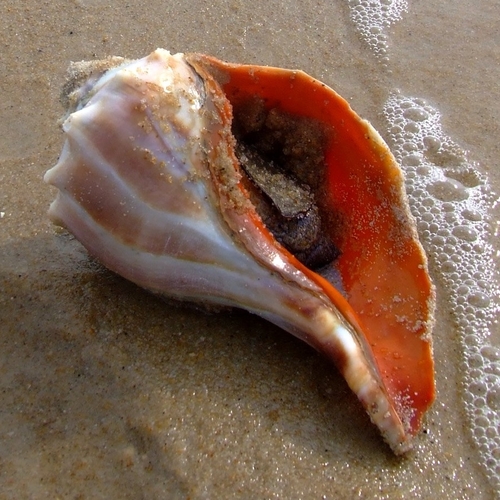
The Knobbed Whelk (Busycon carica) is a spectacular and robust marine gastropod native to the shallow coastal waters of the North Atlantic. Known as a heavy, slow-moving predator, this sea snail plays an essential role in keeping local bivalve populations balanced. The species has historically been highly valued, notably used by Native Americans to craft wampum beads, and is currently honored as the official state shell of both New Jersey and Georgia. It serves as a fascinating example of marine adaptation along the eastern seaboard of North America.
Habitat: Found in shallow coastal waters, estuaries, and sandy or muddy intertidal flats along the Atlantic coast.
The heavy shell of the Knobbed Whelk is distinctly dextral, meaning the opening or aperture is situated on the right side when the spire points upward. It features a sequence of prominent, low spines or knobs along the shoulder of each whorl. The shell's exterior displays a dusty, light-gray or tan coloring that camouflages it against sandy bottoms, whereas the interior aperture is famously flushed with a vibrant, warm orange-yellow hue. Adults usually measure between 12 and 30 centimeters in length and taper into a long siphonal canal.
Category
InvertebrateRarity
Common
Danger
1/5 · Very low
Snaps
Be the first to snap!
Native Americans used the strong central columella of the knobbed whelk shell to carve white wampum beads used for currency and trade.
The Knobbed Whelk is the official state shell of both Georgia (since 1987) and New Jersey (since 1995).
They lay their eggs in a long, papery, spiral chain of capsules often referred to as a 'mermaid's necklace' which frequently washes ashore.
Whelks are 'right-handed' (dextral) snails, unlike the closely related Lightning Whelk, which is 'left-handed' (sinistral).
The whelk utilizes the hard edge of its own shell as a wedge to chip and pry open the tightly closed valves of clams and oysters.
It uses a highly specialized olfactory organ called an osphradium to detect prey chemicals carried by the water current.
Once a prey's shell is slightly parted, the whelk inserts its rasplike radula to scrape and consume the soft tissues inside.
A specialized carnivore feeding mainly on bivalves by utilizing mechanical leverage to break or wedge open their shells.
Age differences: Juveniles feed on smaller bivalves or carrion before transitioning to large clams and oysters as adults.
Mercenaria mercenaria
Predates upon hard clams by using its shell lip to pry their valves apart.
Asterias forbesi
Preys upon young and mid-sized knobbed whelks.
Cancer irroratus
Juveniles are vulnerable to predation by larger coastal crabs.
No trait badges are assigned for this object yet.
No aliases listed yet.
Collections for this object will appear here as more themes are added.
Danger
1/5 · Very low
No special safety notes yet.
Compare the overall shape, opening, spiral, ribs, hinge and surface sculpture. Beach shells often lose the colors and sharp edges they had on the living animal, so shape does most of the work. Seashell Identifier: upload a photo and compare the visible details.
12-30 cm
0.2-1.5 kg
10-20 years
A specialized carnivore feeding mainly on bivalves by utilizing mechanical leverage to break or wedge open their shells.
Found in shallow coastal waters, estuaries, and sandy or muddy intertidal flats along the Atlantic coast.
Foraging
40-150
Zoom in to split clusters and explore where this object has been snapped.
Recent snaps will appear here as new observations are added.

North Carolina, US
You might spot Firewheel, Domestic Horse, and Atlantic Horseshoe Crab.
View guide →

Delaware, US
You might spot Atlantic Horseshoe Crab and Atlantic Ghost Crab.
View guide →

New York, US
You might spot Eastern Box Turtle, Osprey, and Low Pricklypear.
View guide →
Take the discovery with you
Snap it with Snappit to identify it, learn what makes it special, and add the discovery to your collection.