

Late Oyster
sarcomyxa serotina
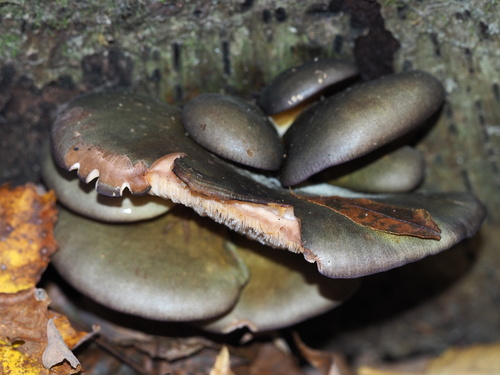
The Late Oyster (Sarcomyxa serotina), also known as the late fall oyster, is a hardy and distinctive gilled fungus that brings a splash of color to the quiet, cold forests of late autumn and winter. Unlike most mushrooms that vanish at the first sign of frost, this resilient species thrives in near-freezing temperatures, often fruiting when snow is on the ground. It plays a critical role in forest ecosystems as a decomposer, slowly breaking down dead deciduous wood and recycling nutrients back into the soil. While edible, its taste can vary from mild to quite bitter, making it more appreciated by experienced foragers and nature lovers who marvel at its ability to brave the winter chill.
Habitat: Found in deciduous and mixed forests, growing in overlapping shelves on decaying hardwood logs, stumps, and fallen branches.
This mushroom features a kidney-shaped or fan-shaped cap, measuring 3 to 12 cm across, which is attached laterally to wood with little to no stem. The cap surface is smooth, slightly sticky when wet, and displays a beautiful palette of olive-green, yellowish-green, or brownish tones, often with a purple or violet tint near the margin when young. Below the cap, the closely spaced gills are pale yellow to orange-yellow, meeting a short, stout, yellowish stem that is covered in fine, velvety hairs.
Category
FungiRarity
Common
Danger
1/5 · Very low
Snaps
4
Its cap has a unique gelatinous layer underneath the skin that swells up when wet, helping the mushroom retain moisture during dry winter winds.
Unlike most mushrooms that decay quickly after a frost, the Late Oyster can survive multiple freezing cycles and continue to drop spores.
While considered edible, it contains a bitter substance that often requires long cooking or boiling to make palatable.
Features a specialized gelatinous layer beneath its cap skin that protects fungal cells from freezing, allowing it to fruit during winter.
Secretes powerful extracellular enzymes like laccase to break down complex lignin and cellulose in dead wood, turning it into rich organic matter.
Capable of releasing spores at temperatures close to freezing, ensuring reproductive success when competitor fungi are dormant.
As a saprotrophic fungus, it derives all of its nutrients by breaking down dead wood, particularly hardwoods like birch, alder, and maple.

Betula papyrifera
Grows on and decomposes the dead logs and stumps of this tree species.
Mycetophila fungorum
The larvae of this fly feed on the fungal tissue of the mushroom cap.
No trait badges are assigned for this object yet.
No aliases listed yet.
Collections for this object will appear here as more themes are added.
Danger
1/5 · Very low
No special safety notes yet.
Compare the cap shape, the underside, the stem and base, and whether the fungus grows on wood or soil. Some fungi have gills, others pores or teeth. A cap seen only from above often hides the most useful features. Mushroom Identifier: upload a photo and compare the visible details.
3-12 cm
0.01-0.15 kg
1-10 years
As a saprotrophic fungus, it derives all of its nutrients by breaking down dead wood, particularly hardwoods like birch, alder, and maple.
Found in deciduous and mixed forests, growing in overlapping shelves on decaying hardwood logs, stumps, and fallen branches.
Zoom in to split clusters and explore where this object has been snapped.

New York, US
You might spot American Toad and Intermediate Wood Fern.
View guide →

Ohio, US
You might spot Duck, Canada Goose, and Muscovy Duck.
View guide →

Massachusetts, US
You might spot Mountain Laurel and North American Porcupine.
View guide →
Take the discovery with you
Snap it with Snappit to identify it, learn what makes it special, and add the discovery to your collection.