

Loggerhead Sponge
spheciospongia vesparium
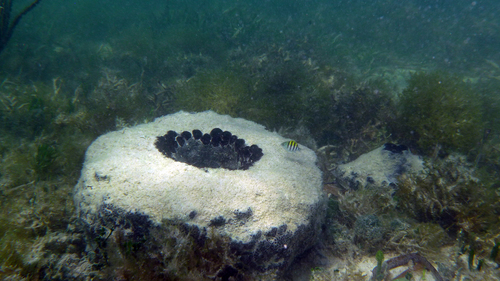
The Loggerhead Sponge (Spheciospongia vesparium) is one of the largest and most ecologically vital sponge species found in the shallow tropical waters of the Western Atlantic. Far from being a simple, passive organism, this massive sponge acts as a bustling, living apartment complex. Its intricate network of internal canals and chambers provides shelter and protection to thousands of tiny marine creatures, including shrimp, crabs, and worms. By continuously pumping and filtering thousands of liters of seawater every day, the Loggerhead Sponge plays a critical role in nutrient cycling and maintaining water clarity across coral reefs and seagrass meadows.
Habitat: Found in shallow tropical and subtropical marine waters, anchored to hard substrates on coral reefs, rocky sea floors, and within seagrass beds.
This sponge typically grows in a large, barrel-like, mound-like, or cake-like shape with a flattened, slightly concave top. Its tough, leathery exterior is usually dark grayish-brown to charcoal black, while the protected interior tissue is a contrasting pale beige or light yellow. The top surface is punctuated by clusters of large, distinct holes called oscula, which serve as water exit portals. Mature specimens are massive, frequently reaching diameters of 30 to 100 centimeters and heights of up to 50 centimeters.
Category
AnimalRarity
Common
Danger
1/5 · Very low
Snaps
Be the first to snap!
A single large loggerhead sponge can provide a home for over 16,000 individual snapping shrimp and other small invertebrates.
Despite having no brain, organs, or nervous system, this animal can successfully filter and process immense volumes of water every second.
Its species name, vesparium, means 'wasp nest' in Latin, referring to the honeycomb-like appearance of its internal chambers when cut open.
It acts as a powerful natural pump, filtering thousands of liters of seawater daily to trap bacteria and microscopic organic particles.
Its highly porous interior acts as a structural refuge, hosting more individual symbiotic macroinvertebrates than almost any other marine organism.
Produces potent secondary metabolites that deter predatory fish and prevent competing organisms from growing over its surface.
Filters microscopic food particles directly from the water column as it pumps seawater through its body canal system.
Synalpheus regalis
Provides a complex internal habitat where entire colonies of eusocial snapping shrimp live, feed, and reproduce.

Caretta caretta
One of the few specialized predators capable of consuming the tough, toxic, and silica-rich tissue of this sponge.
No trait badges are assigned for this object yet.
No aliases listed yet.
Collections for this object will appear here as more themes are added.
Danger
1/5 · Very low
No special safety notes yet.
Look for fins, arms, tentacles, shells and body symmetry. Underwater light shifts colors, so structure and markings usually matter more than shade. Sea Creature Identifier: upload a photo and compare the visible details.
30-100 cm
5-80 kg
20-100 years
Filters microscopic food particles directly from the water column as it pumps seawater through its body canal system.
Found in shallow tropical and subtropical marine waters, anchored to hard substrates on coral reefs, rocky sea floors, and within seagrass beds.
Filtering
Zoom in to split clusters and explore where this object has been snapped.
Recent snaps will appear here as new observations are added.

US
You might spot Great Barracuda, Gray Snapper, and Red Mangrove.
View guide →

US
You might spot Great Barracuda, Gray Snapper, and Atlantic Sergeant Major.
View guide →
Take the discovery with you
Snap it with Snappit to identify it, learn what makes it special, and add the discovery to your collection.