
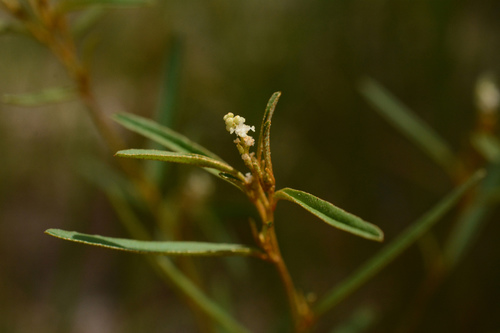


Michaux'S Croton
croton michauxii
Michaux's Croton, scientifically known as Croton michauxii, is a resilient perennial herb native to the southeastern United States. This member of the spurge family thrives in challenging, nutrient-poor sandy soils where few other plants can establish, playing an important role in fire-adapted ecosystems by providing ground cover. Named in honor of the French botanist André Michaux, this species showcases the incredible survival strategies of coastal plain flora, remaining tough and vibrant even in dry, sun-baked environments.
Habitat: Found in sunny, well-drained sandy soils of pine flatwoods, sandhills, and coastal dunes.
This compact herbaceous plant typically grows between 15 and 50 centimeters in height. Its most distinguishing feature is the dusty, silvery-green hue of its narrow, linear to lanceolate leaves, which is caused by a dense covering of tiny, star-shaped hairs. During its blooming period, it produces small, inconspicuous clusters of whitish-green flowers at the tips of its stems.
Category
PlantsRarity
Common
Danger
1/5 · Very low
Snaps
Be the first to snap!
It was named after André Michaux, an esteemed French botanist who described hundreds of North American plants in the late 1700s.
Its star-shaped leaf hairs, called stellate trichomes, look like miniature sparkling stars under a magnifying glass.
The common name 'rushfoil' is often applied to this genus because the thin leaves resemble rushes.
The leaves are densely covered in star-shaped hairs that reflect harsh sunlight and trap a layer of humid air to prevent moisture loss.
A highly developed taproot system allows the plant to seek out moisture deep within sandy, nutrient-deficient substrates.
Produces a toxic, irritating sap that deters herbivores and insect pests from feeding on its foliage.
As a photoautotroph, it utilizes sunlight, carbon dioxide, water, and soil nutrients to synthesize its own food through photosynthesis.
Anaea andria
The caterpillars of this butterfly feed almost exclusively on the leaves of Croton species.

Lasioglossum pectorale
These small native bees visit the tiny white flowers for pollen and nectar, facilitating pollination.
Aristida stricta
Competes for space, light, and nutrients in the fire-maintained ground cover of pine flatwoods.
No trait badges are assigned for this object yet.
Collections for this object will appear here as more themes are added.
Danger
1/5 · Very low
No special safety notes yet.
Start with the whole plant, then compare leaf arrangement, leaf edges, stems and any flowers or fruit. Opposite leaves grow in pairs; alternate leaves come one at a time along the stem. These details tell you far more together than a single green leaf does. Plant Identifier: upload a photo and compare the visible details.
15-50 cm
0.05-0.25 kg
2-5 years
As a photoautotroph, it utilizes sunlight, carbon dioxide, water, and soil nutrients to synthesize its own food through photosynthesis.
Found in sunny, well-drained sandy soils of pine flatwoods, sandhills, and coastal dunes.
Zoom in to split clusters and explore where this object has been snapped.
Recent snaps will appear here as new observations are added.
Take the discovery with you
Snap it with Snappit to identify it, learn what makes it special, and add the discovery to your collection.


















