

Mojave Fringe-Toed Lizard
uma scoparia
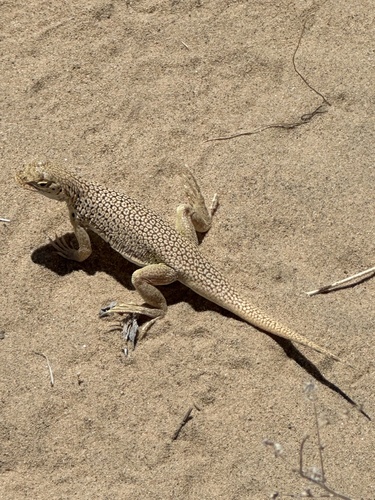
The Mojave Fringe-Toed Lizard, scientific name Uma scoparia, is a fascinating reptile perfectly adapted to the harsh, sandy environments of the Mojave Desert. Renowned for its unique 'fringe' toes, this agile lizard navigates loose sand with remarkable ease, often appearing to skim across the surface. Its cryptic coloration and specialized adaptations make it a master of camouflage and survival in extreme heat. This species is an excellent example of evolutionary specialization, showcasing how life can thrive in seemingly inhospitable landscapes by developing intricate physiological and behavioral traits.
Habitat: The Mojave Fringe-Toed Lizard primarily inhabits arid regions characterized by fine, loose sand dunes and washes with scattered vegetation such as creosote bush and bursage.
This medium-sized lizard typically measures 10-14 cm (4-5.5 inches) from snout to vent, with a tail often longer than its body. Its coloration varies from light tan to pale grey, intricately patterned with dark spots, streaks, and ocelli (eye-like spots) that provide excellent camouflage against sandy substrates. A distinctive feature is the series of elongated, pointed scales along the sides of its toes, forming a 'fringe.' It also possesses specialized nasal flaps and an 'overshot' lower jaw that help keep sand out of its mouth and nostrils.
Category
ReptilesRarity
Common
Danger
1/5 · Very low
Snaps
Be the first to snap!
The specialized 'fringe' on their toes acts like snowshoes, allowing them to run across loose sand at speeds up to 25 km/h (15 mph).
Their cryptic coloration and ability to flatten their bodies against the sand make them incredibly difficult to spot, even when they are present.
They can close their ear openings and nostrils to prevent sand from entering, an essential adaptation for their sandy environment.
When startled, they often sprint a short distance and then abruptly bury themselves in the sand, disappearing from sight almost instantly.
These lizards possess specialized elongated scales on their toes, forming a 'fringe' that increases the surface area of their feet. This adaptation allows them to run swiftly and efficiently over loose sand without sinking.
When threatened or seeking to regulate body temperature, the Mojave Fringe-Toed Lizard can rapidly bury itself completely into loose sand. It uses its shovel-like snout and specialized body movements to 'swim' into the substrate within seconds.
Unique flaps within their nostrils can close completely, preventing sand from entering their respiratory system. This is crucial for survival in their windy, sandy desert environment.
The Mojave Fringe-Toed Lizard is primarily an insectivore, feeding on a variety of small invertebrates found within its desert habitat. Its diet consists of insects and other arthropods that it actively hunts.
Geococcyx californianus
Primary prey item for many desert predators.
Pogonomyrmex rugosus
Main food source, especially for young lizards.
Crotalus cerastes
Prey for larger snakes common in their habitat.

Dipsosaurus dorsalis
Occupies similar ecological niche and can compete for food resources.
No trait badges are assigned for this object yet.
No aliases listed yet.
Collections for this object will appear here as more themes are added.
Danger
1/5 · Very low
No special safety notes yet.
Compare toes, scales, head shape, crests and tail proportions. Many lizards can drop and regrow their tails, so a short tail isn't always a species trait. Lizard Identifier: upload a photo and compare the visible details.
10-15 cm
0.02-0.05 kg
2-5 years
25 km/h
The Mojave Fringe-Toed Lizard is primarily an insectivore, feeding on a variety of small invertebrates found within its desert habitat. Its diet consists of insects and other arthropods that it actively hunts.
The Mojave Fringe-Toed Lizard primarily inhabits arid regions characterized by fine, loose sand dunes and washes with scattered vegetation such as creosote bush and bursage.
Ambush
Zoom in to split clusters and explore where this object has been snapped.
Recent snaps will appear here as new observations are added.
Take the discovery with you
Snap it with Snappit to identify it, learn what makes it special, and add the discovery to your collection.