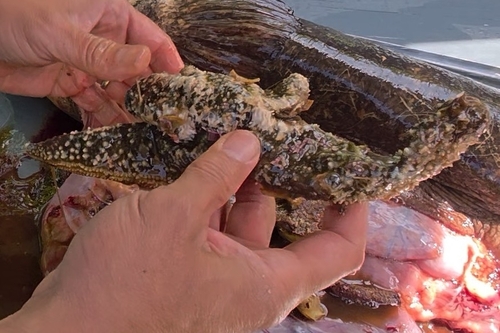


Mottled Star
evasterias troschelii
The Mottled Star is a striking and vibrant sea star commonly found clinging to the rocky shorelines of the Pacific Northwest. An iconic resident of tide pools and intertidal zones, this echinoderm plays a crucial role in maintaining the balance of coastal ecosystems by keeping populations of mussels and barnacles in check. While seemingly stationary to the casual observer, they are actually relentless predators, slowly moving across the rocks on thousands of tiny hydraulic tube feet. Though heavily impacted by Sea Star Wasting Syndrome in recent years, encountering their beautifully textured, mottled bodies in a shallow tide pool remains a spectacular highlight for beachcombers and tide pool enthusiasts.
Habitat: Found in shallow coastal waters, often clinging to rocky intertidal shores and submerged pilings.
True to its name, the Mottled Star features an incredibly variable, irregular color pattern that can include patches of brown, orange, red, grey, and purple. It typically possesses five long, relatively slender arms radiating from a small central disk. The upper surface of its body is covered in a network of small, pale spines arranged in a reticulated or web-like pattern, giving it a rough, coarse texture that provides excellent camouflage against algae-covered rocks and shell beds.
Category
AnimalRarity
Common
Danger
1/5 · Very low
Snaps
4
Despite moving at a snail's pace, their hydraulic tube feet can generate immense continuous pressure, easily prying open the tightly clamped shells of large mussels.
Like many sea stars, the Mottled Star digests its food outside its body by pushing its stomach out through its mouth.
Their rough, mottled upper surface acts like camouflage, blending perfectly into the colorful, algae-covered rocks of tide pools.
They have an incredible ability to regenerate lost limbs; a single surviving arm and part of the central disk can grow into an entirely new sea star.
It can extrude its stomach through its mouth to externally digest prey, allowing it to consume large bivalves without fully opening their shells.
If a Mottled Star loses an arm to a predator or injury, it can completely regenerate the missing limb as long as a portion of the central disk remains intact.
It utilizes thousands of microscopic tube feet powered by a water vascular system to grip slippery rocks, move through strong currents, and pull apart tightly closed mussel shells.
The Mottled Star is a slow but voracious predator that feeds primarily on hard-shelled invertebrates.
Age differences: Juveniles primarily consume smaller prey like barnacle spat and tiny snails, whereas mature stars target large, heavily armored bivalves.
Mytilus californianus
The Mottled Star actively pries open and consumes these bivalves, serving as a key natural predator.
Solaster dawsoni
This large, predatory sea star is known to hunt and eat other sea stars, including the Mottled Star.

Larus glaucescens
During low tide, these seabirds will occasionally forage in the intertidal zone and eat exposed sea stars.
No trait badges are assigned for this object yet.
No aliases listed yet.
Collections for this object will appear here as more themes are added.
Danger
1/5 · Very low
No special safety notes yet.
Look for fins, arms, tentacles, shells and body symmetry. Underwater light shifts colors, so structure and markings usually matter more than shade. Sea Creature Identifier: upload a photo and compare the visible details.
The Mottled Star is a slow but voracious predator that feeds primarily on hard-shelled invertebrates.
Found in shallow coastal waters, often clinging to rocky intertidal shores and submerged pilings.
Foraging
Zoom in to split clusters and explore where this object has been snapped.

Washington, US
You might spot Great Blue Heron, Aggregating Anemone, and Ochre Sea Star.
View guide →

Alaska, US
You might spot Bald Eagle, Salmonberry, and Ochre Sea Star.
View guide →

Washington, US
You might spot Rock Pigeon, Pigeon Guillemot, and American Crow.
View guide →

Washington, US
You might spot Ochre Sea Star, Painted Anemone, and Aggregating Anemone.
View guide →
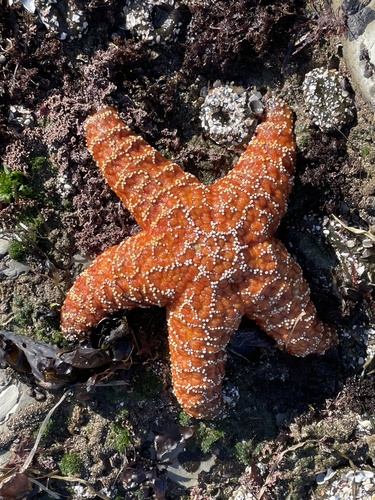
Washington, US
You might spot Ochre Sea Star, Purple Shore Crab, and Strawberry Tree.
View guide →

British Columbia, CA
You might spot Barn Swallow, Pelagic Cormorant, and Sea Lion.
View guide →
Take the discovery with you
Snap it with Snappit to identify it, learn what makes it special, and add the discovery to your collection.