


Mountain Doghobble
leucothoe fontanesiana
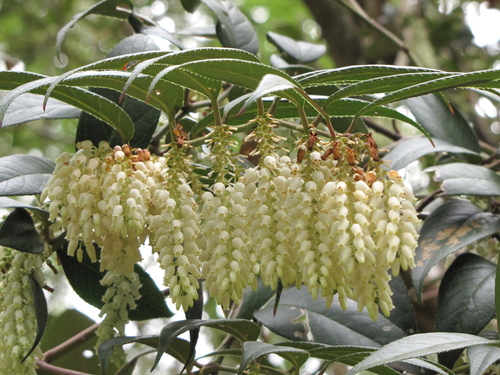
Mountain Doghobble (Leucothoe fontanesiana) is a captivating evergreen shrub that graces the shaded understories of the Appalachian Mountains. Known for its elegant, gracefully arching branches, it brings year-round visual interest to moist, deeply shaded woodlands. In spring, the plant erupts into a spectacular display of tiny, white, urn-shaped flowers that dangle along the stems like rows of delicate pearls, attracting a flurry of early-season pollinators. Beyond its striking appearance, the shrub has a rugged history. It forms dense, nearly impenetrable thickets along stream banks and steep ravines. Local folklore suggests these tangled colonies were notorious for trapping or 'hobbling' hunting dogs as they chased prey through the rugged mountain terrain. Today, while it remains a vital component of wild Appalachian ecosystems, its beauty has also made it a beloved ornamental plant in shade gardens around the world.
Habitat: Found in moist, shaded environments such as Appalachian stream banks, steep ravines, and damp understory woodlands.
Mountain Doghobble typically grows 3 to 6 feet tall, displaying a distinctive fountain-like, arching growth habit. Its leathery, lance-shaped leaves are a glossy dark green during the summer but transform into a striking bronze or deep purplish-red in the winter. During the spring bloom, dense clusters (racemes) of small, white, bell-shaped flowers droop heavily from the undersides of the zigzagging stems, making it easily identifiable in its native shady woodland setting.
Category
PlantsRarity
Common
Danger
1/5 · Very low
Snaps
Be the first to snap!
All parts of the Mountain Doghobble contain grayanotoxins, making the plant highly poisonous to humans, pets, and livestock if ingested.
Because of its shallow, spreading root system, Mountain Doghobble is an excellent plant for stabilizing soil and preventing erosion along steep mountain stream banks.
Its leathery evergreen leaves act as a natural seasonal thermometer, turning a striking bronze or deep purple color when temperatures drop in winter.
The common name 'Doghobble' originated from the plant's tendency to form incredibly dense, tangled thickets that would reportedly trip up hunting dogs tracking bears.
The plant produces toxic compounds known as grayanotoxins in its leaves and nectar, effectively deterring most grazing herbivores.
It utilizes underground rhizomes to clone itself, rapidly spreading outward to form massive, dense thickets that dominate the understory.
Its evergreen leaves produce protective anthocyanins in cold weather, changing from green to a rich bronze or purple to survive freezing temperatures.
As an autotrophic plant, it produces its own energy through photosynthesis while absorbing water and nutrients from the soil.

Bombus impatiens
Pollinates the spring flowers.
Rhizoscyphus ericae
Forms symbiotic relationships with root systems to exchange soil nutrients for plant sugars.
Stephanitis rhododendri
Feeds on the sap of the leaves, causing yellow stippling or spotting.
No trait badges are assigned for this object yet.
No aliases listed yet.
Collections for this object will appear here as more themes are added.
Danger
1/5 · Very low
No special safety notes yet.
Start with the whole plant, then compare leaf arrangement, leaf edges, stems and any flowers or fruit. Opposite leaves grow in pairs; alternate leaves come one at a time along the stem. These details tell you far more together than a single green leaf does. Plant Identifier: upload a photo and compare the visible details.
90-180 cm
20-50 years
As an autotrophic plant, it produces its own energy through photosynthesis while absorbing water and nutrients from the soil.
Found in moist, shaded environments such as Appalachian stream banks, steep ravines, and damp understory woodlands.
Zoom in to split clusters and explore where this object has been snapped.
Recent snaps will appear here as new observations are added.
Take the discovery with you
Snap it with Snappit to identify it, learn what makes it special, and add the discovery to your collection.


















