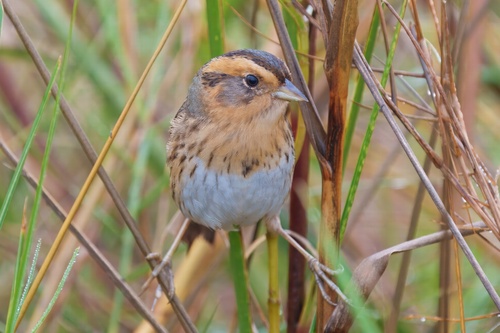


Nelson'S Sparrow
ammospiza nelsoni
Nelson's Sparrow is a small, secretive songbird primarily associated with dense, wet grasses and marshes. Named after American naturalist Edward W. Nelson, this bird is notorious for its skulking behavior, often preferring to run mouse-like through thick marsh vegetation rather than take flight. It comprises three distinct breeding populations: one in the freshwater marshes of the North American interior prairies, one along the Hudson Bay, and one along the northern Atlantic coast. During migration and winter, they converge along the Atlantic and Gulf coasts of the United States. They are a rewarding challenge for birders who have the patience to spot them, offering a beautiful splash of warm ochre and crisp gray plumage once they finally emerge from the reeds.
Habitat: Typically found in the dense, wet grasses of freshwater marshes, coastal estuaries, wet meadows, and saltmarshes.
Nelson's Sparrow is a compact sparrow measuring 11 to 13 centimeters in length. Its most striking feature is a bright ochre or orange-buff face, which contrasts strongly with a broad gray nape and dark brown crown stripes. The bird's back is richly patterned with dark brown and prominent white stripes, while the breast is a warm buff with relatively faint, blurry streaking that fades into a white belly. It features a relatively large bill and a short, spiky tail that aids in navigating through dense marsh grass.
Category
BirdsRarity
Common
Danger
1/5 · Very low
Snaps
Be the first to snap!
Because they are so reluctant to fly when flushed by humans or predators, they will often run through the mud beneath dense marsh grass exactly like a small rodent.
Nelson's Sparrow and the Saltmarsh Sparrow were once considered a single species known as the 'Sharp-tailed Sparrow' before being split into two distinct species in 1995.
Their unusual song is often described as sounding like a drop of cold water hitting a hot frying pan—a quiet, wheezy hiss.
There are three distinct breeding populations of Nelson’s Sparrow, and the birds of the interior prairies look surprisingly different in color saturation than those breeding on the Atlantic coast.
Navigates dense marsh vegetation by running quickly along the ground rather than flying, which helps it evade aerial predators.
Males do not defend strict territories; instead, they roam widely across the marsh to find receptive females in a non-territorial mating strategy.
Coastal and wintering populations have physiological adaptations to process high-salt diets, allowing them to thrive in tidal saltmarshes.
Consumes a mix of insects and marine invertebrates during the breeding season, switching primarily to grass and weed seeds in the winter.
Age differences: Nestlings are fed an exclusively protein-rich diet consisting of insects and small invertebrates.
Spartina alterniflora
Builds nests in and forages among smooth cordgrass.

Circus hudsonius
Preyed upon by aerial predators hunting over open marshes.
Cistothorus palustris
Competes for resources and faces occasional nest destruction by aggressive territorial marsh wrens.
No trait badges are assigned for this object yet.
No aliases listed yet.
Collections for this object will appear here as more themes are added.
Danger
1/5 · Very low
No special safety notes yet.
Compare the silhouette, bill shape, tail length, wing bars and markings around the eyes. The same small brown bird at your feeder can look quite different in breeding plumage, winter plumage or its first year. Bird Identifier: upload a photo and compare the visible details.
11-13 cm
17-20 cm
0.013-0.017 kg
3-7 years
40 km/h
Consumes a mix of insects and marine invertebrates during the breeding season, switching primarily to grass and weed seeds in the winter.
Typically found in the dense, wet grasses of freshwater marshes, coastal estuaries, wet meadows, and saltmarshes.
Zoom in to split clusters and explore where this object has been snapped.
Recent snaps will appear here as new observations are added.
Take the discovery with you
Snap it with Snappit to identify it, learn what makes it special, and add the discovery to your collection.