
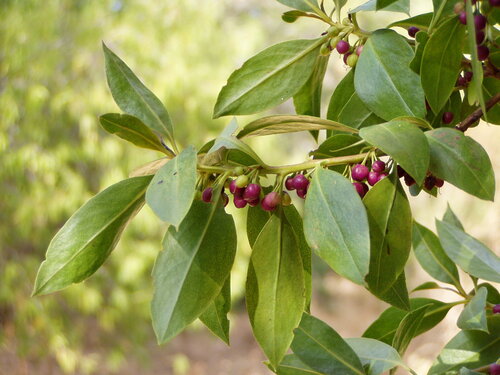


Ngaio
myoporum laetum
The Ngaio is a resilient, fast-growing evergreen shrub or small tree native to coastal New Zealand. Widely known for its incredible tolerance to harsh coastal winds and salt spray, this species plays a vital ecological role in stabilizing dunes and cliff edges. It is often cultivated as a robust hedge or shelterbelt in exposed coastal gardens. While it provides excellent shelter and produces berries favored by native birds, almost all parts of the plant—especially the leaves—contain 'ngaione', a toxic essential oil that protects the plant from mammalian herbivores.
Habitat: Commonly found in coastal environments including cliffs, sand dunes, rocky shores, and lowland coastal forests throughout New Zealand.
Ngaio typically grows as a sprawling shrub or rounded tree reaching heights of 1 to 10 meters. It features lance-shaped, bright green leaves that feel somewhat fleshy or leathery to the touch and are covered in unique, translucent gland dots visible when held to the light. In spring and summer, it produces small, star-shaped white flowers speckled with distinct purple spots, which later develop into succulent, reddish-purple oblong fruits (drupes) about 5 to 8 millimeters long.
Category
PlantsRarity
Common
Danger
1/5 · Very low
Snaps
Be the first to snap!
Despite its medicinal and insect-repelling uses, the plant is highly toxic to livestock like horses and sheep, causing severe liver damage if consumed.
Indigenous Māori historically rubbed the bruised leaves of the ngaio tree directly onto their skin to repel biting mosquitoes and sandflies.
The translucent dots on the leaves are actually tiny oil-secreting glands, making the leaves look like they have been pierced with pins when held up to the light.
The leaves feature thousands of tiny, translucent glands containing ngaione, a toxic oil that deters insect pests and mammalian herbivores from feeding on them.
It possesses thick, leathery leaves and a flexible wood structure that allows it to withstand extreme coastal salt spray and gale-force winds.
With a wide-reaching and deep root system, the ngaio can firmly anchor itself in shifting sands, helping to prevent erosion along coastal dunes.
Ngaio is a photosynthetic plant that manufactures its own organic compounds and energy using sunlight, water, carbon dioxide, and essential nutrients absorbed from the soil.
Hemiphaga novaeseelandiae
The native pigeon consumes the ripe purple fruits and acts as a major seed disperser for the tree.
Klambothrips myopori
An invasive pest insect that feeds extensively on the young foliage, causing severe leaf galling and damage.
Prosthemadera novaeseelandiae
Visits the small white flowers to feed on nectar, assisting in the pollination of the plant.
No trait badges are assigned for this object yet.
No aliases listed yet.
Collections for this object will appear here as more themes are added.
Danger
1/5 · Very low
No special safety notes yet.
Start with the whole plant, then compare leaf arrangement, leaf edges, stems and any flowers or fruit. Opposite leaves grow in pairs; alternate leaves come one at a time along the stem. These details tell you far more together than a single green leaf does. Plant Identifier: upload a photo and compare the visible details.
100-1000 cm
30-80 years
Ngaio is a photosynthetic plant that manufactures its own organic compounds and energy using sunlight, water, carbon dioxide, and essential nutrients absorbed from the soil.
Commonly found in coastal environments including cliffs, sand dunes, rocky shores, and lowland coastal forests throughout New Zealand.
Zoom in to split clusters and explore where this object has been snapped.
Recent snaps will appear here as new observations are added.
Take the discovery with you
Snap it with Snappit to identify it, learn what makes it special, and add the discovery to your collection.

















