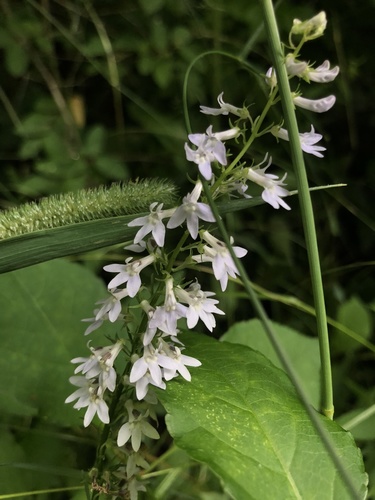


Pale-Spiked Lobelia
lobelia spicata
The Pale-Spiked Lobelia (Lobelia spicata) is a delicate, upright perennial wildflower native to the grasslands, prairies, and open woodlands of North America. Standing on slender, unbranched stems, this charming plant produces a tight, spike-like cluster of small, pale blue to white blossoms during the warmth of mid-summer. It is a subtle yet vital member of its local ecosystem, drawing in various native bees with its nectar. Unlike some of its moisture-loving relatives, the Pale-Spiked Lobelia is remarkably adaptable, often flourishing in drier, sandy, or rocky soils where other plants might struggle. Its presence is a classic indicator of high-quality native prairie and savanna remnants.
Habitat: Typically found in open prairies, savannas, limestone glades, meadows, and along grassy roadsides with dry to moist, well-draining soils.
This slender wildflower typically grows 30 to 100 centimeters tall, featuring light green, unbranched stems that are sometimes slightly hairy near the base. The leaves are alternate, lance-shaped to obovate, and gradually shrink in size as they ascend the stem. The defining feature is the terminal spike-like raceme, densely packed with tubular, two-lipped flowers. Each flower is small, about 1 centimeter long, ranging in color from pale lavender-blue to pure white. The lower lip of the corolla is deeply three-lobed, often featuring faint white or greenish-yellow markings near the throat that serve as nectar guides for visiting insects.
Category
PlantsRarity
Common
Danger
1/5 · Very low
Snaps
1
Despite its delicate appearance, the plant contains lobeline, an alkaloid chemically similar to nicotine that has been studied for its physiological effects.
Historically, various Native American tribes utilized preparations of the roots and leaves of this plant for traditional herbal remedies.
The scientific name 'spicata' refers to the spike-like arrangement of its delicate flowers.
Produces a toxic milky latex sap containing lobeline, which effectively deters generalist mammalian herbivores from feeding on its foliage.
Flowers mature sequentially from the bottom of the spike upward, lengthening the flowering season and increasing chances of successful cross-pollination.
Produces thousands of microscopic, dust-like seeds per capsule that are easily dispersed to new colonization sites by wind and rainwater.
As a photosynthetic plant, it manufactures organic compounds from carbon dioxide and water utilizing solar energy, drawing essential mineral nutrients through its root system.
Age differences: Germinating seeds rely on stored endosperm nutrients before developing roots and photosynthetic cotyledons to sustain self-sufficient growth.
Bombus pensylvanicus
Serves as a primary pollinator, visiting the small tubular flowers to harvest nectar.
Ceratina dupla
Visits the pale blossoms for pollen and nectar, aiding in the plant's sexual reproduction.
No trait badges are assigned for this object yet.
No aliases listed yet.
Collections for this object will appear here as more themes are added.
Danger
1/5 · Very low
No special safety notes yet.
The easiest way to identify Pale-Spiked Lobelia is to use the Snappit nature identifier app.
30-100 cm
2-5 years
As a photosynthetic plant, it manufactures organic compounds from carbon dioxide and water utilizing solar energy, drawing essential mineral nutrients through its root system.
Typically found in open prairies, savannas, limestone glades, meadows, and along grassy roadsides with dry to moist, well-draining soils.
Photosynthesis
Zoom in to split clusters and explore where this object has been snapped.

Arkansas, US
You might spot Widow's-Cross, Yucca Giant-Skipper, and Outis Skipper.
View guide →

Wisconsin, US
You might spot Green Comet Milkweed, Wood Lily, and Flowering Spurge.
View guide →
Take the discovery with you
Snap it with Snappit to identify it, learn what makes it special, and add the discovery to your collection.











.jpg&width=800)



_001.jpg&width=800)




