
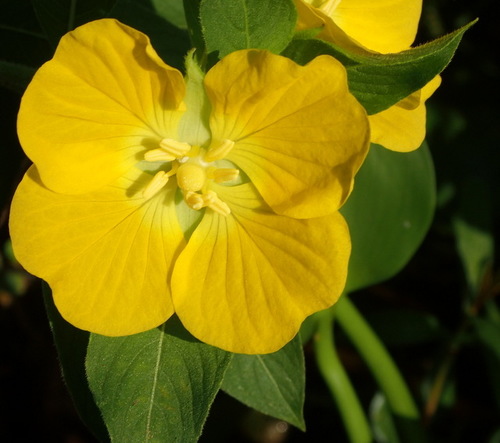


Peruvian Primrose-Willow
ludwigia peruviana
The Peruvian Primrose-Willow (Ludwigia peruviana) is an eye-catching, semi-aquatic deciduous shrub native to wet areas of Central and South America. Though appreciated for its large, showy yellow flowers, it has gained notoriety worldwide as an aggressive, highly invasive wetland weed. It thrives in freshwater habitats, quickly forming dense, woody thickets that can choke out local native species, clog waterways, and alter fragile aquatic ecosystems.
Habitat: Typically found in wet environments such as freshwater marshes, swamps, lake margins, flooded pastures, and slow-moving streams.
This robust shrub typically grows between 1 to 4 meters in height, featuring brownish-green stems covered in fine, soft hairs. It produces alternate, lance-shaped leaves that can reach up to 15 centimeters in length. The most distinctive features are its brilliant yellow flowers, which are 2 to 5 centimeters wide with 4 or 5 large, rounded petals surrounding a cluster of prominent stamens.
Category
PlantsRarity
Common
Danger
1/5 · Very low
Snaps
Be the first to snap!
A single mature Peruvian Primrose-Willow plant can produce up to several million seeds in a single growing season.
Because of its ability to grow rapidly and form dense stands, it is known to block recreational boating and alter water flow in canals.
Its wood is so soft and spongy that it can be easily compressed, a physiological adaptation that keeps the plant lightweight in aquatic environments.
Produces seeds containing air pockets that allow them to float effortlessly on water currents, facilitating rapid downstream colonization.
Develops specialized spongy tissue in its roots and stems that allows oxygen to reach underwater parts, ensuring survival in flooded environments.
Can rapidly regenerate entire new plants from broken stem fragments that break off and float to new locations.
As a photoautotrophic plant, it produces its own energy using sunlight, carbon dioxide, water, and essential soil minerals through photosynthesis.
Apis mellifera
Provides nectar and pollen to foraging insects in wetland ecosystems.
Eichhornia crassipes
Competes directly for space, sunlight, and aquatic nutrients.
Altica litigata
The larvae and adults of this beetle feed heavily on the leaves of the plant.
No trait badges are assigned for this object yet.
No aliases listed yet.
Collections for this object will appear here as more themes are added.
Danger
1/5 · Very low
No special safety notes yet.
Start with the whole plant, then compare leaf arrangement, leaf edges, stems and any flowers or fruit. Opposite leaves grow in pairs; alternate leaves come one at a time along the stem. These details tell you far more together than a single green leaf does. Plant Identifier: upload a photo and compare the visible details.
100+ cm
3+ years
As a photoautotrophic plant, it produces its own energy using sunlight, carbon dioxide, water, and essential soil minerals through photosynthesis.
Typically found in wet environments such as freshwater marshes, swamps, lake margins, flooded pastures, and slow-moving streams.
Zoom in to split clusters and explore where this object has been snapped.
Recent snaps will appear here as new observations are added.
Take the discovery with you
Snap it with Snappit to identify it, learn what makes it special, and add the discovery to your collection.

















