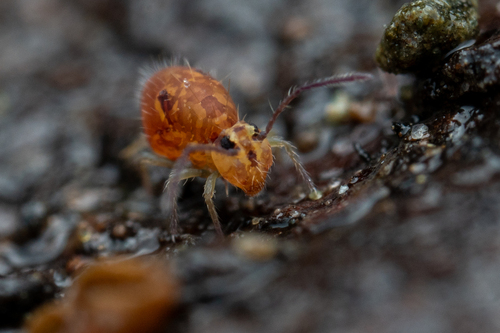





Ptenothrix Maculosa
ptenothrix maculosa
The Spotted Globular Springtail (Ptenothrix maculosa) is a tiny, captivating hexapod that populates the damp floors of temperate forests. Belonging to the class Entognatha, these ancient soil-dwelling creatures are characterized by their internal mouthparts and incredibly spherical bodies. With their bulbous, patterned abdomens and rapid, playful hops, they play an essential role in forest ecosystems as decomposers, feeding on fungi and decaying organic material to recycle nutrients back into the soil. Though minuscule and easily overlooked, they are a favorite among macro-photographers due to their intricate color patterns and charming, alien-like appearance. When threatened, they utilize a specialized jumping organ called a furcula to instantly leap away from danger, vanishing in the blink of an eye. Watching these tiny organisms navigate their miniature forest floor habitats offers a fascinating window into the hidden complexity of soil biodiversity.
Habitat: Found in temperate moist forests, primarily residing in damp leaf litter, mosses, decaying logs, and beneath loose tree bark.
Ptenothrix maculosa is a small, globular springtail measuring between 1.5 to 2.5 millimeters in length. Its most distinguishing feature is its bulbous, rounded abdomen, which is cream or pale-yellow and heavily mottled with intricate patterns of dark purple, black, or reddish-brown spots. It possesses long, four-segmented antennae where the third segment is conspicuously elongated, a characteristic diagnostic of its genus. Large, dark eye patches are visible on either side of its head, and its wingless body is sparsely covered in fine sensory hairs. On its underside, it carries a folded, spring-loaded furcula and a tube-like collophore used for water absorption.
Category
AnimalRarity
Common
Danger
1/5 · Very low
Snaps
Be the first to snap!
Despite having no wings, their spring-loaded escape jump allows them to travel a distance equivalent to over 100 times their body length in a single leap.
The spots on Ptenothrix maculosa are highly variable, making each individual's pattern unique and helpful for blending into mottled soil and leaf environments.
Unlike true insects, springtails do not undergo complete metamorphosis and continue to molt periodically even after reaching full sexual maturity.
Possesses a specialized, spring-loaded abdominal appendage called a furcula that allows it to launch itself several inches into the air to escape predators.
Utilizes a ventral tube structure to drink water, absorb moisture from damp surfaces, and chemically sample its surrounding environment.
Features a complex nanostructured outer skin that repels water, preventing the tiny organism from drowning during rainstorms or in soggy soils.
Feeds primarily on fungal spores, hyphae, algae, and microflora growing on decomposing organic matter within the forest leaf litter.
Stratiolaelaps scimitus
Preys upon small soil organisms, including globular springtails like Ptenothrix maculosa.
Tomocerus minor
Competes for fungal food resources and living space within the damp leaf litter layers of the forest floor.
Trichoderma harzianum
Consumes the microscopic fungal threads of various forest fungi as its primary source of nutrition.
Furry describes animals possessing a dense covering of soft hair or fur.
Marked with spots or patches of a different color.
Solitary animals live alone for most of their lives, only interacting with others for mating or parental care.
Arboreal animals live primarily in trees, utilizing them for shelter, food, and protection from predators.
Nocturnal animals are primarily active during the nighttime hours, typically resting or sleeping during the day.
Collections for this object will appear here as more themes are added.
Danger
1/5 · Very low
No special safety notes yet.
Start with body shape, legs or fins, fur, feathers or scales, and standout markings. Then weigh size, habitat and where you saw it. Young animals and seasonal coats can look very different from familiar adults. Animal Identifier: upload a photo and compare the visible details.
0 cm
0-1 years
Feeds primarily on fungal spores, hyphae, algae, and microflora growing on decomposing organic matter within the forest leaf litter.
Found in temperate moist forests, primarily residing in damp leaf litter, mosses, decaying logs, and beneath loose tree bark.
Foraging
10-50
10-30 days
Zoom in to split clusters and explore where this object has been snapped.
Recent snaps will appear here as new observations are added.

Washington, US
You might spot Cross Orbweaver, Duck, and Fringed Willowherb.
View guide →
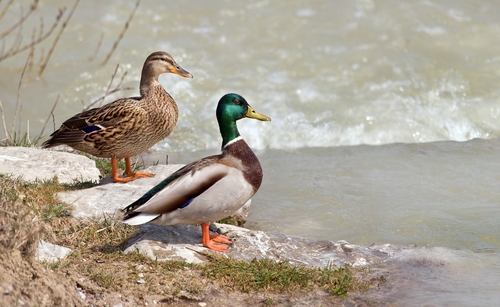
Washington, US
You might spot Duck, American Tuliptree, and Great Blue Heron.
View guide →

Washington, US
You might spot Western Hemlock, Duck, and Western Sword Fern.
View guide →
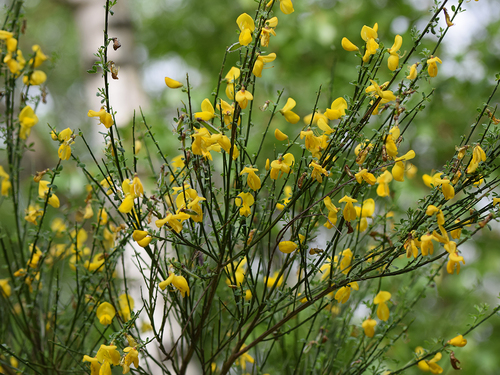
British Columbia, CA
You might spot Scotch Broom, Pacific Trillium, and Fringe Cups.
View guide →

British Columbia, CA
You might spot Pacific Madrone, Brown-Lined Looper, and Salal.
View guide →
Take the discovery with you
Snap it with Snappit to identify it, learn what makes it special, and add the discovery to your collection.