
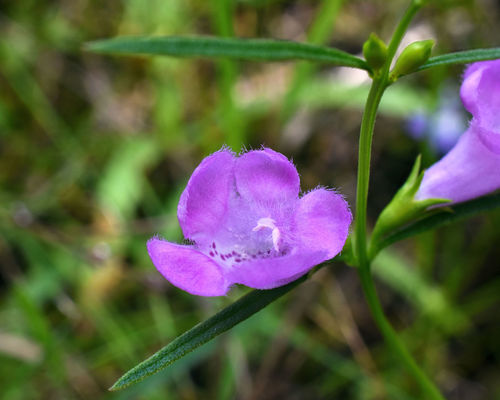


Purple False Foxglove
agalinis purpurea
The Purple False Foxglove (Agalinis purpurea) is a striking annual wildflower native to North America, renowned for its vibrant pinkish-purple, bell-shaped blooms that paint damp meadows and prairies in late summer and autumn. Belonging to the broomrape family (Orobanchaceae), this delicate-looking plant hides a fascinating ecological secret: it is hemiparasitic. While it possesses green leaves and is fully capable of photosynthesis, its root system forms specialized connections called haustoria, which tap into the roots of neighboring plants, particularly grasses and sedges, to steal water and vital mineral nutrients.
Habitat: Typically found in moist, open environments such as wet prairies, meadows, bogs, pine savannas, and disturbed roadsides.
This slender, erect plant typically grows between 30 to 120 cm tall, featuring smooth, branching green stems lined with narrow, needle-like, opposite leaves. Its most defining feature is the beautiful, trumpet-shaped flowers, measuring about 2 to 4 cm long, which display a brilliant rose-pink to deep purple color. The throat of each flower is typically adorned with two yellow lines and numerous dark purple spots, which serve as nectar guides for visiting pollinators. The fruit is a small, rounded capsule containing numerous tiny seeds.
Category
PlantsRarity
Common
Danger
1/5 · Very low
Snaps
Be the first to snap!
Despite being a parasite that drains resources from grasses, its presence can actually increase overall plant diversity in a prairie by keeping aggressive grass species in check.
Each flower blooms for only a single day, opening in the early morning and dropping its corolla by late afternoon.
Its scientific name Agalinis is derived from Greek words meaning remarkable flax, referring to its delicate, flax-like leaves.
It develops specialized root structures called haustoria that penetrate the roots of nearby host plants to extract water and essential nutrients.
Though it can steal resources from hosts, it retains fully functional green leaves and can photosynthesize independently if no host is present.
The inside of its throat features intricate yellow lines and dark spots that reflect UV light to guide bumblebees directly to its nectar.
As a hemiparasite, this plant produces its own energy via photosynthesis but steals water and minerals from the roots of neighboring host plants.
Age differences: Seedlings rely initially on stored seed reserves before developing photosynthetic leaves and seeking out host roots to parasitize.

Junonia coenia
The caterpillars of this butterfly species use the Purple False Foxglove as a primary host plant, feeding on its leaves.

Schizachyrium scoparium
Serves as a host plant for this hemiparasite, which taps into its root system to extract water and minerals.
Bombus impatiens
Pollinates the flowers while foraging for nectar and pollen, guided by the yellow and purple throat markings.
No trait badges are assigned for this object yet.
No aliases listed yet.
Collections for this object will appear here as more themes are added.
Danger
1/5 · Very low
No special safety notes yet.
Start with the whole plant, then compare leaf arrangement, leaf edges, stems and any flowers or fruit. Opposite leaves grow in pairs; alternate leaves come one at a time along the stem. These details tell you far more together than a single green leaf does. Plant Identifier: upload a photo and compare the visible details.
30-120 cm
1 years
As a hemiparasite, this plant produces its own energy via photosynthesis but steals water and minerals from the roots of neighboring host plants.
Typically found in moist, open environments such as wet prairies, meadows, bogs, pine savannas, and disturbed roadsides.
Parasitism
Zoom in to split clusters and explore where this object has been snapped.
Recent snaps will appear here as new observations are added.
Take the discovery with you
Snap it with Snappit to identify it, learn what makes it special, and add the discovery to your collection.

















