

Red Beard Sponge
clathria prolifera
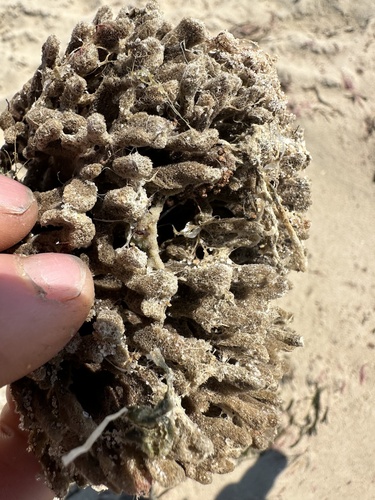
The Red Beard Sponge is an eye-catching marine invertebrate famous for its brilliant orange-red coloration and intricate, shrub-like growth patterns. Found widely in estuaries and shallow coastal zones along the western Atlantic, this sponge forms a crucial element of shallow-water marine communities. Unlike plants, this creature is actually a primitive multicellular animal that remains permanently anchored to hard substrates like rocks, pilings, and oyster reefs. It lacks true organs, tissues, or a nervous system, yet it performs sophisticated functions that are critical to local water quality. By pumping vast quantities of water through its intricate labyrinth of internal chambers, it extracts microscopic particles and organic matter, acting as a natural, highly efficient filtration system. For marine enthusiasts and tidepoolers, encountering a bright cluster of Red Beard Sponge is always a visual treat that highlights the rich biodiversity of coastal ecosystems.
Habitat: Typically found attached to hard substrates like rocks, pier pilings, and oyster shells in shallow, brackish or marine estuaries, bays, and coastal waters.
This species is easily recognized by its vibrant bright red, reddish-brown, or orange coloration. It grows in a branching, bushy, or finger-like form, rising from an encrusting base to heights of up to 20 centimeters. The surface of the branches is rough, porous, and bristly due to microscopic skeletal elements called spicules that protrude outward. Individual branches are typically slender, measuring only a few millimeters to a centimeter in thickness, and frequently fuse together to create complex, tangled clusters.
Category
AnimalRarity
Common
Danger
1/5 · Very low
Snaps
1
If blended or pushed through a sieve, the individual cells of a Red Beard Sponge will find each other and reform into a complete sponge within days.
Its brilliant red color is derived from carotenoid pigments, which are believed to protect the sponge from solar radiation in shallow water.
These sponges act as miniature apartment complexes, hosting dozens of species of tiny crabs, worms, and amphipods within their porous structures.
Utilizes specialized flagellated cells to pump massive quantities of water through its body, filtering out microscopic organic particles.
If mechanically separated into single cells through a fine mesh, the cells can actively crawl back together and fully reorganize into a functional sponge.
Produces bioactive chemical compounds that deter predators and prevent competitive fouling organisms from growing over its surface.
Suspension feeds by drawing water into its body pores to trap and consume microscopic organisms and suspended organic matter.

Crassostrea virginica
Provides structural support and stabilization to oyster beds while colonizing their hard shells.
Doris verrucosa
Feeds directly on sponge tissue, tolerating the defensive toxins and utilizing them for its own protection.
No trait badges are assigned for this object yet.
No aliases listed yet.
Collections for this object will appear here as more themes are added.
Danger
1/5 · Very low
No special safety notes yet.
Look for fins, arms, tentacles, shells and body symmetry. Underwater light shifts colors, so structure and markings usually matter more than shade. Sea Creature Identifier: upload a photo and compare the visible details.
5-20 cm
0.05-0.5 kg
2-10 years
Suspension feeds by drawing water into its body pores to trap and consume microscopic organisms and suspended organic matter.
Typically found attached to hard substrates like rocks, pier pilings, and oyster shells in shallow, brackish or marine estuaries, bays, and coastal waters.
Filtering
Zoom in to split clusters and explore where this object has been snapped.

US
You might spot Wharf Louse, Osprey, and Ruddy Turnstone.
View guide →

Virginia, US
You might spot Yellow-Crowned Night Heron, Laughing Gull, and Royal Tern.
View guide →
Take the discovery with you
Snap it with Snappit to identify it, learn what makes it special, and add the discovery to your collection.