

River Red Gum
eucalyptus camaldulensis
The River Red Gum is an iconic symbol of the Australian outback. This majestic, broad-leaved evergreen tree is famous for lining the banks of inland watercourses, providing much-needed shade and stability to riparian ecosystems. Its twisted, massive branches create a dramatic silhouette against the sky, while its natural hollows offer crucial nesting sites for dozens of native bird and mammal species. Adaptable yet dependent on periodic flooding to regenerate, the River Red Gum plays a foundational role in Australia's hydrology and biodiversity. Its heavy, red timber is highly durable, valued historically for railway sleepers and modernly for fine furniture. For thousands of years, Indigenous Australians have utilized this tree for shelter, medicine, and canoes, cementing its status as an ecological and cultural cornerstone.
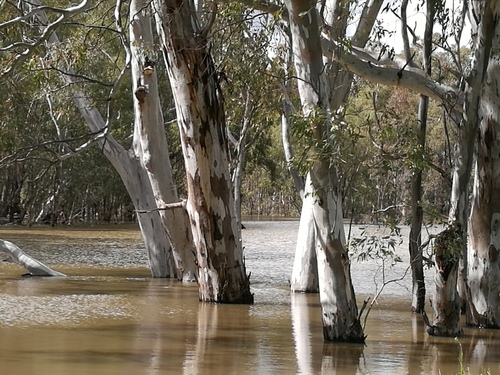
Habitat: Typically found lining the banks of watercourses, rivers, and seasonal floodplains across mainland Australia.
Growing up to 45 meters tall, the River Red Gum features a thick, gnarled trunk and a massive, spreading crown. Its distinctive bark is smooth and mottled, patterned with patches of white, grey, green, and pinkish-red, which peels away in long ribbons. The adult leaves are narrow, lance-shaped, and hang vertically, displaying a dull, grey-green color on both sides. In spring and summer, it produces clusters of small, creamy-white flowers, which mature into woody, cup-shaped seed capsules about 5 to 8 millimeters wide.
Category
PlantsRarity
Common
Danger
1/5 · Very low
Snaps
Be the first to snap!
Because it regularly drops huge limbs without warning, camper safety signs in Australia often warn against pitching tents directly beneath them.
The timber has a rich, deep red color and is incredibly dense, making it highly resistant to termites and water rot.
They are known as 'cradle trees' or 'canoe trees' because Indigenous Australians carved bark sheets from them to make watercraft and shields, leaving permanent scars.
It develops extensive root systems that can penetrate up to 30 meters deep to access groundwater during severe droughts.
The tree is known to drop large, heavy branches during dry spells to conserve water and survive extreme heat.
Its seeds rely on retreating floodwaters to deposit them on fertile, moist mud, initiating rapid germination.
As a photoautotrophic plant, the River Red Gum produces its own food through photosynthesis, utilizing sunlight, carbon dioxide, and water.

Phascolarctos cinereus
The leaves of the River Red Gum are a secondary food source and its branches provide roosting sites.
Calyptorhynchus banksii
Uses hollows in mature trees for nesting and feeds on the seeds.
Dicaeum hirundinaceum
Feeds on mistletoe parasitic on the gum branches, spreading seeds.
No trait badges are assigned for this object yet.
No aliases listed yet.
Collections for this object will appear here as more themes are added.
Danger
1/5 · Very low
No special safety notes yet.
Start with the whole plant, then compare leaf arrangement, leaf edges, stems and any flowers or fruit. Opposite leaves grow in pairs; alternate leaves come one at a time along the stem. These details tell you far more together than a single green leaf does. Plant Identifier: upload a photo and compare the visible details.
2000-4500 cm
5000-60000 kg
200-1000 years
As a photoautotrophic plant, the River Red Gum produces its own food through photosynthesis, utilizing sunlight, carbon dioxide, and water.
Typically found lining the banks of watercourses, rivers, and seasonal floodplains across mainland Australia.
10-21 days
Zoom in to split clusters and explore where this object has been snapped.
Recent snaps will appear here as new observations are added.
Take the discovery with you
Snap it with Snappit to identify it, learn what makes it special, and add the discovery to your collection.