

Robillard'S Dendronotid
dendronotus robilliardi
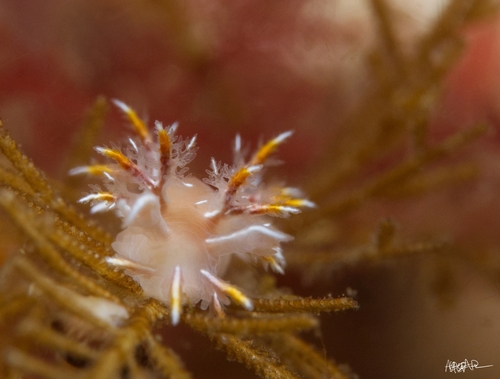
Robillard's Dendronotid is a stunning marine gastropod that inhabits cold-temperate marine waters. Like other members of the Dendronotidae family, this nudibranch is characterized by its magnificent, branching dorsal appendages, which resemble miniature underwater forests. These appendages, called cerata, not only assist in respiration but also mimic the hydroids upon which the animal feeds, offering superb crypsis. Observant divers and tidepoolers are often spellbound by the delicate, translucent bodies of these sea slugs as they slowly navigate rocky substrates. Their presence is a great indicator of a healthy, diverse benthic ecosystem rich in colonial cnidarians.
Habitat: Typically found in cold-temperate intertidal and subtidal rocky reefs, often clinging to bryozoan mats and colonial hydroids.
This species is a small nudibranch, typically reaching lengths between 1 to 5 centimeters. Its body is translucent white, sometimes flushed with pale orange, pink, or yellow undertones. It is adorned with branching cerata along its back, which have tipped variations of opaque white or golden yellow. Bright orange or reddish-brown speckles are often dotted across its body, and its highly branched rhinophores (sensory tentacles) protrude elegantly from the head, creating a complex, frilly silhouette that blends seamlessly into marine turf.
Category
InvertebrateRarity
Common
Danger
1/5 · Very low
Snaps
Be the first to snap!
Its highly branched rhinophores function as chemical receptors, allowing the nudibranch to 'smell' food and mates in the water column.
Like many nudibranchs, it is a simultaneous hermaphrodite, possessing both male and female reproductive organs to maximize mating opportunities.
The elegant branching structures on its back act as gills, maximizing surface area for oxygen absorption directly from the seawater.
Its highly branched body appendages perfectly mimic the hydroid colonies it lives on, making it virtually invisible to visual predators.
It sequesters toxic or distasteful compounds from its cnidarian prey, rendering its own body unpalatable to potential predators.
If attacked, it can autotomize (shed) its branching cerata to distract a predator and later fully regenerate them without permanent damage.
Feeds almost exclusively on colonial hydroids, using its specialized radula to scrape and consume the individual polyps.
Sertularella turgida
Preys directly on colonial hydroid colonies, stripping polyps from the branching stalks.

Pycnopodia helianthoides
Is occasionally preyed upon by specialized sea stars in rocky subtidal zones.
No trait badges are assigned for this object yet.
No aliases listed yet.
Collections for this object will appear here as more themes are added.
Danger
1/5 · Very low
No special safety notes yet.
Look for fins, arms, tentacles, shells and body symmetry. Underwater light shifts colors, so structure and markings usually matter more than shade. Sea Creature Identifier: upload a photo and compare the visible details.
1-5 cm
0.001-0.005 kg
1 years
Feeds almost exclusively on colonial hydroids, using its specialized radula to scrape and consume the individual polyps.
Typically found in cold-temperate intertidal and subtidal rocky reefs, often clinging to bryozoan mats and colonial hydroids.
Grazing
500-5000
Zoom in to split clusters and explore where this object has been snapped.
Recent snaps will appear here as new observations are added.
Take the discovery with you
Snap it with Snappit to identify it, learn what makes it special, and add the discovery to your collection.