

Round-Leaf Wattle
acacia acinacea
The Round-Leaf Wattle, scientifically known as Acacia acinacea, is a charming and resilient native Australian shrub. It's highly regarded for its distinctive foliage and the spectacular display of golden-yellow flowers that brighten the landscape from late winter into spring. This species is a true testament to the adaptability of Australian flora, thriving in often challenging, dry conditions. Beyond its ornamental appeal, the Round-Leaf Wattle plays a vital ecological role, providing habitat and food for native wildlife, and contributing to soil health through its nitrogen-fixing capabilities. Its cheerful presence makes it a popular choice for native gardens and revegetation efforts across its range.
Habitat: Found in a variety of habitats including dry sclerophyll forests, woodlands, mallee, and heathlands, often on rocky slopes or sandy soils.
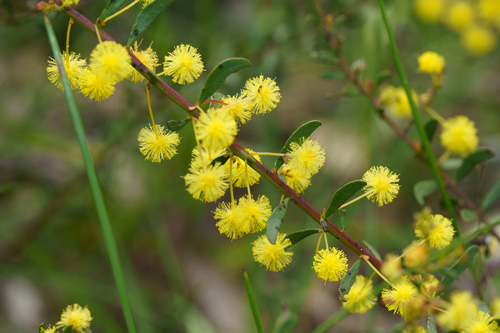
This species typically grows as a dense, spreading shrub, reaching heights and widths of 1 to 3 meters. Its most defining feature is its small, round to obovate phyllodes (flattened leaf stalks) which are 0.5 to 2 cm long, often featuring a slightly pointed tip and a grey-green to mid-green coloration. The flowers are bright golden yellow, appearing in profuse, spherical clusters along the branches, creating a striking visual impact. Following flowering, it produces linear, coiled, or curved seed pods that contain dark, hard seeds.
Category
PlantsRarity
Common
Danger
1/5 · Very low
Snaps
Be the first to snap!
Acacia acinacea is a popular choice for rockeries, low-maintenance gardens, and as a small informal hedge due to its drought tolerance, attractive appearance, and adaptability to various soil types.
Its vibrant yellow flowers are an important early-season food source, providing nectar and pollen for a diverse array of native insects and birds, contributing significantly to local biodiversity.
The 'leaves' of the Round-Leaf Wattle are actually flattened leaf stalks called phyllodes, an adaptation that helps the plant conserve water in dry Australian environments.
The genus Acacia is the largest plant genus in Australia, comprising over 1,000 species, most of which are commonly known as 'wattles' and are iconic symbols of the Australian bush.
Acacia acinacea is exceptionally well-adapted to arid and semi-arid conditions, allowing it to thrive with minimal water once established and making it resilient to prolonged dry spells.
Like other legumes, this wattle forms a symbiotic relationship with specific rhizobium bacteria in its root nodules, converting atmospheric nitrogen into a usable form, thereby enriching the soil.
The seeds of Acacia acinacea possess a hard coat that often requires heat or smoke treatment to break dormancy and germinate, a critical adaptation for regeneration after bushfires in its native environment.
As a photosynthetic plant, Acacia acinacea generates its own energy by converting sunlight into sugars through photosynthesis. It absorbs essential water and mineral nutrients from the soil via its root system and takes in carbon dioxide from the atmosphere.
Apis mellifera
Pollination of flowers
various species
Pollination of flowers
Macropus spp.
Browsing on foliage and young shoots
various species
Seed dispersal via elaiosomes
No trait badges are assigned for this object yet.
No aliases listed yet.
Collections for this object will appear here as more themes are added.
Danger
1/5 · Very low
No special safety notes yet.
Start with the whole plant, then compare leaf arrangement, leaf edges, stems and any flowers or fruit. Opposite leaves grow in pairs; alternate leaves come one at a time along the stem. These details tell you far more together than a single green leaf does. Plant Identifier: upload a photo and compare the visible details.
100-300 cm
2-20 kg
10-25 years
As a photosynthetic plant, Acacia acinacea generates its own energy by converting sunlight into sugars through photosynthesis. It absorbs essential water and mineral nutrients from the soil via its root system and takes in carbon dioxide from the atmosphere.
Found in a variety of habitats including dry sclerophyll forests, woodlands, mallee, and heathlands, often on rocky slopes or sandy soils.
Foraging
Zoom in to split clusters and explore where this object has been snapped.
Recent snaps will appear here as new observations are added.
Take the discovery with you
Snap it with Snappit to identify it, learn what makes it special, and add the discovery to your collection.