

San Diego Dorid
diaulula sandiegensis
The San Diego Dorid is a fascinating marine gastropod mollusk, belonging to the group of shell-less marine snails known as nudibranchs. Widely distributed along the rocky Pacific coast of North America, this sea slug captivates beachgoers and tidepoolers with its elegant appearance and slow, deliberate movements. Unlike many colorful nudibranchs, it displays a sophisticated, understated palette of creams and browns, making it a master of camouflage among the sponges it inhabits. This species plays an important role in its local ecosystem, acting as a specialized predator of marine sponges. By consuming these organisms, the dorid not only controls sponge populations but also bioaccumulates toxic compounds from its prey, repurposing them for its own chemical defense system. Observing a San Diego Dorid in a tide pool provides a wonderful glimpse into the complex evolutionary adaptations of soft-bodied marine invertebrates.
Habitat: Found in rocky intertidal and subtidal zones, particularly on reefs, in tide pools, and under ledges where marine sponges are abundant.
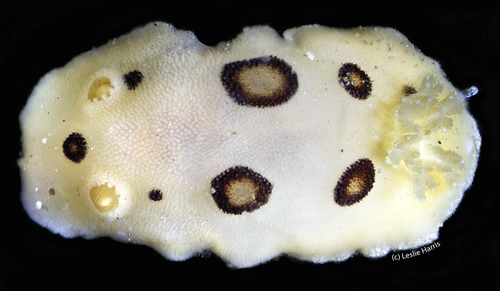
The San Diego Dorid features an oval, slightly flattened body, typically ranging from cream to pale yellow or light tan. Its mantle is covered in numerous tiny, sensory papillae that give it a velvety, carpet-like texture. The most distinguishing identifier is the pattern of dark brown to black rings or spots scattered across its back, resembling leopard spots. Near the anterior end, it has two sensory rhinophores resembling small horns, while the posterior end boasts a conspicuous, flower-like rosette of retractile gills. It can grow up to 10 centimeters in length.
Category
InvertebrateRarity
Common
Danger
1/5 · Very low
Snaps
4
The dark ring patterns on each San Diego Dorid are entirely unique, acting much like a human fingerprint.
Their eggs are laid in beautiful, spiral ribbons that resemble white lace or ruffled carnation petals attached to rocks.
When threatened, they can emit a mildly acidic secretion that makes them taste terrible to potential predators.
It absorbs toxic secondary metabolites from the sponges it consumes, using these noxious chemicals to deter predatory fish and crabs.
Its skin is packed with microscopic, glass-like calcareous spicules called caryophyllidia, providing a rough physical barrier against predators.
It can instantly withdraw its fragile posterior gill plume into a protective pocket inside its body when it senses vibrations or physical contact.
This nudibranch is a highly specialized carnivore that feeds almost exclusively on various species of marine sponges by scraping them with its radula.
Haliclona permollis
Feeds extensively on this encrusting sponge, scraping its tissue with a specialized radula.
Dermasterias imbricata
Serves as a prey item for this predatory sea star, which is one of the few organisms capable of tolerating the dorid's toxic defenses.
No trait badges are assigned for this object yet.
No aliases listed yet.
Collections for this object will appear here as more themes are added.
Danger
1/5 · Very low
No special safety notes yet.
The easiest way to identify San Diego Dorid is to use the Snappit nature identifier app.
2-10 cm
0.005-0.05 kg
1-2 years
This nudibranch is a highly specialized carnivore that feeds almost exclusively on various species of marine sponges by scraping them with its radula.
Found in rocky intertidal and subtidal zones, particularly on reefs, in tide pools, and under ledges where marine sponges are abundant.
Grazing
1000-15000
Zoom in to split clusters and explore where this object has been snapped.

California, US
You might spot Sunburst Anemone, Ochre Sea Star, and Striped Shore Crab.
View guide →

California, US
You might spot Great Blue Heron, Western Gull, and Coyote.
View guide →

US
You might spot Ochre Sea Star and Giant Green Anemone.
View guide →
Take the discovery with you
Snap it with Snappit to identify it, learn what makes it special, and add the discovery to your collection.