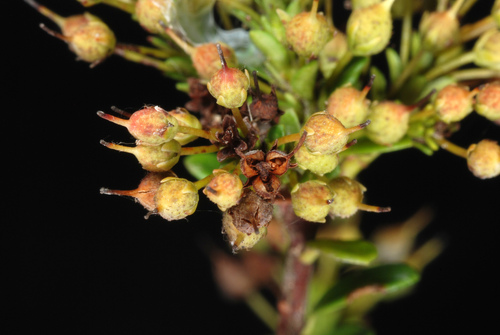


Sand Myrtle
kalmia buxifolia
Sand Myrtle (Kalmia buxifolia) is a charming, resilient evergreen shrub that adds a touch of delicate beauty to some of the harshest environments in the eastern United States. Thriving in both the acidic, sandy soils of coastal pine barrens and the windswept, rocky summits of the southern Appalachian Mountains, this low-growing member of the heath family is celebrated for its dense, cushion-like growth form and spectacular late-spring blooms. Historically classified under its own genus, Leiophyllum, modern genetic studies have placed it within the Kalmia genus alongside the mountain laurels. What makes Sand Myrtle particularly fascinating is its extreme adaptability. It successfully bridges two radically different ecological zones—coastal plains and high-elevation mountaintops—by utilizing specialized survival strategies. During its peak blooming season, the shrub transforms into a stunning mound of starry white-and-pink blossoms, attracting a diverse array of native pollinators and making it a beloved find for hikers and botanists alike.
Habitat: Thrives in acidic, sandy soils of coastal pine barrens as well as high-elevation rocky outcrops and heath balds in the Appalachian Mountains.
This low, multi-branched evergreen shrub typically ranges from 10 to 100 centimeters in height, often forming dense, rounded mounds. Its small, glossy, dark green leaves are oval-shaped and highly resemble boxwood leaves, measuring only about 1 to 2 centimeters in length. In late spring, the plant produces numerous terminal clusters of small, five-petaled white to light pink flowers. A key identifying feature is the collection of prominent, spring-loaded stamens with bright red or purple-pink anthers that project outward, giving the blossoms a fuzzy, star-like appearance against the dark foliage.
Category
PlantsRarity
Common
Danger
1/5 · Very low
Snaps
Be the first to snap!
Sand Myrtle can survive in cracks of solid granite on windswept mountain summits where almost no other woody plants can take root.
The plant's flowers have unique red or pink-tipped centers (anthers) that create a beautiful bi-colored contrast against the white petals.
The species name 'buxifolia' translates to 'boxwood-leaved,' highlighting the close resemblance of its leaves to the unrelated boxwood shrub.
Partners with specialized ericoid mycorrhizal fungi to extract vital nutrients from highly acidic, nutrient-poor soils.
Features highly sensitive stamens that snap upward when touched by insects, effectively dusting the pollinator with pollen.
Possesses a woody root crown that allows the plant to quickly sprout new growth after wildfire or severe physical damage.
As a photoautotroph, Sand Myrtle synthesizes its own sugars through photosynthesis, drawing water and basic nutrients from acidic soils with the help of symbiotic fungi.
Bombus impatiens
Feeds on nectar and serves as a major pollinator during the spring bloom.
Rhizoscyphus ericae
Forms an essential symbiotic relationship, aiding the plant's nutrient uptake in harsh soils.
Stephanitis takeyai
Sucks sap from the underside of leaves, causing foliage discoloration and damage.
No trait badges are assigned for this object yet.
No aliases listed yet.
Collections for this object will appear here as more themes are added.
Danger
1/5 · Very low
No special safety notes yet.
Start with the whole plant, then compare leaf arrangement, leaf edges, stems and any flowers or fruit. Opposite leaves grow in pairs; alternate leaves come one at a time along the stem. These details tell you far more together than a single green leaf does. Plant Identifier: upload a photo and compare the visible details.
10-100 cm
10-30 years
As a photoautotroph, Sand Myrtle synthesizes its own sugars through photosynthesis, drawing water and basic nutrients from acidic soils with the help of symbiotic fungi.
Thrives in acidic, sandy soils of coastal pine barrens as well as high-elevation rocky outcrops and heath balds in the Appalachian Mountains.
Photosynthesis
14-30 days
Zoom in to split clusters and explore where this object has been snapped.
Recent snaps will appear here as new observations are added.

South Carolina, US
You might spot Yellow Pitcher Plant and Juvenal's Duskywing.
View guide →

New Jersey, US
You might spot Spoonleaf Sundew, Purple Pitcher Plant, and Sheep Laurel.
View guide →
Take the discovery with you
Snap it with Snappit to identify it, learn what makes it special, and add the discovery to your collection.