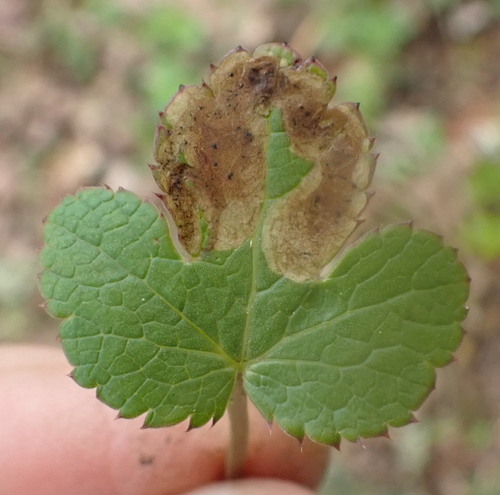





Sanicle Leafminer
Phytomyza saniculae
The Sanicle Leafminer is a tiny insect that lives in leaves. It makes little tunnels inside the leaves, which can look like tiny paths. These paths are where the insect eats and grows!
Habitat: Forests
The Sanicle Leafminer is a tiny, dark-bodied fly, often appearing black or dark brown with translucent wings. Its small size, typically a few millimeters long, makes it easily mistaken for other minute flies. Its most striking visual feature is often the serpentine mine it creates within leaves, rather than the fly itself.
Category
InsectsRarity
Common
Danger
1/5 · Very low
Snaps
Be the first to snap!
Baby leafminers eat and live *inside* a leaf, like being in a living sandwich!
Despite their name, they are actually a type of very tiny fly, not a worm.
Each winding path on a leaf is a map of where the tiny larva has traveled.
Their 'leaf art' looks like tiny, wiggly drawings inside the plant's leaves!
Sanicle Leafminer larvae can tunnel through plant leaves, creating protective winding paths that shield them from predators while they eat.
Adult Sanicle Leafminers have keen senses that help them precisely locate specific Sanicle plants for egg-laying.
Sanicle Leafminer larvae have strong mandibles that allow them to consume soft inner leaf tissues, staying hidden from view.
Tiny larvae munch on the soft insides of sanicle leaves for energy!
Age differences: Adults may consume nectar; larvae feed exclusively on leaf tissue.
Sanicula europaea
larvae feed within its leaves
Diglyphus isaea
lays eggs on or in larvae

Parus major
adults and pupae are prey
Solitary animals live alone for most of their lives, only interacting with others for mating or parental care.
This trait characterizes organisms whose diet consists entirely or primarily of plant material.
Describes organisms that break down dead organic material, recycling nutrients back into the ecosystem.
Forest habitats are terrestrial environments dominated by dense tree cover, supporting a high diversity of plant and animal life.
Pertaining to species that are significantly smaller than typical or average for their kind.
Describes organisms that transfer pollen, enabling the fertilization and reproduction of plants.
No aliases listed yet.
Danger
1/5 · Very low
Always look but don't touch insects, as some may be delicate.
Look for six legs, antennae, three body sections and the shape of the wings. Beetles have hardened front wings; flies have just one working pair. Tiny insects may need a close view before their group is clear. Insect Identifier: upload a photo and compare the visible details.
4-6 mm
2-3 mm
7-14 days
Tiny larvae munch on the soft insides of sanicle leaves for energy!
Forests
Foraging
6
Zoom in to split clusters and explore where this object has been snapped.
Recent snaps will appear here as new observations are added.
Take the discovery with you
Snap it with Snappit to identify it, learn what makes it special, and add the discovery to your collection.