

Seal Salamander
desmognathus monticola
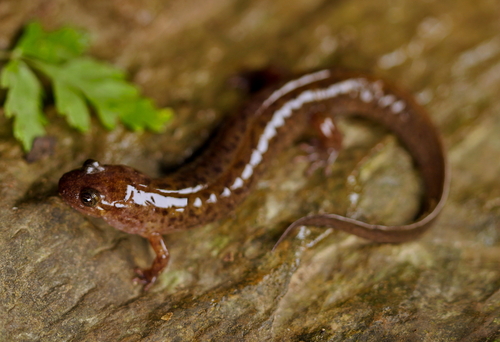
The Seal Salamander (Desmognathus monticola) is a robust and fascinating amphibian native to the Appalachian Mountains. Known for its streamlined body adapted to life in swift-moving streams, this species plays a vital role as both predator and prey in its cool, aquatic habitats. Its mottled coloration provides excellent camouflage against stream substrates, allowing it to ambuscade unsuspecting invertebrates. These salamanders are often encountered by turning over rocks and logs in their preferred habitats, offering a glimpse into the diverse ecology of mountain streams.
Habitat: Found in cool, clear, rocky mountain streams, their adjacent seepage areas, and moist, well-wooded riparian zones.
The Seal Salamander is a medium-sized, stocky salamander, typically ranging from 7 to 13 cm in total length. Its dorsal coloration is usually dark brown to black, often adorned with mottled gray or reddish-brown markings that can form an indistinct, net-like pattern. The ventral surface is generally lighter, a uniform grayish tone. A key identification feature is its laterally compressed tail, which is distinctly keeled towards the tip, aiding in propulsion through water. It possesses a somewhat flattened head and a robust build.
Category
AmphibiansRarity
Common
Danger
1/5 · Very low
Snaps
2
Female Seal Salamanders exhibit parental care by coiling around their clutch of eggs until they hatch, protecting them from predators and desiccation.
The 'Seal' in their name may derive from their sleek, robust appearance in water, or perhaps their somewhat dog-like snout.
They possess prominent nasolabial grooves, tiny channels running from their nostrils to their upper lip, which are crucial for enhancing their sense of smell underwater and on land.
Unlike many amphibians, they undergo direct development, meaning the eggs hatch into miniature versions of the adult, skipping a free-living larval stage in the traditional sense, though some aquatic larval traits persist briefly.
Like all plethodontid salamanders, the Seal Salamander is lungless, absorbing all necessary oxygen through its moist skin and the lining of its mouth and throat. This adaptation is highly effective in the well-oxygenated waters it inhabits.
Its robust, muscular body and laterally compressed, keeled tail are perfectly adapted for navigating strong currents in mountain streams. This body shape allows it to move efficiently both in and out of fast-flowing water.
The mottled dark brown and gray patterns on its dorsal side provide excellent camouflage against the wet rocks, gravel, and leaf litter found on stream beds, helping it avoid detection by predators and ambush prey effectively.
Seal Salamanders are opportunistic predators, feeding primarily on a variety of small invertebrates found within and along the edges of their aquatic habitats.
Age differences: Larval salamanders consume smaller aquatic invertebrates. As they mature, adults incorporate a wider range of both aquatic and terrestrial prey into their diet.
Thamnophis sirtalis
Snakes prey on salamanders found near water.

Procyon lotor
Raccoons forage for salamanders in and around streams.
Tipulidae spp.
Salamanders consume various insect larvae as part of their diet.
Oniscidea spp.
Salamanders feed on small invertebrates like isopods found in moist litter.
No trait badges are assigned for this object yet.
No aliases listed yet.
Collections for this object will appear here as more themes are added.
Danger
1/5 · Very low
No special safety notes yet.
Compare body shape, toes, markings, tail and skin texture. Tadpoles and larvae can look nothing like the adults they turn into. Amphibian Identifier: upload a photo and compare the visible details.
7-13 cm
0.003-0.01 kg
5-10 years
Seal Salamanders are opportunistic predators, feeding primarily on a variety of small invertebrates found within and along the edges of their aquatic habitats.
Found in cool, clear, rocky mountain streams, their adjacent seepage areas, and moist, well-wooded riparian zones.
Ambush/foraging
10-30
Zoom in to split clusters and explore where this object has been snapped.

Virginia, US
You might spot Duck, Eastern Gray Squirrel, and Painted Turtle.
View guide →

West Virginia, US
You might spot Great Rhododendron and Mountain Laurel.
View guide →
Take the discovery with you
Snap it with Snappit to identify it, learn what makes it special, and add the discovery to your collection.