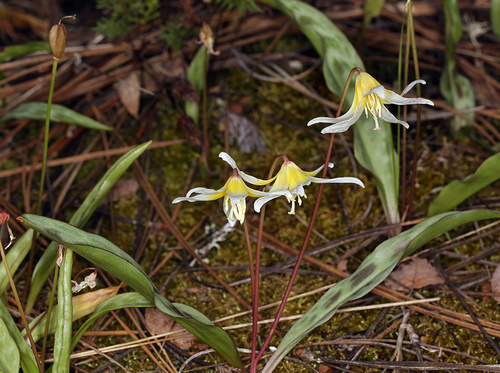


Sierra Fawn Lily
erythronium multiscapideum
The Sierra Fawn Lily (Erythronium multiscapoideum) is an enchanting perennial wildflower endemic to California, primarily occurring in the low to mid-elevation foothills of the Sierra Nevada. Emerging in early spring, this elegant plant produces nodding, creamy-white flowers with bright yellow centers that gracefully hang from slender stems, brightening up the damp forest floor. It grows from a deep-seated bulb, producing beautifully mottled green and brown leaves that resemble the dappled coat of a fawn, which gives the genus its common name. Thriving in moist, shaded environments, it is a highly anticipated herald of spring for hikers, contributing vital early-season resources to local pollinators. It often forms dense colonies, transforming the woodland understory into a spectacular carpet of delicate blooms. This species is highly adapted to the Mediterranean climate of California, making it a resilient and captivating member of its native plant community.
Habitat: Found in shaded, moist woodlands, chaparral, and coniferous forests, often growing on serpentine soils or rocky slopes in the Sierra Nevada foothills.
Growing up to 35 centimeters tall, this lily features one to several nodding flowers with six recurved, creamy-white tepals that flare dramatically outward and backward to reveal a bright yellow center. Its most striking vegetative feature is the pair of basal leaves, which are oblong, up to 20 centimeters long, and heavily mottled with dark green, brown, or maroon splotches. The slender stems are often reddish, holding the delicate blooms well above the damp forest floor.
Category
PlantsRarity
Common
Danger
1/5 · Very low
Snaps
1
It can take several years of growth from seed before a Sierra Fawn Lily plant is mature enough to produce its first flower.
Its petals curve so far backwards when fully open that they nearly touch behind the flower stem.
The common name 'fawn lily' refers to the mottled pattern on the leaves, which closely resembles the spotted coat of a young deer.
Survives the hot, dry California summers by storing nutrients and moisture deep underground in a specialized bulb, remaining dormant until spring.
The marbled green-and-brown pattern on its leaves mimics the dappled sunlight on the forest floor, helping to conceal it from herbivores.
Produces seeds equipped with lipid-rich elaiosomes that entice ants to carry them underground, protecting and planting the seeds.
As a photosynthetic plant, it manufactures its own sugars using sunlight, carbon dioxide, and water absorbed through its root system.
Pogonomyrmex subnitidus
Ants collect the seeds to feed on the lipid-rich appendages, inadvertently planting them in their subterranean galleries.
Bombus vosnesenskii
Bees visit the nodding blooms to forage for early spring nectar and pollen, transferring pollen between flowers.
Odocoileus hemionus
Deer graze on the fresh spring foliage and flowering buds when other green forage is scarce.
No trait badges are assigned for this object yet.
No aliases listed yet.
Collections for this object will appear here as more themes are added.
Danger
1/5 · Very low
No special safety notes yet.
Start with the whole plant, then compare leaf arrangement, leaf edges, stems and any flowers or fruit. Opposite leaves grow in pairs; alternate leaves come one at a time along the stem. These details tell you far more together than a single green leaf does. Plant Identifier: upload a photo and compare the visible details.
10-35 cm
5-15 years
As a photosynthetic plant, it manufactures its own sugars using sunlight, carbon dioxide, and water absorbed through its root system.
Found in shaded, moist woodlands, chaparral, and coniferous forests, often growing on serpentine soils or rocky slopes in the Sierra Nevada foothills.
Foraging
Zoom in to split clusters and explore where this object has been snapped.
Take the discovery with you
Snap it with Snappit to identify it, learn what makes it special, and add the discovery to your collection.