





silver fir
Abies alba
The silver fir is a tall tree with soft, green needles and a lovely shape. It can grow very high and is often found in beautiful forests, providing homes for many animals.
Habitat: Forests
The silver fir has distinctive flat, dark green needles with two silvery white bands on their undersides, giving it a frosty appearance. Its cylindrical cones stand upright like candles on branches, unique among many conifers, and its bark is smooth and grey.
Category
PlantsRarity
Common
Danger
1/5 · Very low
Snaps
Be the first to snap!
A special resin from its bark was historically used by scientists for delicate optical lenses.
Its cones stand tall like candles on the branches, unlike most conifers whose cones hang down!
Some very old silver firs can develop a unique, flat 'stork's nest' shape at their very tops.
The silver fir is Europe's tallest native fir, reaching amazing heights like a skyscraper!
Silver fir has sticky resin that oozes out to trap insects and seal wounds, acting like a natural bandage to protect it.
Its cones stand upright and break apart on the tree, letting wind easily scatter its winged seeds widely for reproduction.
Young silver firs can grow well in shade beneath older trees, patiently waiting for their chance to reach the sun and thrive.
Silver firs have very deep roots that help anchor them firmly in mountainous terrain and find water far below the surface.
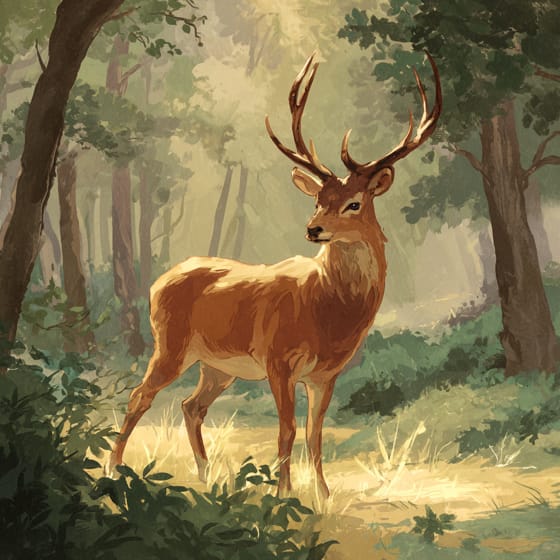
Cervus elaphus
Browses on young trees and bark
Pityokteines curvidens
Bores into bark, weakening the tree
Glaucidium passerinum
Nests in old firs' cavities
Boletus edulis
Shares nutrients with its roots
Aromatic plants produce and emit fragrant volatile organic compounds, often for defense or to attract pollinators.
Shade tolerant plants are adapted to grow and thrive in areas with low light levels, requiring less direct sunlight.
Coniferous plants are typically evergreen, bearing needles or scales and reproductive cones.
Evergreen plants retain their foliage throughout the year, never shedding all their leaves at once.

Fragrant flowers emit a pleasant aroma, often to attract pollinators or for defense.

Timber refers to wood that has been prepared for use in building and carpentry.

This trait signifies organisms belonging to a very old evolutionary group with ancestors dating back millions of years.

Forest habitats are terrestrial environments dominated by dense tree cover, supporting a high diversity of plant and animal life.

This trait characterizes organisms with an exceptionally long lifespan compared to others of their kind.

Describes a species whose presence and role have a disproportionately large effect on its environment.
No aliases listed yet.
Danger
1/5 · Very low
Stay on paths when exploring forests and don't climb trees without an adult.
The easiest way to identify silver fir is to use the Snappit nature identifier app.
3000-6000 cm
500-1000 cm
Spring
Yes
None
Perennial
Wind
Zoom in to split clusters and explore where this object has been snapped.
Recent snaps will appear here as new observations are added.
Take the discovery with you
Snap it with Snappit to identify it, learn what makes it special, and add the discovery to your collection.








.jpg&width=800)


_001.jpg&width=800)

