
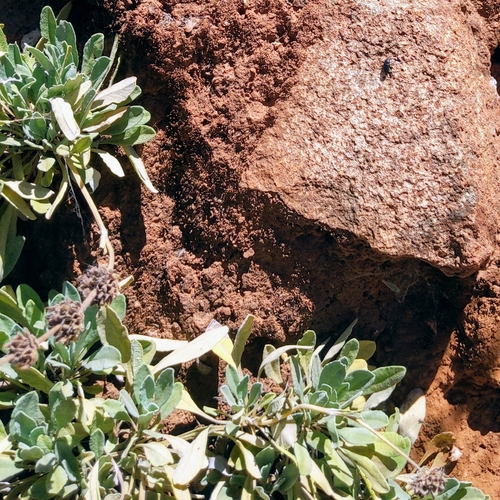


Sonoma Sage
salvia sonomensis
Sonoma Sage (Salvia sonomensis) is a delightful, low-growing evergreen perennial that carpet-spreads across the dry slopes of California. Renowned for its aromatic foliage, this resilient plant emits a highly fragrant scent reminiscent of a blend of pine and traditional sage when brushed against or crushed. It forms dense, low-growing mats that hug the ground, making it an exceptional natural erosion control agent in its native ecosystems. During late spring, the plant transforms into a vibrant display as upright stalks adorned with whorls of bluish-purple, two-lipped flowers emerge, drawing in a wide variety of native pollinators. This hardy sage is beloved by native plant enthusiasts and gardeners for its extreme drought tolerance and ability to thrive in challenging, rocky soils where other plants struggle. It serves as a vital ecological contributor, offering nectar to bees, butterflies, and hummingbirds while stabilizing hillsides in fire-prone chaparral habitats.
Habitat: Typically found on dry, rocky slopes, ridges, and openings within chaparral, oak woodlands, and yellow pine forests.
This creeping perennial grows as a flat mat only 10 to 30 centimeters tall, but can spread horizontally up to a meter wide. Its elongated, lance-shaped leaves are grayish-green, highly textured with a wrinkled surface, and have finely toothed margins. In late spring and early summer, it sends up vertical, flowering spikes containing tight whorls of small, two-lipped flowers ranging in color from pale lavender to deep blue-violet, punctuated by protruding stamens.
Category
PlantsRarity
Common
Danger
1/5 · Very low
Snaps
Be the first to snap!
It is a highly effective ground cover, with a single plant spreading up to one meter wide via creeping stems that root where they touch soil.
Native American tribes, such as the Miwok, historically used infusions of the leaves to treat colds and other ailments.
The leaves emit a strong, pleasant medicinal scent when crushed, which is a mix of sage and pine.
As the plant's stems sprawl across the ground, they form roots at the nodes where they contact soil, allowing it to rapidly spread and stabilize loose slopes.
The leaves are covered in fine, pale hairs and contain aromatic oils that minimize water loss through transpiration, enabling survival in intense summer heat.
Produces strong, terpene-rich essential oils that give off a pungent scent, deterring most mammalian herbivores from browsing its foliage.
Sonoma Sage is a photosynthetic plant that manufactures its own food using sunlight, water, and carbon dioxide.
Bombus vosnesenskii
Provides nectar and receives pollination services from the yellow-faced bumblebee.
Callophrys dumetorum
Serves as a vital nectar source for this small native butterfly during late spring.
No trait badges are assigned for this object yet.
No aliases listed yet.
Collections for this object will appear here as more themes are added.
Danger
1/5 · Very low
No special safety notes yet.
Start with the whole plant, then compare leaf arrangement, leaf edges, stems and any flowers or fruit. Opposite leaves grow in pairs; alternate leaves come one at a time along the stem. These details tell you far more together than a single green leaf does. Plant Identifier: upload a photo and compare the visible details.
10-30 cm
5-15 years
Sonoma Sage is a photosynthetic plant that manufactures its own food using sunlight, water, and carbon dioxide.
Typically found on dry, rocky slopes, ridges, and openings within chaparral, oak woodlands, and yellow pine forests.
Zoom in to split clusters and explore where this object has been snapped.
Recent snaps will appear here as new observations are added.

California, US
You might spot Yellow Star-Tulip and Mountain Misery.
View guide →

California, US
You might spot Sonoma Sage, White Globe Lily, and Mute Swan.
View guide →
Take the discovery with you
Snap it with Snappit to identify it, learn what makes it special, and add the discovery to your collection.

















