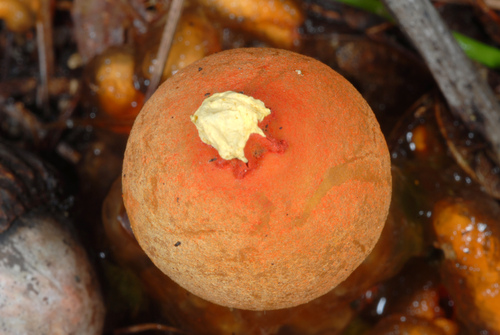


Stalked Puffball-In-Aspic
calostoma cinnabarinum
The Stalked Puffball-In-Aspic, scientifically known as Calostoma cinnabarinum, is a captivating and visually distinct fungus found in specific woodland ecosystems. Unlike typical puffballs, this species boasts a prominent, often reddish stalk and is encased in a unique gelatinous layer during its early development, giving it its memorable 'in-aspic' moniker. This vibrant fungus plays a crucial ecological role as a mycorrhizal partner, forming a symbiotic relationship with the roots of certain trees. It facilitates the exchange of essential nutrients from the soil to its host trees, receiving carbohydrates in return. Its striking appearance, combining a bright red spore sac with a jelly-like sheath and a textured stalk, makes it a fascinating find for any nature enthusiast.
Habitat: This species thrives on the forest floor in deciduous and mixed forests, commonly found among moss or leaf litter, typically forming symbiotic associations with oak or pine trees.
Calostoma cinnabarinum is instantly recognizable by its vivid cinnabar red to orange-red spore sac, which is typically spherical to slightly flattened, measuring about 1 to 2.5 cm in diameter. This colorful cap is supported by a distinctive, often ribbed or reticulated stalk that stands 3 to 6 cm tall and 0.5 to 1.5 cm thick, varying in color from pale yellow to reddish-orange. A key identifying feature, especially in younger specimens, is the thick, transparent, jelly-like layer that encases the developing fruiting body, giving it a glistening, gelatinous appearance.
Category
FungiRarity
Common
Danger
1/5 · Very low
Snaps
Be the first to snap!
Its remarkably vibrant cinnabar red color is due to unique pigments, making it one of the most visually striking fungi found in its native woodlands.
The 'aspic' in its common name refers to the clear, jelly-like outer layer encasing the young fruiting body, which resembles a savory gelatin.
The genus name 'Calostoma' is derived from Greek, meaning 'beautiful mouth,' a direct reference to its elegant and pronounced apical pore.
Unlike many puffballs that release spores from a torn surface, this species has a distinctive, precise apical pore at the top of its spore sac for spore ejection.
Upon reaching maturity, the internal spore mass dries to a fine powder. External disturbances, such as raindrops or passing animals, can cause a small puff of spores to be ejected through an apical pore, facilitating dispersal.
The fungus forms an ectomycorrhizal relationship with the roots of host trees, efficiently exchanging critical soil nutrients like phosphorus and nitrogen for the carbohydrates produced by the trees through photosynthesis.
The developing fruiting body is enveloped in a unique, thick, clear gelatinous layer. This sheath is believed to provide vital protection against desiccation and physical damage, ensuring optimal development in fluctuating environmental conditions.
The Stalked Puffball-In-Aspic primarily obtains its nutritional requirements through a symbiotic ectomycorrhizal association with the root systems of specific host trees. It supplements this by absorbing decaying organic matter from the surrounding forest soil, contributing to nutrient recycling.
Quercus species
Forms essential ectomycorrhizal associations with its roots, receiving carbohydrates.
Pinus species
Forms essential ectomycorrhizal associations with its roots, receiving carbohydrates.
Various gastropod species
May feed on the fruiting bodies, potentially aiding in spore dispersal through consumption.
Various bacterial species
Participates in the decomposition of organic matter within the same soil ecosystem.
No trait badges are assigned for this object yet.
No aliases listed yet.
Collections for this object will appear here as more themes are added.
Danger
1/5 · Very low
No special safety notes yet.
Compare the cap shape, the underside, the stem and base, and whether the fungus grows on wood or soil. Some fungi have gills, others pores or teeth. A cap seen only from above often hides the most useful features. Mushroom Identifier: upload a photo and compare the visible details.
3-8 cm
0.001-0.01 kg
The Stalked Puffball-In-Aspic primarily obtains its nutritional requirements through a symbiotic ectomycorrhizal association with the root systems of specific host trees. It supplements this by absorbing decaying organic matter from the surrounding forest soil, contributing to nutrient recycling.
This species thrives on the forest floor in deciduous and mixed forests, commonly found among moss or leaf litter, typically forming symbiotic associations with oak or pine trees.
Symbiotic Absorption And Saprotrophic Absorption
Zoom in to split clusters and explore where this object has been snapped.
Recent snaps will appear here as new observations are added.
Take the discovery with you
Snap it with Snappit to identify it, learn what makes it special, and add the discovery to your collection.