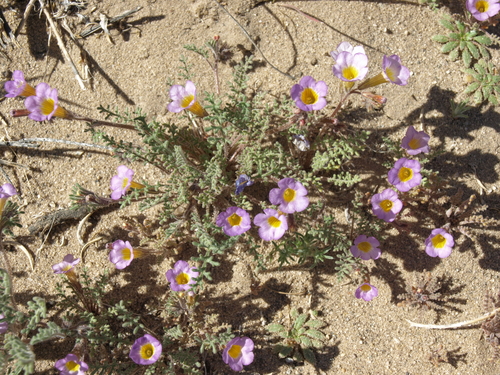


Two-Colored Phacelia
phacelia bicolor
The Two-Colored Phacelia (Phacelia bicolor) is an enchanting, low-growing annual wildflower native to the sandy slopes, desert washes, and open woodlands of the western United States, particularly California and Nevada. Belonging to the borage family (Boraginaceae), this resilient plant is celebrated for its striking, bell-shaped flowers that display a beautiful contrast of vibrant violet-purple petals and bright yellow or white throats. Appearing primarily in the spring, the Two-Colored Phacelia carpets otherwise barren landscapes in colorful blooms following seasonal rains. Its stems and leaves are covered in fine, glandular hairs that give the plant a slightly sticky texture. As an early-season bloomer, it provides vital nectar and pollen for native bees, butterflies, and other pollinators, playing an essential role in sustaining local desert ecosystems before the intense heat of summer sets in.
Habitat: Typically found on sandy slopes, desert washes, chaparral, and open pine woodlands throughout the western United States.
This small annual wildflower typically grows between 5 and 40 centimeters in height. Its tubular, bell-shaped flowers are its most identifying feature, boasting five rounded petals of a rich violet or lavender-blue hue with a bright, contrasting yellow or cream-colored center. The stems are reddish-green and, along with the deeply lobed or divided leaves, are densely covered in fine, sticky, glandular hairs. These sticky hairs can trap tiny dust particles, giving the plant a slightly dusty or rustic appearance in its dry, sandy habitat.
Category
PlantsRarity
Common
Danger
1/5 · Very low
Snaps
7
It is affectionately categorized as a 'belly flower' by botanists, because you often have to lie flat on your belly to appreciate its intricate, miniature beauty.
The bright yellow center of the flower absorbs ultraviolet light differently than the purple outer petals, creating a hidden bullseye pattern visible only to bees.
The glandular, sticky hairs on the stems and leaves can cause mild contact dermatitis (skin irritation) in some humans, similar to a very mild poison oak reaction.
Stems and leaves are covered in sticky, glandular hairs that deter crawling insect herbivores and reduce moisture loss.
Seeds can survive in dry desert soils for several years, germinating only when triggered by sufficient winter rainfall.
The high-contrast yellow and purple coloration of the flowers acts as a visual target, guiding native bees directly to the nectar.
As a photosynthetic plant, the Two-Colored Phacelia synthesizes its own organic compounds from sunlight, carbon dioxide, water, and soil minerals.
Bombus vosnesenskii
Serves as an essential early-season nectar and pollen source for these native pollinators.

Sylvilagus audubonii
The foliage and flowers are occasionally grazed by native desert herbivores.
No trait badges are assigned for this object yet.
No aliases listed yet.
Collections for this object will appear here as more themes are added.
Danger
1/5 · Very low
No special safety notes yet.
The easiest way to identify Two-Colored Phacelia is to use the Snappit nature identifier app.
5-40 cm
0.002-0.05 kg
1 years
As a photosynthetic plant, the Two-Colored Phacelia synthesizes its own organic compounds from sunlight, carbon dioxide, water, and soil minerals.
Typically found on sandy slopes, desert washes, chaparral, and open pine woodlands throughout the western United States.
Zoom in to split clusters and explore where this object has been snapped.
Take the discovery with you
Snap it with Snappit to identify it, learn what makes it special, and add the discovery to your collection.












.jpg&width=800)



_001.jpg&width=800)




