
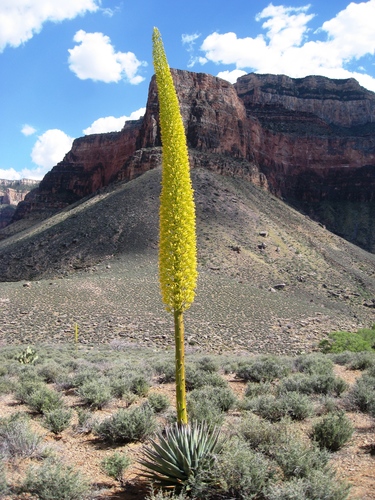


Utah Agave
agave utahensis
The Utah Agave (Agave utahensis) is a remarkable, cold-hardy succulent that thrives in some of the most arid and rugged terrains of the American Southwest. Growing in compact, highly protective rosettes, this slow-growing perennial is uniquely adapted to survive extreme temperature swings, from blistering summer heat to freezing winter snow. Its survival strategy culminates in a single, spectacular life event where it expends all of its stored energy to produce a towering, golden-yellow flower spike before dying. This dramatic reproductive cycle makes it a focal point of desert ecology, attracting various pollinators to its high-altitude rocky perches. For hikers and desert enthusiasts, encountering a blooming Utah Agave is a memorable highlight of the southwestern wilderness. Its ability to cling to sheer limestone cliffs demonstrates the incredible resilience of desert flora.
Habitat: Found clinging to limestone cliffs, gravelly slopes, and rocky outcroppings in arid desert mountains.
This species is distinguished by its compact, spherical rosettes of thick, fleshy, lance-shaped leaves that are pale blue-green to grayish-green in color. Each leaf is armed with sharp, prominent teeth along its margins and tipped with a long, spine-like terminal needle that can turn gray or white with age. The rosette typically measures 15 to 40 centimeters in diameter. During its rare blooming phase, the plant sends up a monumental, unbranched flower stalk reaching 2 to 4 meters in height, densely packed with bright yellow, tubular flowers on its upper half.
Category
PlantsRarity
Common
Danger
1/5 · Very low
Snaps
Be the first to snap!
Indigenous peoples traditionally roasted the nutrient-dense hearts of this agave in stone-lined pits for food.
The flower stalk of the Utah Agave can grow up to 10 times the height of the actual rosette.
The plant's fibrous leaves were historically harvested and processed to create strong ropes, sandals, and baskets.
Opens its stomata only at night to absorb carbon dioxide, dramatically reducing water loss through transpiration during the hot day.
Unlike most agave species, it can survive freezing temperatures down to -18 degrees Celsius by producing natural antifreeze sugars.
Conserves resources for decades before rapidly launching a massive flower stalk that can grow up to 15 centimeters per day.
As a photoautotrophic plant, the Utah Agave produces its own food using sunlight, water, and carbon dioxide through photosynthesis.
Xylocopa varipuncta
Feeds on the flower nectar and acts as a primary pollinator during the blooming season.
Ovis canadensis nelsoni
Feeds on the emerging, moisture-rich flower stalks during spring, sometimes destroying the bloom.
Caulotops barberi
Sucks sap from the succulent leaves, occasionally causing localized tissue damage.
No trait badges are assigned for this object yet.
No aliases listed yet.
Collections for this object will appear here as more themes are added.
Danger
1/5 · Very low
No special safety notes yet.
Compare leaf arrangement, rosette shape, ribs, spines and flowers. Keep in mind that drought and strong sun can shift a plant's color and shape. Succulent Identifier: upload a photo and compare the visible details.
15-40 cm
1-5 kg
15-30 years
As a photoautotrophic plant, the Utah Agave produces its own food using sunlight, water, and carbon dioxide through photosynthesis.
Found clinging to limestone cliffs, gravelly slopes, and rocky outcroppings in arid desert mountains.
Zoom in to split clusters and explore where this object has been snapped.
Recent snaps will appear here as new observations are added.

Arizona, US
You might spot Gambel Oak and Abert's Squirrel.
View guide →

Arizona, US
You might spot Gambel Oak and Greater Short-Horned Lizard.
View guide →

Arizona, US
You might spot Common Raven, Gambel Oak, and Vulture.
View guide →
Take the discovery with you
Snap it with Snappit to identify it, learn what makes it special, and add the discovery to your collection.

















