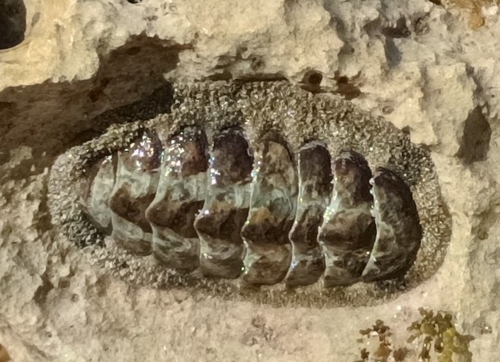


West Indian Fuzzy Chiton
acanthopleura granulata
The West Indian Fuzzy Chiton (Acanthopleura granulata) is a fascinating marine mollusk that perfectly exemplifies adaptation to the harsh, wave-battered intertidal zone. Clinging tightly to rocks in the Caribbean and tropical western Atlantic, this species belongs to the class Polyplacophora, characterized by their eight overlapping, armor-like shell plates. What makes these creatures truly remarkable is their 'fuzzy' appearance, which comes from a specialized girdle covered in tiny spine-like structures that help them retain moisture and deter predators during low tide. As the tide ebbs and flows, the fuzzy chiton lives a highly calculated life. By day, they withstand extreme heat and wave action, practically blending into the rocky coastline. By night, they slowly creep across the rocks to graze on algae, using their extraordinarily strong, iron-mineralized teeth. They are a vital component of the rocky shore ecosystem, keeping algal growth in check and serving as a tough-shelled challenge for coastal predators.
Habitat: Found on wave-swept, rocky intertidal shores, particularly on limestone and volcanic rocks within the splash zone.
The West Indian Fuzzy Chiton is easily identified by its oval-shaped body and eight dark, overlapping plates (valves) that are often heavily eroded, showing a mix of grey, dull brown, and white coloration. The most distinctive feature is the thick, fleshy girdle surrounding the plates, which is densely covered in short, dark-and-white banded bristles or fuzzy spicules, giving it a mossy or hairy texture. They typically range from 5 to 10 centimeters in length and lay completely flat against the rock surface, mimicking the natural texture of eroded limestone.
Category
InvertebrateRarity
Common
Danger
1/5 · Very low
Snaps
Be the first to snap!
Because of their incredible suction power, a fuzzy chiton can withstand the impact of powerful crashing waves that would easily wash away a human.
Chitons have been on Earth for over 500 million years, predating the dinosaurs and surviving multiple mass extinction events.
Their teeth are coated with magnetic iron, meaning a magnet can actually pick up a chiton's discarded feeding radula.
Their shell plates are embedded with thousands of microscopic eyes containing lenses made of aragonite, allowing them to detect changes in light and shadow.
Their radular teeth are capped with magnetite, a hard iron mineral, enabling them to scrape algae directly off hard rock surfaces without wearing down.
They exhibit a homing behavior, returning to the exact same 'home scar' or depression on their host rock after nocturnal foraging excursions.
They graze on microscopic algae, diatoms, and cyanobacteria from rocky surfaces during high tide or at night.
Age differences: Juveniles feed on smaller organic films, while adults can scrape larger, tougher encrusting algae.
Purpura patula
Predator that drills or uses chemical secretions to consume the chiton's flesh.

Haematopus palliatus
Coastal shorebird that pries the chiton off wave-swept rocks at low tide.
Lottia antillarum
Competes for grazing territory and algal food resources on intertidal limestone.
No trait badges are assigned for this object yet.
No aliases listed yet.
Collections for this object will appear here as more themes are added.
Danger
1/5 · Very low
No special safety notes yet.
Compare the overall shape, opening, spiral, ribs, hinge and surface sculpture. Beach shells often lose the colors and sharp edges they had on the living animal, so shape does most of the work. Seashell Identifier: upload a photo and compare the visible details.
5-10 cm
0.02-0.08 kg
2-8 years
They graze on microscopic algae, diatoms, and cyanobacteria from rocky surfaces during high tide or at night.
Found on wave-swept, rocky intertidal shores, particularly on limestone and volcanic rocks within the splash zone.
Grazing
Zoom in to split clusters and explore where this object has been snapped.
Recent snaps will appear here as new observations are added.
Take the discovery with you
Snap it with Snappit to identify it, learn what makes it special, and add the discovery to your collection.