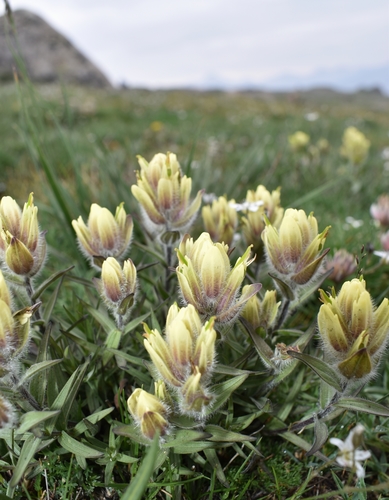


Western Paintbrush
castilleja occidentalis
The Western Paintbrush (Castilleja occidentalis) is a captivating alpine wildflower that adds splashes of pale yellow, cream, and sometimes purplish hues to the high-elevation meadows of Western North America. Thriving in the harsh, windswept environments of the subalpine and alpine tundra, this resilient perennial is a master of survival. What makes it particularly fascinating is its hemi-parasitic lifestyle. While it is fully capable of photosynthesis, it stealthily taps into the root systems of neighboring grasses, sedges, or sagebrush to secure water and essential nutrients, giving it an evolutionary edge in nutrient-poor mountain soils.
Habitat: Found in alpine tundra, gravelly slopes, and moist subalpine meadows high in the Rocky Mountains.
Standing relatively short at 10 to 30 centimeters tall, the Western Paintbrush features cluster-like terminal spikes adorned with colorful bracts. These bracts, which are often mistaken for petals, range from pale greenish-yellow to cream and occasionally tinged with purple, concealing the small, inconspicuous green true flowers within. Its leaves are lance-shaped, alternating along unbranched stems, and lack the deep lobes seen in some other paintbrush species. The entire plant is often covered in fine, soft hairs, a physical adaptation that helps conserve moisture in dry alpine winds.
Category
PlantsRarity
Common
Danger
1/5 · Very low
Snaps
1
Because they are hemi-parasites, trying to transplant these wildflowers into a home garden almost always fails because they cannot survive without their host plants.
Despite their bright, flower-like appearance, the colorful parts of the Western Paintbrush are actually modified leaves called bracts.
The scientific genus name, Castilleja, honors Domingo Castillejo, an 18th-century Spanish botanist and instructor.
It utilizes specialized underground root connections called haustoria to penetrate and siphon water and mineral nutrients from neighboring host plants.
Accumulates high concentrations of cellular solutes and is covered in fine hairs to prevent frost damage during sudden alpine temperature drops.
Absorbs and concentrates selenium from alpine soils, making itself highly distasteful and toxic to many potential herbivores.
As a hemi-parasite, it generates energy via photosynthesis while stealing water and mineral nutrients from the roots of nearby host plants.
Age differences: Seedlings must rely on their own limited resources until they successfully establish a parasitic connection with a host plant's roots.
Phleum alpinum
Secures water and vital nutrients by parasitizing the root system of this alpine grass.
Bombus occidentalis
Relies on this bumblebee species for pollination of its hidden, tube-like flowers.
Carex scopulorum
Commonly taps into the root system of this wet-meadow sedge to supplement nutrients.
No trait badges are assigned for this object yet.
No aliases listed yet.
Collections for this object will appear here as more themes are added.
Danger
1/5 · Very low
No special safety notes yet.
The easiest way to identify Western Paintbrush is to use the Snappit nature identifier app.
10-30 cm
3-10 years
As a hemi-parasite, it generates energy via photosynthesis while stealing water and mineral nutrients from the roots of nearby host plants.
Found in alpine tundra, gravelly slopes, and moist subalpine meadows high in the Rocky Mountains.
Parasitic Root Tapping
Zoom in to split clusters and explore where this object has been snapped.
Take the discovery with you
Snap it with Snappit to identify it, learn what makes it special, and add the discovery to your collection.












.jpg&width=800)



_001.jpg&width=800)




