


White Vervain
verbena urticifolia
White Vervain (Verbena urticifolia) is a hardy, upright perennial wildflower native to eastern and central North America. Belonging to the vervain family, it is commonly found in moist soils, open woodlands, meadows, and disturbed areas. Despite its somewhat inconspicuous tiny white flowers, it plays a vital role in local ecosystems by attracting a diverse array of native pollinators, including bees, wasps, and butterflies. Its species name, urticifolia, translates to 'nettle-leaved,' highlighting its striking visual resemblance to stinging nettles, although it completely lacks their painful stinging hairs. This resilient plant is an excellent indicator of natural transitions between woodlands and open fields, thriving in partial shade to full sun. It adds structural variety to wild gardens and serves as an important food source for many beneficial insects during the late summer months when other blooms begin to fade.
Habitat: Typically found in moist meadows, open woodlands, thickets, riverbanks, and disturbed sites like roadsides and old fields.
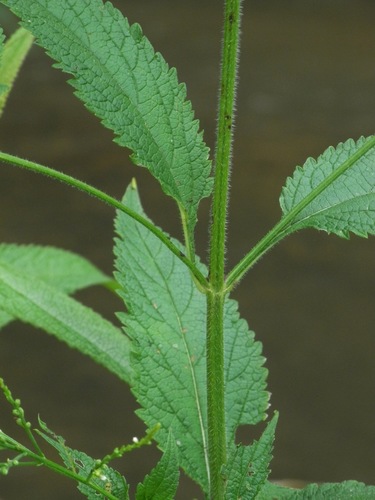
White Vervain is a tall, slender plant reaching heights of 90 to 180 cm, featuring square green stems with rough, spreading hairs. Its oppositely arranged leaves are ovate to lanceolate, coarsely toothed, and strongly resemble those of stinging nettles. In mid to late summer, the plant produces highly branched, panicle-like spikes carrying hundreds of tiny, white, tubular flowers. Each flower is only about 2 mm across, with five lobes, and they bloom progressively from the bottom of the spikes upward, creating a delicate, airy appearance against the green foliage.
Category
PlantsRarity
Common
Danger
1/5 · Very low
Snaps
Be the first to snap!
Historically, various Native American tribes utilized white vervain for medicinal purposes, including treating fevers, stomach aches, and skin ailments.
The species name 'urticifolia' literally means 'nettle-leaved' due to its resemblance to stinging nettles, but it does not sting.
The tiny flowers open sequentially starting from the bottom of the long spikes, slowly working their way to the top over several weeks.
Its coarsely toothed, deeply veined leaves strongly resemble stinging nettles, which can deter herbivores from grazing on them.
Flowers bloom sequentially from the bottom of the spikes upward over several weeks, ensuring prolonged pollinator visitation.
It has a robust root system and high seed viability that allows it to quickly colonize recently cleared forest edges and fields.
As a photoautotrophic plant, White Vervain synthesizes its own energy using sunlight, carbon dioxide, water, and soil nutrients.

Bombus impatiens
Feeds on nectar and pollen, acting as an important pollinator.
Crambodes talidiformis
The caterpillars of this moth feed specifically on the foliage of vervains, including White Vervain.

Lasioglossum
These small sweat bees are frequent visitors seeking nectar and pollen from the tiny white blossoms.
No trait badges are assigned for this object yet.
No aliases listed yet.
Collections for this object will appear here as more themes are added.
Danger
1/5 · Very low
No special safety notes yet.
Start with the whole plant, then compare leaf arrangement, leaf edges, stems and any flowers or fruit. Opposite leaves grow in pairs; alternate leaves come one at a time along the stem. These details tell you far more together than a single green leaf does. Plant Identifier: upload a photo and compare the visible details.
90+ cm
2+ years
As a photoautotrophic plant, White Vervain synthesizes its own energy using sunlight, carbon dioxide, water, and soil nutrients.
Typically found in moist meadows, open woodlands, thickets, riverbanks, and disturbed sites like roadsides and old fields.
Zoom in to split clusters and explore where this object has been snapped.
Recent snaps will appear here as new observations are added.

New Hampshire, US
You might spot Hackberry Emperor, Tansy, and Wood Nettle.
View guide →

Maryland, US
You might spot Bluntnose Minnow and Eastern Blacknose Dace.
View guide →
Take the discovery with you
Snap it with Snappit to identify it, learn what makes it special, and add the discovery to your collection.

















