
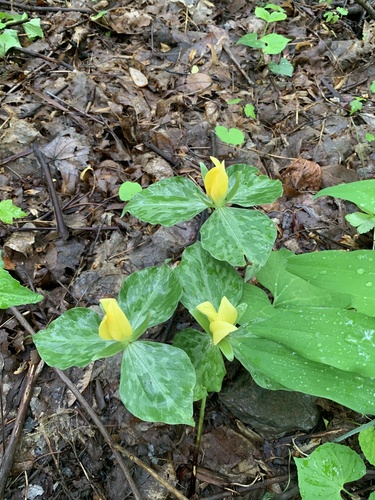


Yellow Wakerobin
trillium luteum
The Yellow Wakerobin (Trillium luteum) is a captivating spring-blooming perennial wildflower native to the rich, moist forests of the southeastern United States. Emerging early in the spring before the forest canopy closes, this plant is celebrated for its striking, lemon-scented yellow flowers that sit proudly atop beautifully mottled leaves. It is a signature species of the Great Smoky Mountains, where it blankets the forest floor in vibrant gold.
Habitat: Found in rich, moist deciduous forests, often in soils overlying limestone or other calcareous rocks.
This herbaceous plant is easily recognized by its single stem bearing a whorl of three stalkless, oval-shaped bracts that are marbled with light and dark green. Nestled directly in the center of these leaves is a single, upright flower with three lance-shaped, lemon-yellow petals, surrounded by three smaller green sepals. The plant typically reaches a height of 15 to 40 centimeters.
Category
PlantsRarity
Common
Danger
1/5 · Very low
Snaps
Be the first to snap!
It can take between seven and ten years for a single seed to mature and produce its very first flower.
The species name 'luteum' is Latin for yellow, referring to the bright coloration of its delicate petals.
While many trillium species have a fetid, rotting-meat odor to attract flies, this species smells pleasantly of lemons.
Produces seeds with rich, oily appendages called elaiosomes that entice ants to carry them back to their nests, dispersing the seeds.
Lacks a flower stalk, allowing the blossom to nestle safely directly on the leaves to shield it from harsh early spring winds.
Emits a distinctive lemon-like fragrance that acts as a chemical lure to attract early-season insect pollinators.
As a photosynthetic plant, it utilizes sunlight, water, and carbon dioxide to manufacture organic compounds while absorbing essential minerals from the soil.
Aphaenogaster rudis
Disperses the seeds of the Yellow Wakerobin by carrying them back to underground nests to feed on the elaiosome.

Odocoileus virginianus
Browses heavily on the leaves and flowers, which can severely deplete the plant's energy reserves.
No trait badges are assigned for this object yet.
No aliases listed yet.
Collections for this object will appear here as more themes are added.
Danger
1/5 · Very low
No special safety notes yet.
Start with the whole plant, then compare leaf arrangement, leaf edges, stems and any flowers or fruit. Opposite leaves grow in pairs; alternate leaves come one at a time along the stem. These details tell you far more together than a single green leaf does. Plant Identifier: upload a photo and compare the visible details.
15-40 cm
10-30 years
As a photosynthetic plant, it utilizes sunlight, water, and carbon dioxide to manufacture organic compounds while absorbing essential minerals from the soil.
Found in rich, moist deciduous forests, often in soils overlying limestone or other calcareous rocks.
Zoom in to split clusters and explore where this object has been snapped.
Recent snaps will appear here as new observations are added.
Take the discovery with you
Snap it with Snappit to identify it, learn what makes it special, and add the discovery to your collection.


















