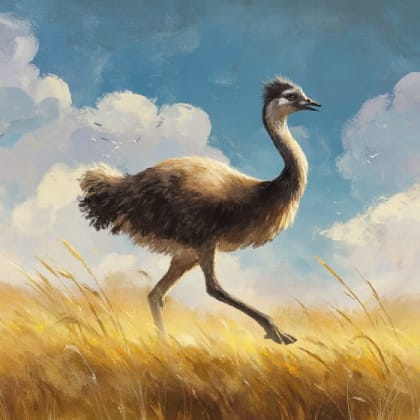
A flexible half day
Choose three animal stops from the park map before entering, then make the playground your break rather than the finish line. Afterwards, return to one animal you missed or found especially interesting.
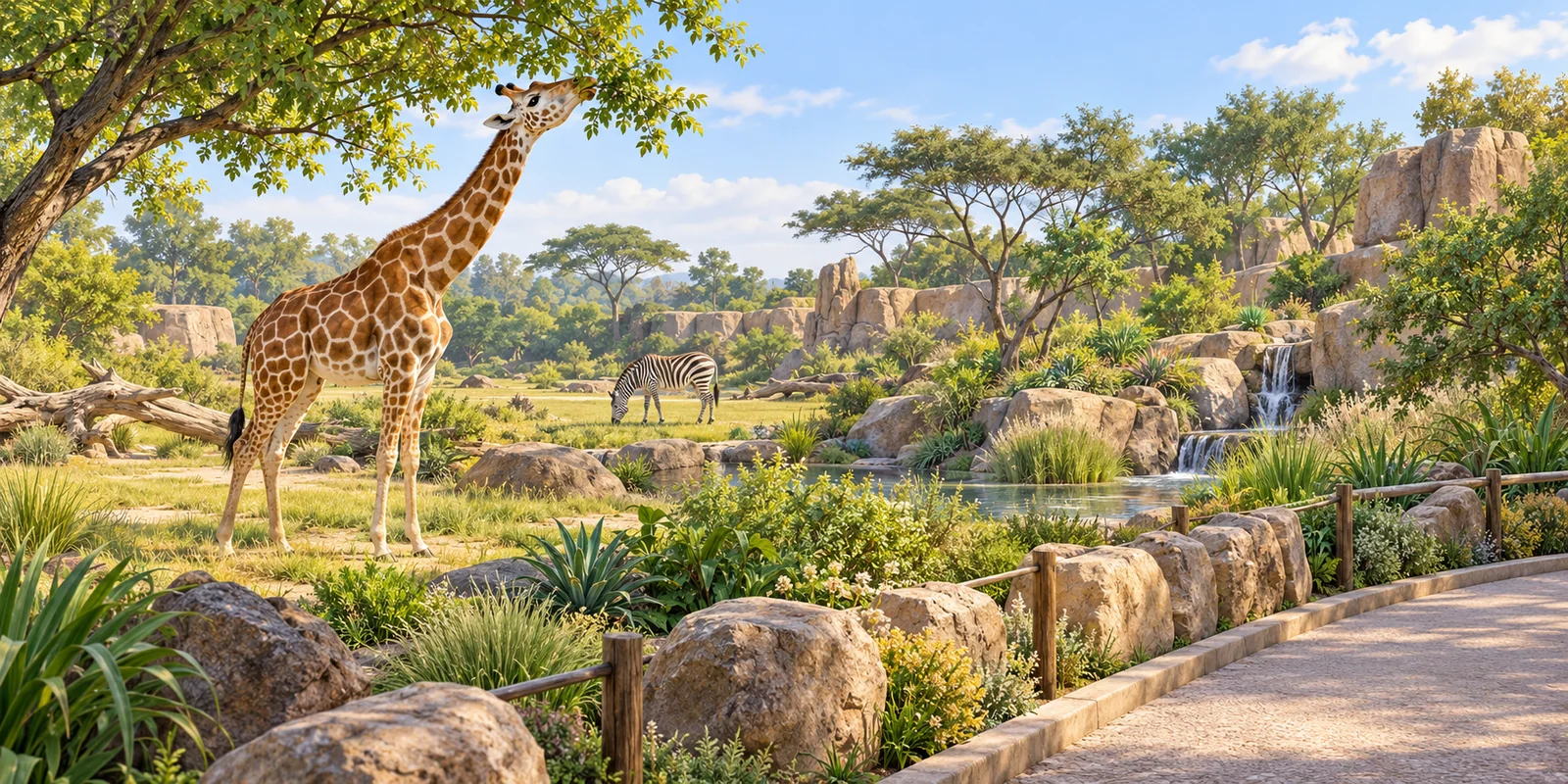 Illustration
Tierpark Hamm is a good choice for a relaxed animal outing with plenty of time for children to play.
Tierpark Hamm is a good choice for a relaxed animal outing with plenty of time for children to play. Start with the park map and choose a few animals you especially want to see; the pleasure here is in lingering at an enclosure rather than hurrying through a checklist. The Fabeltier-Erlebniswelt playground gives younger visitors a substantial break between animal stops.
Several of the most rewarding views bring different species together. At the Africa enclosure, zebras and eland share space with black wildebeest, which arrived in 2026. The Africa pavilion is a place to pause and compare them. In the African aviary, look low for rock hyraxes among the stones and blacksmith lapwings near the water, then lift your eyes for hornbills.
Around the pond, the Inselwelten area leads to the Madagascar house and its lemur island. Ring-tailed and white-headed lemurs can use the trees or settle nearer the ground, so check both. Elsewhere, seek out the fossa, a climbing predator from Madagascar, and the tayra, a member of the weasel family. These less familiar mammals make good reasons to slow down beyond the bigger enclosures. Enhance your adventure: download the Snappit app to identify the local species you encounter.
The zoo opened in 1934 on former wooded parkland after local bookbinder Fritz Vogel proposed creating it. Destroyed during the Second World War, it reopened in 1951. Recent changes include the Madagascar house in 2022, the rebuilt South America enclosure in 2023 and the African aviary in 2024.
Build your visit around the Madagascar house, the walk-through Bennett’s wallaby enclosure and the African aviary, using the park map to choose your order. The wallabies can retreat into the adjoining emu enclosure, so give them space and let them decide how close to come. At the South America enclosure, use the viewing platform to look for guanacos, rheas and Patagonian maras sharing the same area.
For a simple family challenge, ask everyone to choose one animal and notice how it moves: a lemur climbing, a meerkat digging or a fossa balancing with its long tail. Leave a proper play break for the owl tower and beaver-dam climbing structures in the Fabeltier-Erlebniswelt. These are imaginary animal characters and play equipment. The children’s farm adds another change of pace, with sheep and goat walk-through areas and traditional livestock breeds.
The zoo normally opens every day. March–October has a longer visiting day than November–February; 24 and 31 December have shorter hours again. From 1 November 2026, winter hours are 9 am–5 pm, with last admission at 4 pm and no public weekend feedings. Check current notices before travel, especially during severe-weather warnings.
The main paths are suitable for wheelchairs and walking frames, and the zoo describes most of the grounds as accessible. Ask about individual houses and viewing platforms if you need step-free access throughout. A wheelchair can be reserved, subject to availability. Hire wagons are for belongings and must not be used to carry children.
Visit the Madagascar house, look across the lemur island and enter the Bennett’s wallaby walk-through when open.
Compare zebras, eland and black wildebeest, then look for hyraxes and birds around the African aviary’s rocks and water.
Make time for the fossa, tayra and Bornean gibbon as well as the Siberian tiger enclosure.
Climb through the Fabeltier-Erlebniswelt and meet traditional sheep and goat breeds in the farm’s walk-through areas.
Choose three animal stops from the park map before entering, then make the playground your break rather than the finish line. Afterwards, return to one animal you missed or found especially interesting.
Suggested sightseeing priorities only; no official marked route or measured distance asserted.
At the African aviary, let each person search a different level: rocks for hyraxes, water’s edge for lapwings and the space above for hornbills. Compare how one enclosure offers several different places to live.
At the children’s farm, read the names of the Skudde and spotted mountain sheep, then compare their coats. The conservation story here includes domestic breeds as well as wild species.
In the Madagascar house, look beyond the lemurs for day geckos in the planted water-and-land display and rose chafers in the glazed floor terrarium. Make the outdoor sections shorter if the weather is uncomfortable.
Watch for the long tail, used for balance when climbing. A fossa may be active by day or night; if it is resting, try another look later.
Look in the trees as well as on the ground. On warmer days, you may see the lemurs sitting out in the sun with their arms spread.
Search the rock pile and the stone wall towards the back of the aviary. A still, rounded animal can be easy to overlook among the stones.
Watch the ground around the small pond. Listen as well as look: the species is named for a metallic call that recalls a hammer striking an anvil.
Look above the ground-level residents for a bird moving through the aviary. Compare bills if both sexes are visible: males have red-and-yellow bills, females black ones.
Check the thatched roof for a lookout, then the sand for digging animals. In winter, spend time at the windows of the heated indoor area.
The group joined the Africa enclosure in March 2026. From the pavilion, compare their outlines and white tails with the zebras and eland sharing the space.
Look closely at two animals’ stripe patterns rather than trying to fit the whole herd into one picture. Each zebra has its own pattern.
Use the viewing platform to search beneath the sightline of the taller guanacos and rheas. Despite their hare-like appearance, maras belong to the guinea-pig family.
Compare the guanacos with the llamas you may know from farms or pictures: the guanaco is the llama’s wild ancestor. Here the animals live in a managed zoo enclosure.
Watch these large flightless birds alongside the mammals. Their family story makes a good talking point: males incubate the eggs and care for the chicks.
Look for Hamm’s Siberian tiger without expecting constant movement. Tigers are solitary animals; a resting individual can still offer a chance to study its coat and outline.
Rock hyraxes are related to elephants and sea cows. Look at the hyraxes in the African aviary, then imagine how differently related mammals can evolve.
Each card links to a full Explore page with photos, traits, and fun facts.
Start with the big picture, then zoom in to explore individual wildlife observations around this place.
Arrive at Grünstraße 150
Visitor parking is free. Bus 7 runs from Hamm Hauptbahnhof/Willi-Brandt-Platz to Tierpark on Langewanneweg, about five minutes’ walk from the entrance; check the current timetable.
Check tickets first
Compare individual and family tickets on the official price page. Family day tickets cover up to five people with either one or two adults.
Pack before entering
Leaving the park invalidates your admission ticket, so bring everything you need for the visit.
Plan a lunch-and-play stop
The main food outlet and picnic seating are beside the adventure playground. Peuselhappie at the African aviary opens on fine-weather weekends.
Dogs have restricted access
Keep dogs on a lead; they cannot enter animal houses, walk-through enclosures or the playground.
Keep animal contact gentle
Never lift animals or bring food to feed them. Follow enclosure signs and staff instructions about the zoo’s own animal feed.
Leave scooters at home
Bicycles, balance bikes, scooters and skates are not allowed inside.
Photograph considerately
Private photos and videos are permitted; commercial photography needs management permission. Give resting animals space.
Recent snaps will appear here as new observations are added.

North Carolina, US
You might spot American Robin and Eastern Gray Squirrel.
View guide →

Florida, US
You might spot Anhinga, American Alligator, and Wood Duck.
View guide →

New Mexico, US
You might spot Wood Duck, Duck, and Canada Goose.
View guide →

Michigan, US
You might spot African Lion, Komodo Dragon, and Brown Bear.
View guide →
Take the discovery with you
Identify the wildlife you spot, learn as you go, and keep a collection of the adventure.