Red Schnuppertour
A compact introduction to the front of the park, with the animal house, poultry and Turopolje pond. It works well when you want a few memorable stops before playtime.
 Illustration
Come to Arche Warder to discover how varied farm animals can be, from corkscrew-horned goats to pigs that enjoy a swim.
Come to Arche Warder to discover how varied farm animals can be, from corkscrew-horned goats to pigs that enjoy a swim. The roughly 40-hectare park in Naturpark Westensee spreads across pastures, ponds and hedgerows, with broad views and plenty of reasons to stop. Start at the entrance animal house and petting courtyard, then choose a colour-coded walk that suits everyone's energy.
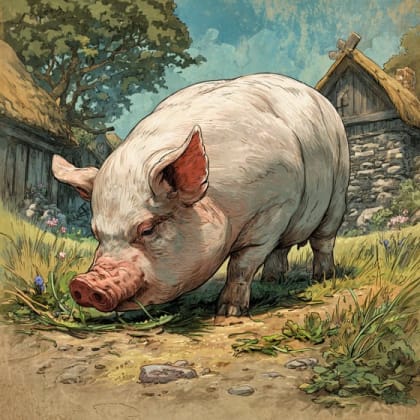
Look beyond the familiar words sheep, cow and chicken on your way round. A Girgentana goat carries spectacular twisting horns; the Hungarian curly-feathered goose wears a very different coat from its smooth-feathered neighbours. At the Turopolje pond, you might see pigs taking to the water. They come from Croatia's Sava floodplains, where swimming and finding food in wet ground are part of their heritage.
The park's purpose is to keep rare domestic breeds alive through breeding, research and education. A breed is a distinct population within a domestic animal species, so several very different-looking sheep can still belong to the same species. Read their individual names together: learning to notice those differences is one of the pleasures of this place. Animal groups can move between pastures, so let the current signs guide you. Planning to visit? Download the Snappit app to identify the wildlife you spot in real-time.
The present conservation organisation was founded in 2003 after the earlier park ran into financial trouble. Greenpeace and the Umweltstiftung Greenpeace helped secure its future, and the renewed park opened in May 2004. Its work now reaches beyond the visitor grounds: satellite pastures allow larger breeding populations, spread the risk of disease outbreaks and put traditional grazing animals back to work caring for landscapes.
Choose the red Schnuppertour for the front section, including poultry, sheep and goats, and the Turopolje pond. The green Genießertour reaches the water buffalo and the Stone Age settlement at the high point of its circuit. The blue Walkingtour makes a fuller outing through the sheep pastures, viewpoint, Schweineland, cattle and horse areas, and Eselland. The park suggests about half an hour for red, an hour at a brisk pace for green, and around three hours with animal stops for blue. Give yourselves longer if you want to play or eat.
The DOMESTICANEUM adds an indoor chapter to the day. Its interactive rooms explore the changing relationship between people and domestic animals, with a virtual chariot ride through ancient Uruk and a game about farming's future. Outside, the reconstructed Stone Age settlement offers another way to imagine life with livestock. Children can break up the watching with the Spielarche or the straw play castle near the restaurant.
Spring is a good season to look for young animals in the animal house, though births and access vary. On warm days, pause at the Turopolje pond without counting on a swimming display. Bring windproof layers for exposed pastures and waterproof shoes after rain. In winter, only the main paths in the front entrance area are routinely cleared or gritted.
The entrance area, Tierschauhaus and Streichelhof are suitable for wheelchair users, and the restaurant is reachable. Elsewhere, sand and steep sections can make assistance necessary, especially in poor weather. An accessible toilet is available. The DOMESTICANEUM is step-free, but pushchairs are not allowed inside; use the designated parking area outside and bring a carrier if helpful. For a wheelchair, mobility aid or pushchair, call 04329 9134-0 to discuss a manageable visit and current path conditions.
Watch for the Croatian pigs in and around the water, with swimming a possibility rather than a performance.
Compare the horns, feathers, coats and shapes of domestic animals with very different regional histories.
Follow the Schafweg and choose a longer walk if you want to include Schweineland and Eselland.
Explore domestication, ancient farming and future choices through games, models and multimedia.
A compact introduction to the front of the park, with the animal house, poultry and Turopolje pond. It works well when you want a few memorable stops before playtime.
Adds the water buffalo and Stone Age settlement to the front-area animals. The hour suggested by the park assumes a brisk walk; take your time if the sheep or the village catch your interest.
Choose the fuller circuit for the viewpoint, Schweineland, cattle, horses and Eselland. Allow additional time for the indoor exhibition or a meal.
Begin with the animal house and a few front-area stops. After a play or snack break, decide together whether to continue into the wider pastures or spend more time in the DOMESTICANEUM. Save an unhurried final look for whichever breed sparked the most questions.
Choose three animals and copy their breed names. Draw one feature that helps you recognise each, such as horns, feather patterns or body shape. At home, see whether everyone can match the sketches to the names without looking at the photos.
After watching the livestock, visit the Stone Age settlement and imagine the daily jobs its farmers had to do. Ask everyone to choose one task they would find interesting and one they would find difficult, then look for clues in the buildings and animal pens.
Use the DOMESTICANEUM for games and stories about domestic animals, then make a shorter stop in the Tierschauhaus. Check access on the day and bring waterproofs for moving between the buildings. A family with a dog will need to take turns in the visitor centre.
Poitou donkeys were bred in western France to sire strong mules. Use the breed sign to identify them, then compare their size and outline with the smaller donkeys. Keep watching from the visitor area and do not offer food.
At the pond, watch how a Turopolje pig chooses between land and water. In Schweineland, compare it with other signed breeds, including woolly Mangalitza pigs. Different coats do not make them different species, and a swimming sighting is never guaranteed.
Look for the Girgentana name before looking for the twisting horns. This domestic breed comes from Sicily. Compare the horn outline from a safe distance, and pet only animals in an area explicitly open for contact.
Small, short-tailed Skudde sheep are one of many breeds to look for. Choose two signed breeds and compare their proportions and fleeces. The broad sheep grouping here does not identify the breed; the enclosure sign gives that extra detail.
Find the Englisches Parkrind label and watch the group from outside the barrier. Their name recalls cattle kept in British parks in medieval times. Compare the animals with another signed cattle breed, but never touch cattle.
The Posavina comes from the Sava region and has broad hooves suited to wet ground. If one is standing where you can see its feet, compare their outline with your drawing of another horse. Stay outside restricted pastures and do not feed.
Use the sign to distinguish the water buffalo from the cattle breeds. In warm weather, look for resting or wallowing behaviour. These are domesticated water buffalo; the word European describes their breeding and keeping history, not a separate wild species.
Look closely at the barred feather pattern of the Deutscher Sperber, a breed developed in Duisburg. Compare its markings with another chicken, then try the Vom Ei zum Huhn learning station to explore what happens before a chick hatches.
Find the Ungarische Lockengans sign and compare the loose curls with the feathers of another goose. The unusual feather form is an inherited trait. Give the birds space and keep children’s faces and hands away from their beaks.
Watch for the upright stance that makes this domestic duck breed so distinctive. Let the label confirm the identification, then compare a walking bird with a swimming one if both are visible. Plumage alone is a poor shortcut when several duck breeds share the collection.
These animals are kept and bred in the park. The names highlight domestic breeds, while most animal links cover their broader domestic species; Sheep is a wider group. Indian Runner Duck is a breed-specific link. Use the current enclosure labels for breed names and locations, and allow animals to remain out of view.
The Poitou donkeys graze the park’s dry grassland. Their grazing helps keep this open habitat, with plants such as sheep’s-bit and grey hair-grass, from becoming overgrown. Stay on the visitor paths and enjoy the smaller details without collecting anything.
Some of the park’s animals spend time on satellite grazing sites elsewhere in Schleswig-Holstein. This creates room for larger breeding groups and reduces the risk of keeping an entire population in one place. It also explains why the animals you meet can vary between visits.
The farm shop forms the entrance. Handcart hire, an accessible toilet, outdoor play areas and the Farmküche offer useful breaks. Pushchair parking and lockers are provided outside the DOMESTICANEUM. Food service follows its own timetable, so check before counting on a full meal.
Each card links to a full Explore page with photos, traits, and fun facts.
Start with the big picture, then zoom in to explore individual wildlife observations around this place.
Arrival
Use Langwedeler Weg 11, 24646 Warder. Follow the park signs from the A7 Warder exit or the A215 Blumenthal exit. Use the marked parking areas; the smaller one beside the main building is primarily for staff and visitors with mobility impairments. Enter through the Hofladen.
By public transport
From Nortorf station, look for bus 786 to Warder Arche Warder. From Kiel, bus 780 towards Nortorf serves Langwedel Denkmal, about 1.2 km on foot from the park. Check both journeys for your actual date in NAH.SH before leaving, especially at weekends and during school holidays.
Food and breaks
Check the Farmküche timetable separately. Food may come from a grill or snack stand rather than the restaurant, and weather or private functions can change service. Vegetarian and vegan options are offered. Bring drinking water and a snack for children.
Feeding
Use only food bought at the park, and only where permitted. Never feed horses, donkeys or alpacas, or animals in the Tierschauhaus and petting courtyard. Do not hand-feed pigs. Check the signs and ask staff before offering anything.
Animal contact
Pet animals only in designated areas and let them approach. Never touch cattle, chase retreating animals or enter their resting areas. Keep children away from electric fences and give horns and goose beaks plenty of room.
With small children
Handcarts can be hired. Plan a play break before taking on the longer pastures, and remember the DOMESTICANEUM pushchair restriction when packing for the day.
Dogs
Keep dogs on a short lead. They cannot enter the Streichelhof, Ferkelstube or DOMESTICANEUM, even when carried. If adults take turns visiting these areas, someone must stay with the dog; do not leave it tied up unattended.
Book ahead
Guided visits, school activities and birthday programmes need advance arrangements. Aim to enquire at least two weeks ahead, and explain your group’s ages, interests and access needs. Private photography is allowed in visitor areas; commercial photography needs prior written permission.
Recent snaps will appear here as new observations are added.

North Carolina, US
You might spot American Robin and Eastern Gray Squirrel.
View guide →

Florida, US
You might spot Anhinga, American Alligator, and Wood Duck.
View guide →

New Mexico, US
You might spot Wood Duck, Duck, and Canada Goose.
View guide →

Michigan, US
You might spot African Lion, Komodo Dragon, and Brown Bear.
View guide →
Take the discovery with you
Identify the wildlife you spot, learn as you go, and keep a collection of the adventure.