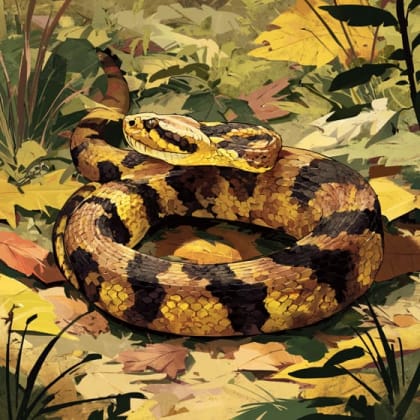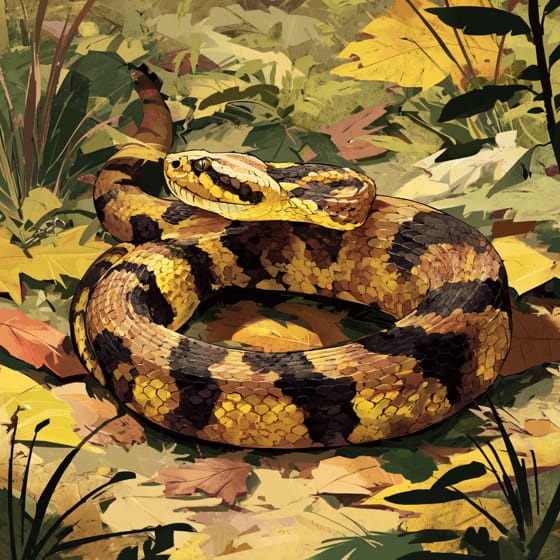





Timber Rattlesnake
Crotalus horridus
The Timber Rattlesnake is a special snake known for its loud rattle! It has beautiful patterns on its skin and can be found in forests and mountains. This snake is important for nature and helps keep the balance in its home.
Habitat: Forests
The Timber Rattlesnake has a heavy body, typically yellow, brown, or gray with dark, V-shaped crossbands. Its head is distinctly triangular, and its tail ends in a segmented rattle. This pattern helps it blend seamlessly into forest environments.
Category
ReptilesRarity
Common
Danger
5/5 · Extreme
Snaps
1
A baby rattlesnake is born alive and called a 'neonate!'
Their impressive fangs can be up to an inch long!
They are one of North America's heaviest venomous snakes!
They can wait for weeks or months between meals!
Timber Rattlesnake has special heat-sensing pits on its face that help them find warm-blooded prey even in total darkness.
Timber Rattlesnake has patterned scales that help them disappear into forest leaf litter and rocky terrain, surprising prey.
Timber Rattlesnake can vibrate its keratin tail segments to create a loud rattling sound that warns off threats.
These stealthy hunters eat small mammals and birds, striking quickly with their venom.
Peromyscus leucopus
A common prey item in its forest habitat.
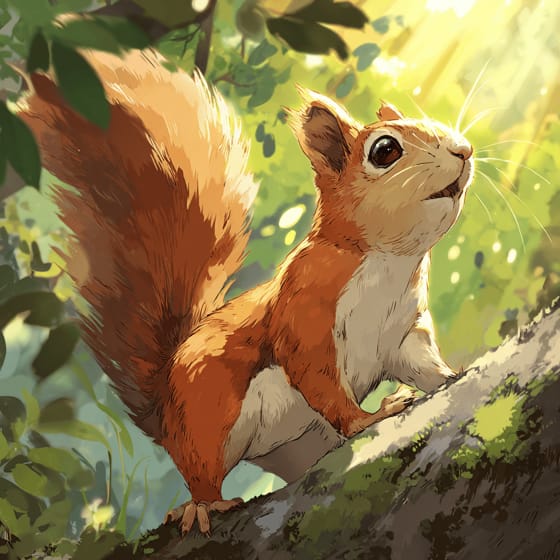
Sciurus carolinensis
Prey, especially younger squirrels.
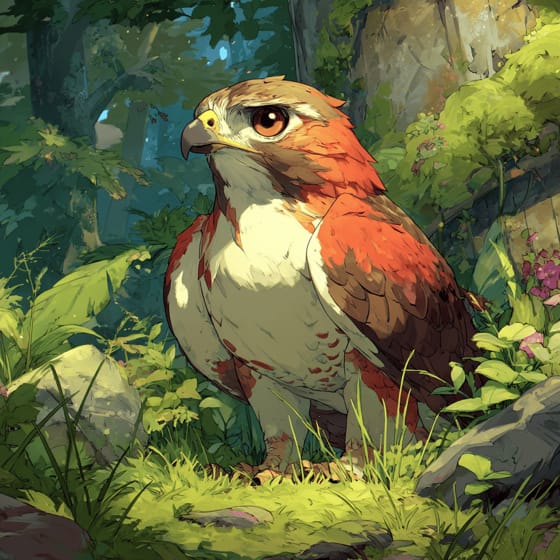
Buteo jamaicensis
Young rattlesnakes are sometimes prey for hawks.
Marked with spots or patches of a different color.
Solitary animals live alone for most of their lives, only interacting with others for mating or parental care.
Camouflaged describes organisms that possess coloring or patterns that allow them to blend into their environment.
This habitat trait identifies species found in mountainous regions, characterized by high elevation, steep slopes, and varying climate zones.

An ambush predator hunts by patiently waiting and concealing itself, then launching a sudden attack when unsuspecting prey comes within range.

Forest habitats are terrestrial environments dominated by dense tree cover, supporting a high diversity of plant and animal life.

Hibernating animals enter a state of metabolic depression during cold periods or when food is scarce, characterized by reduced body temperature and activity.

This trait characterizes organisms with an exceptionally long lifespan compared to others of their kind.

This trait identifies organisms whose diet consists entirely or primarily of animal tissue.

Describes a species whose presence and role have a disproportionately large effect on its environment.

Venomous organisms produce toxins that are injected into another animal, typically through a bite or sting.

Endangered status indicates a species is at a very high risk of extinction in the wild in the near future.
Danger
5/5 · Extreme
If you see a snake, stay calm and back away slowly. It's best to leave them alone.
90-180 cm
0.5-2 kg
15-25 years
5 km/h
These stealthy hunters eat small mammals and birds, striking quickly with their venom.
Forests
Ambush
5-20
Zoom in to split clusters and explore where this object has been snapped.

Louisiana, US
You might spot Linnaeus's Two-Toed Sloth and Corn Snake.
View guide →
Oklahoma, US
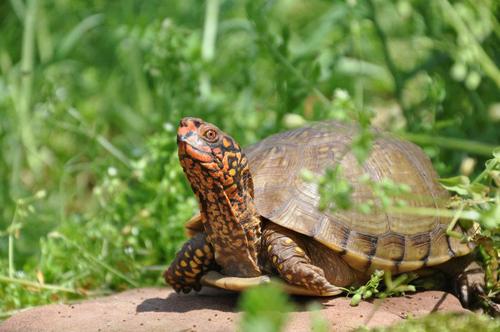
You might spot Three-Toed Box Turtle and Blackjack Oak.
View guide →

Louisiana, US
You might spot Ringed Teal, Kirk's Dik-Dik, and Chinchilla Lanigera.
View guide →