King Cobras
Ophiophagus
King Cobras are the longest venomous snakes in the world! They can grow up to 18 feet long and are known for their beautiful colors and hooded appearance when they feel threatened.
Habitat: Forests, Grasslands
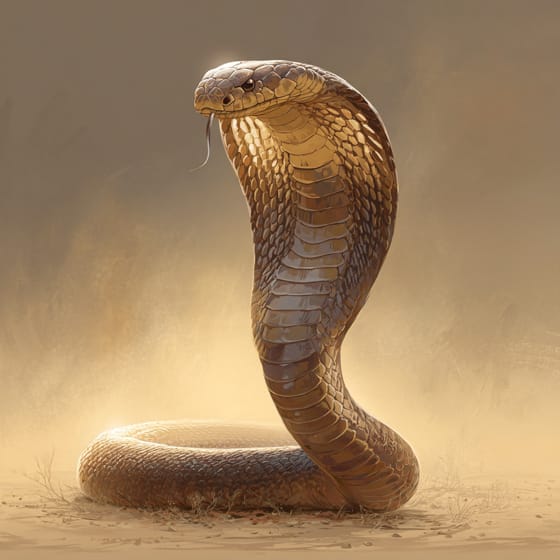
The King Cobra is a very long, slender snake with smooth scales that can range from olive green to black, often with light yellow or cream bands. It has a distinctive, large hood it can flare, making its head appear wider than its body. Its eyes are relatively large with round pupils.
Category
ReptilesRarity
Common
Danger
5/5 · Extreme
Snaps
Be the first to snap!
King Cobras are the longest venomous snakes on Earth!
Mothers are the only snakes known to build complex nests for eggs!
Their scientific name means 'snake-eater', which is most of their diet!
They can lift their head to eye-level with a tall person!
King Cobras can expand a wide hood because of flexible ribs that helps them look larger and intimidate predators.
King Cobras can build a two-story nest of leaves and dirt because of their strong body that helps them protect their eggs.
King Cobras has a forked tongue that helps them 'taste' the air to find prey and sense danger from afar.
These powerful snakes mostly hunt and eat other snakes, including venomous ones!
Ptyas mucosa
A common large snake that King Cobras often hunt in their habitat.
Naja naja
King Cobras frequently hunt and eat other venomous cobras.
Varanus salvator
Young King Cobras may prey on smaller monitor lizards.
Spilornis cheela
Young King Cobras can sometimes be preyed upon by large raptors.
Solitary animals live alone for most of their lives, only interacting with others for mating or parental care.
Colorful describes organisms or objects displaying a wide range of bright and distinct colors.
Grassland habitats are terrestrial biomes dominated by grasses and herbaceous plants, supporting a variety of grazing animals.
An ambush predator hunts by patiently waiting and concealing itself, then launching a sudden attack when unsuspecting prey comes within range.

Forest habitats are terrestrial environments dominated by dense tree cover, supporting a high diversity of plant and animal life.

This trait identifies organisms whose diet consists entirely or primarily of animal tissue.

Diurnal animals are primarily active during daylight hours, typically resting or sleeping at night.

Describes a species whose presence and role have a disproportionately large effect on its environment.

Venomous organisms produce toxins that are injected into another animal, typically through a bite or sting.

Endangered status indicates a species is at a very high risk of extinction in the wild in the near future.
Danger
5/5 · Extreme
If you see a snake, stay calm and walk away. It's best to leave them alone.
300-580 cm
6-20 kg
20-30 years
19 km/h
These powerful snakes mostly hunt and eat other snakes, including venomous ones!
Forests, Grasslands
Pursuit
20-50
Zoom in to split clusters and explore where this object has been snapped.
Recent snaps will appear here as new observations are added.