
Snappit logo
Snappit
Get App
Generic illustration, not a photograph of this venueIllustration
ParkKR

Daewangam Park

The pleasure of Daewangam is the change of scene.

About

The pleasure of Daewangam is the change of scene. Inside the pinewood, the path is enclosed by trunks and foliage; beyond Ulgi Lighthouse, the view opens onto rock channels and the sea. You can make the coast the main event, spend longer in the woodland, or add the northern suspension bridge when it is operating.

Keep the two bridges distinct when planning. Daewanggyo connects the mainland approach with the Daewangam rock outcrop. The much longer suspension bridge is a separate attraction on the park’s northern shore. Neither needs to be crossed to enjoy the woodland and mainland views. Families and mixed-mobility groups can choose a shared mainland outing without committing everyone to the same exposed crossing. Wondering what that bird or insect is? Find out on your visit using the Snappit nature app.

Local tradition connects the rocks with the queen of Silla’s King Munmu: after death, she is said to have become a guardian dragon and entered the sea beneath the rocks. Read this as the park’s legend, rather than a verified account of a royal burial. Ulgi Lighthouse adds a different kind of history. The original light dates to 1906. As the surrounding pines grew, a newer tower was built nearby in 1987 to keep the light visible. Looking at the two towers together makes the relationship between the working coast and its growing woodland easier to understand. Exterior viewing is worthwhile on its own; do not assume a tower climb or indoor visit is included.

What to do here

For a first visit, begin with a woodland route toward Ulgi Lighthouse, then continue to the mainland viewpoints facing Daewangam. Decide there whether the rock approach suits your group. If you want a longer, more varied walk, use the signed Legend Rock Trail for coastal formations and return by a woodland path where the on-site map permits. Treat the suspension bridge as an optional addition, with its own opening hours and entry rules.

Seasonal info

The woodland remains a strong part of the visit when flowers are out of season. Spring blossom and late-summer purple groundcover add colour, but bloom dates vary. On a rainy, foggy or windy day, be ready to shorten the walk or postpone the exposed sections.

Accessibility

A designated accessible mainland walking route and improved rest areas offer a useful way to see the forest and coast. Choose that signed route rather than following every coastal spur. The suspension bridge does not admit wheelchairs or strollers; the rock-crossing approach also needs separate checking.

Don't miss

1

Pine woodland opening onto a rocky sea horizon

2

Ulgi Lighthouse’s old and newer towers

3

Named coastal formations along the Legend Rock Trail

4

A separate 303-metre suspension bridge, when operating

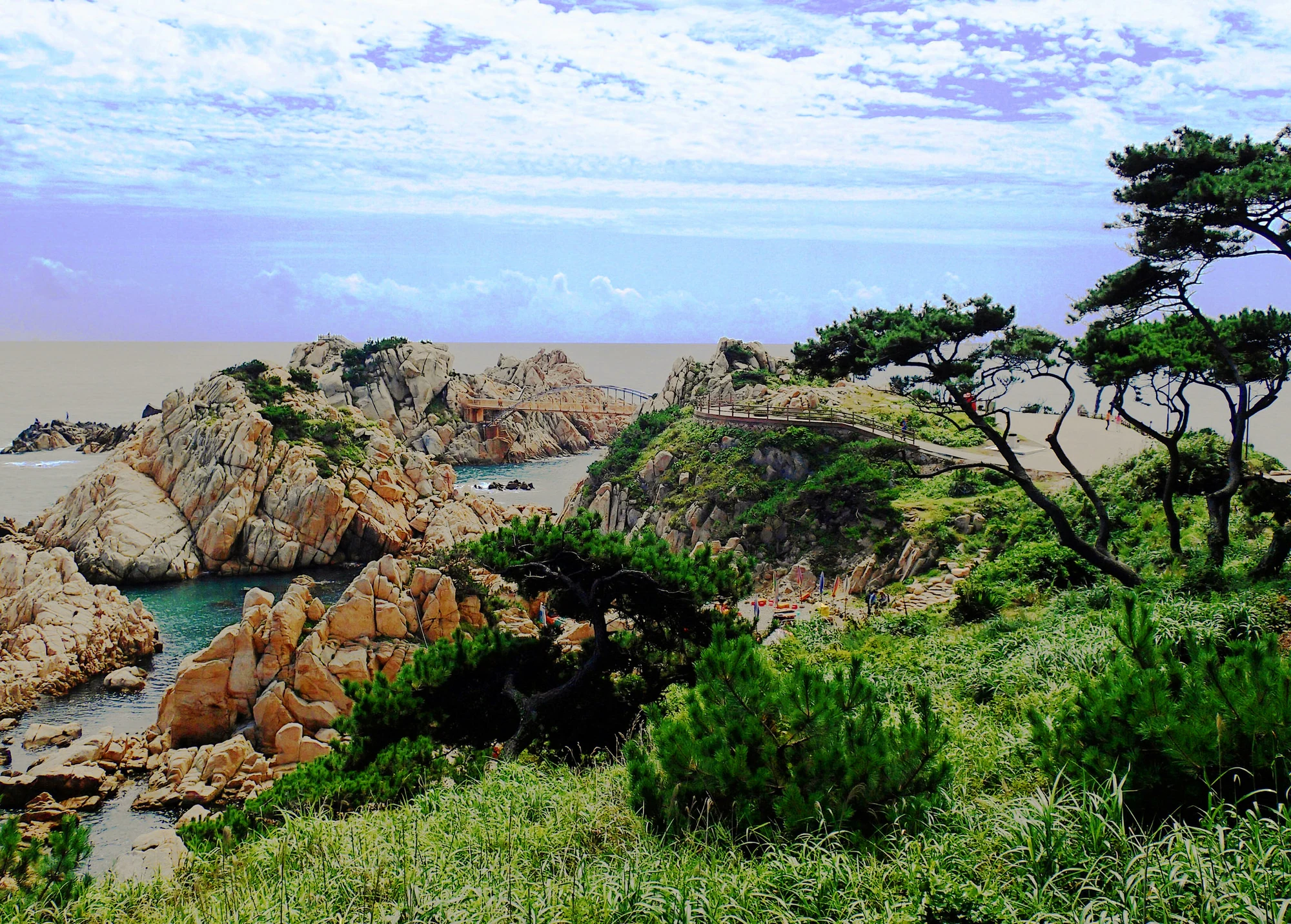
Pine trees frame rocky coastal outcrops and an older pedestrian bridge beneath a blue-purple sky at Daewangam Park.

Daewangam’s rocky coast in a photograph dated 13 September 2014. The strongly processed colour is retained from the original; this historical scene does not show current bridge design or access conditions.

“Daewangam Park, Ulsan, South Korea” by Jasmine Halki, via Flickr, CC BY 2.0. No changes. · Creative Commons 1 · Creative Commons 2

Walks and routes

Pine Forest Trail

Choose the Songnim-gil for the woodland part of the outing. It centres on the pine-covered approach between the entrance/management-office area and Ulgi Lighthouse, with connections onward toward Daewangam. The operator gives about 40 minutes for its named course; stop for the lighthouse surroundings and allow longer if you continue to the rock viewpoints.

Choose the signed accessible alternative where indicated; woodland paths and coastal spurs are not uniformly step-free.

Pine Forest Trail

Four Seasons Trail

The Sagyejeol-gil follows the central approach, with flowering trees beside the path. It is a useful short woodland choice toward the lighthouse rather than a complete coastal circuit. The operator’s estimate is about 15 minutes; a return walk, photographs and a lighthouse stop need extra time.

A short published time says nothing about continuous wheelchair access; use the designated accessible route and current signs.

Four Seasons Trail

Legend Rock Trail

The Jeonseolbawi-gil follows the northern coastal side, with wooden-deck sections and views of Tanggeonam, Yonggul and Halmi Rock. The published course connects the Daewangam area toward Ilsan Beach and takes about 30 minutes before longer stops. Use the names on the interpretation signs to follow the stories; viewing a cave or rock does not mean entering it.

Expect an exposed coastal outing. Do not assume the complete course or beach connection is step-free.

Legend Rock Trail

Seaside Trail toward Seuldo

The Badatga-gil continues along the southern coast toward Seuldo, passing viewpoints and the camping-area side of the headland. The operator gives about 40 minutes for the named course. You can simply walk an open section and turn back; reaching Seuldo adds a neighbouring destination and requires a return plan.

Check coastal surfaces and changes of level before committing to the onward walk, particularly with a wheelchair or stroller.

Seaside Trail toward Seuldo

A first visit with room to pause

Start at the entrance route board, take a woodland path to the lighthouse surroundings, and continue to a mainland viewpoint. Have a break before deciding on the rock approach. Return by the signed mainland route you selected at the start. Allow 90 minutes to two hours; if the weather is unsettled, keep the coastal stop brief.

More coast, without chasing every trail

With two to three hours, combine a woodland approach with an open section of the Legend Rock Trail and its interpretation stops. Add the suspension bridge only if everyone wants to cross and it is operating. Save the onward Seuldo walk for a longer visit rather than squeezing it into the same allowance. These timings are editorial planning suggestions.

Things to try

Choose the suspension bridge deliberately

The northern suspension bridge is 303 metres long. Its published hours are 09:00–18:00, with entry ending at 17:40; admission is currently listed as free. It closes on the second Tuesday of each month and can close for rain, weather warnings, poor visibility or maintenance. Children under 13 and visitors needing assistance must have a companion. Food, drinks and high heels are prohibited on the bridge. Leave enough time to reach the entrance comfortably, and accept staff decisions if conditions change.

A family stop near the entrance

Mir Playground uses a large dragon form inspired by the park legend. It can make a useful beginning or finish for children who will not enjoy a long coastal walk. The central maze garden offers another short diversion. Check each play area’s condition on arrival, particularly after rain, and stay with younger children.

When the coast is uncomfortable

A short mainland visit may be enough in light rain, provided paths remain open and footing is secure. Heavy rain, strong wind or poor visibility is a reason to postpone the headland outing. Do not use the forest as shelter during dangerous weather, and do not depend on an indoor lighthouse visit as a guaranteed fallback.

Wildlife and habitats

Japanese black pine

The haesong of the park’s coastal woodland is Japanese black pine, Pinus thunbergii. Enjoy the structure of the mature trees from the path, including the way dark trunks frame glimpses of sea. This is managed park woodland. Leave roots and bark undisturbed, and enjoy the trees from the walking path.

Stories and discoveries

Two crossings with different jobs

Daewanggyo is the rock-access bridge; the suspension bridge crosses a different stretch of the northern coast. Keeping those names separate helps you read signs and ask the right access question. The long suspension bridge was completed in 2021, so an older park photograph may show only the rock-access crossing.

When to visit

Spring: the central flower walk

Choose the Four Seasons Trail for the avenue’s cherry blossom when it is flowering. Keep the rest of the outing flexible: a comfortable woodland walk and a clear coastal view are good reasons to come even if peak blossom has passed.

Late summer: colour beneath the pines

Ulsan’s August 2026 guide highlights purple maekmundong flowers beneath the pinewood, generally from August into early September. Treat that as a seasonal window rather than a fixed peak date. Stay on the path instead of stepping into planted groundcover for a photograph.

Autumn and winter: choose conditions first

Use clear days for a longer coastal walk and carry a windproof layer. In colder weather, judge comfort on the exposed headland separately from comfort in the trees. Finish unfamiliar paths in daylight and skip icy, wave-washed or closed sections.

Getting there and practical advice

Admission, toilets and a practical starting point

Ordinary park admission is free; separately operated facilities, including camping, have their own arrangements. Toilets, accessible toilets and visitor help are available in the park visitor area. Use the facilities before a longer coastal stretch. The park office is 052-209-3738; for the suspension bridge, the published contact is 052-209-3767.

Play areas and overnight stays

Mir Playground and the maze garden are listed as free visitor facilities. An overnight stay belongs in the separately booked campsite, rather than an improvised spot in the park or car park. Day visitors should keep to public routes when passing the camping area.

Arriving by public transport

Search for Daewangam Park, 대왕암공원, in the Ulsan bus-information service, using your actual starting point and travel day. Dong-gu’s published local-bus notice includes the park on route 02. Check the stop position and return service before setting off; a stop labelled “park entrance” can leave a longer approach than the park terminus.

Taxi or car

Use the official visitor address, 95 Deungdae-ro, Dong-gu, Ulsan, and specify Daewangam Park. Parking is available, but read the current tariff at the car park rather than relying on an old claim of free weekday parking. For an accessible arrival, ask for the designated entrance-area parking and walking route.

Plan an accessible mainland visit

The 2026 accessible-tourism update describes improved walking surfaces, marked routes, accessible toilets, rest spaces and designated parking in the second car park. Follow the accessible-tourism map and ask which entrance best suits your mobility needs. That provides a better starting point than assuming every path to the same landmark is equivalent.

Where the route needs extra care

KTO’s detailed route guidance flags uneven woodland approaches, a steeper approach from the parking tower and steps at Daewanggyo. Some of that route commentary predates the newer improvements, so confirm the current surface and a suitable turnaround with staff. The operator explicitly excludes wheelchairs and strollers from the suspension bridge. Equipment loans are listed by KTO; confirm availability before relying on one.

Sources and useful links

Wildlife you might spot

1

Each card links to a full Explore page with photos, traits, and fun facts.

We are still adding species preview cards for this place.

Snap map for this place

Start with the big picture, then zoom in to explore individual wildlife observations around this place.

Loading map…

Good to know before you go

Wear shoes with dependable grip, even for a short visit.

Pack drinking water and sun protection before leaving the entrance area.

Keep children close at railings and crossings, and leave room for walkers passing in both directions.

Stay behind safety barriers; a tempting rock ledge is not an extra viewpoint.

Use the on-site route board to choose your return before taking a coastal branch.

If you want a relaxed visit, leave space in the day for a seated break rather than trying to complete every named trail.

Frequently asked questions

No. You can enjoy the pinewood, lighthouse surroundings and mainland sea views without either crossing. Decide separately about Daewanggyo to the rocks and the northern suspension bridge, especially if someone dislikes heights or needs a step-free route.
Check the park’s current notices and weather forecast, or call the bridge office on 052-209-3767. The regular closure is the second Tuesday of each month, and rain, strong wind, poor visibility or maintenance can stop access. Confirm on the day if the crossing is central to your plans.
The operator prohibits pets on the suspension bridge. Ask the park office about the current rules for your intended mainland walk before travelling with an animal, including any assistance-dog arrangements.
It is an optional onward coastal walk. The named Seaside Trail continues toward Seuldo, so add time for the return or arrange onward transport. This guide covers Daewangam Park and does not treat the entire neighbouring Seuldo coast as one park.

Recent snaps at this place

Recent snaps will appear here as new observations are added.

View all ›

Take the discovery with you

Exploring Daewangam Park?

Identify the wildlife you spot, learn as you go, and keep a collection of the adventure.

  1. 1Spot it
  2. 2Snap it
  3. 3Keep the discovery
