Snappit logo
Snappit
Get App
Generic illustration, not a photograph of this venueIllustration
ParkKansai, Japan

Expo '70 Commemorative Park

The Tower of the Sun is the big welcome, but give the gardens most of your time.

About

The Tower of the Sun is the big welcome, but give the gardens most of your time. This broad green park in Suita occupies the grounds of Osaka’s 1970 world exposition. Around its surviving landmarks, former pavilion sites have become woodland, lawns and flower gardens. It is an easy place to mix a little design history with a proper afternoon outdoors.

Start by choosing between two different kinds of green space. The Natural and Cultural Gardens hold the Tower, open lawns, seasonal planting and the western woodland. The Japanese Garden is a distinct, gated garden on the northern side, included in the same ordinary admission ticket. Its streams connect garden styles from different eras. Around Shinji-ike, the large central pond, pause at the rest area and then walk a little farther: a new angle changes the arrangement of stones, trees and water.

For a first visit, pair the Tower’s exterior with the central and eastern Japanese Garden. In summer, make the lotus pond the extra destination; at other times, linger over pond reflections and the contrast between garden styles. If birds and woodland interest you more, turn west for moricara, the nature observation centre, and a short forest walk instead. Trying to fit both garden ends, every museum and the play attractions into a few hours makes this generous park feel unnecessarily hurried.

There is a good story behind the shade. Much of the woodland was planted after the exposition, as part of a long-term effort to rebuild a varied, self-sustaining forest. The carefully composed Japanese Garden and that recovering woodland show two very different ways people shape nature. Leave time simply to look, listen and compare. Unlock an interactive field guide for this spot: get the Snappit app to identify nature on the go.

The park preserves part of the 1970 Japan World Exposition site. The Japanese Garden was the Japanese government’s exposition exhibit, while the Natural and Cultural Gardens developed as former pavilion grounds were replanted. Taro Okamoto’s Tower of the Sun survived as the site’s best-known artwork, and its interior reopened in March 2018. The Japanese Garden was registered as a national monument in the scenic-place category on 11 October 2024.


What to do here

See the Tower of the Sun from the park paths, then choose a Japanese Garden stroll or a western woodland outing with moricara. Look for the changing shapes of water, stones and plants, and use the current flower map to choose one seasonal detour. The Tower interior and museums are optional additions with their own tickets and opening arrangements.

Seasonal info

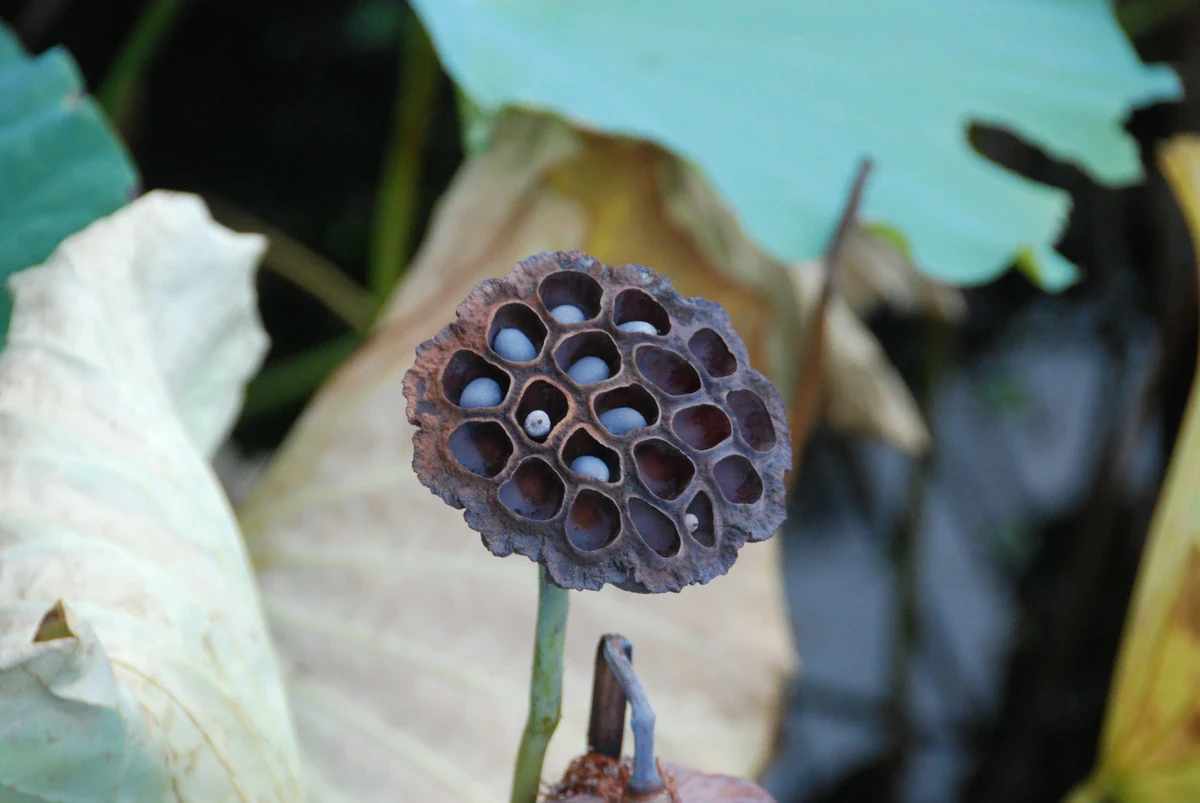
Lotus usually flowers from early July to late August. The park’s 2026 report marked flowering finished on 26 August. After flowering, the seed-bearing heads offer another shape to notice, if they remain visible. The botanical close-up below was photographed at Kōraku-en in Okayama in 2010; it shows a mature lotus head and is not an Expo park photograph. Leave plants and seed heads where they are.

Accessibility

Free wheelchair and stroller loans are limited and first-come, with no advance reservation. Ask gate staff to help choose a route that suits your chair and walking range; the whole garden is a much longer outing than its entrance view suggests. Wet stones, leaves and moss can be slippery. The Tower interior has stairs, with a separately booked, capacity-limited elevator option. Do not plan on the closed Sorado observation tower.

Don't miss

1

The Tower of the Sun’s three exterior faces, with a very different view from the back

2

Shinji-ike and the Japanese Garden’s changing compositions of water, stones and trees

3

Summer lotus flowers, and the seed-head shapes that follow them

4

moricara and a short woodland walk on the former exposition grounds

Walks and routes

Tower exterior and the central-to-eastern Japanese Garden

From the central gate, visit the Tower exterior and continue toward the Japanese Garden’s main entrance beyond the rose garden. Start with the view over Shinji-ike. Follow the garden paths east toward the modern koi pond and, in lotus season, the lotus pond, then return by open signed paths. Save the western waterfall and bamboo area for a longer visit rather than feeling obliged to cover every garden style.

Ask staff for the most suitable pond-side route and turn back before the longer eastern extension if needed. Stay on the open paths rather than taking shortcuts through planting or over rocks.

Tower exterior and the central-to-eastern Japanese Garden

moricara and a western woodland wander

Choose this instead of the long Japanese Garden visit. Head west from the central area to moricara, then make a short out-and-back on the open woodland paths nearby. Pause when you hear small birds moving through the trees. In autumn, the plane-tree avenue Nishi-oji is another option if the extra walk suits everyone. Keep the return simple and use the official map to avoid drifting into a much bigger circuit.

Ground-level woodland routes still vary in surface and slope. Agree a short route with staff, especially after rain, and leave enough energy for the return to your gate.

moricara and a western woodland wander

A relaxed half-day

Arrive near opening, enjoy the Tower exterior, and spend the main part of the morning in the Japanese Garden. Take a break before deciding whether to extend east toward the lotus pond or return. Add the Pavilion only if there is time and energy left; a Tower interior booking should set the order of the day.

A shorter visit with children

Choose moricara and one nearby outdoor stop, with an unhurried snack break. Or keep the Japanese Garden visit around Shinji-ike and skip the far ends. A successful visit does not need every museum, flower bed and play attraction.

Things to try

Find the Tower’s different faces

From the open paths, compare the bright face at the top, the front face and the dark sun on the back. They represent future, present and past. If you have booked the interior, the Tree of Life changes the visit from a distant landmark into an enclosed artwork.

Make a two-view garden sketch

At Shinji-ike, pick a tree or stone as the centre of a quick sketch. Walk to another permitted viewpoint and draw it again. Which parts disappear, and what new piece of the garden comes into view? A pencil and a few minutes are enough.

Look beyond the lotus flower

In summer, compare the round leaves, buds and flowers from the paths and pond bridge. Later, look for the broad receptacles that held the seeds. The off-site close-up helps show their separate chambers; it does not tell you which cultivar grows in front of you. Observe without pulling stems or taking seeds.

Let moricara set up your nature walk

Browse its nature displays, aquariums and wooden play area, then choose one thing to look for outside. Ask about binocular loans and that day’s activities; organised observation or craft sessions can have their own sign-up arrangements.

For a short shower

Use moricara as an indoor nature stop when it is open, or shorten the Japanese Garden walk to the central pond view and rest area. Wet leaves and moss make the garden paths more slippery, so give up the longer loop if footing feels uncertain.

For a mostly wet day

Make a separately ticketed museum the main outing: the Pavilion for Expo history, the National Museum of Ethnology for world cultures, or the Folk Crafts Museum for objects made for everyday use. Check its own calendar and ticket rules first; park opening alone does not guarantee that a museum is open.

Wildlife and habitats

Round leaves, flowers and seed heads

The Japanese Garden’s cultivated lotus is the summer plant to take slowly. Compare a bud, an open flower and a seed head if you can see them together. The off-site photograph shows the seed-bearing chambers; use the garden’s labels for cultivar names.

A coastal tree in a designed landscape

At Matsuno-suhama, Japanese black pines form part of a deliberately coastal-looking scene with pale gravel. Look at their outlines against the lighter ground and water. The plants help suggest a shore even though you are in a landscaped garden.

Watch the flock, not just one bird

The park lists long-tailed tits among its winter mixed flocks. Pause beside an open woodland path and watch a moving group for a while rather than following it into the vegetation. Several kinds of small bird may be travelling together.

A winter visitor with orange shoulders

Bramblings are among the park’s winter visitors, with numbers varying from year to year. Look for orange on the shoulders and chest; a white rump can show when they fly. The park notes birds feeding in trees and later on fallen seeds around lawns.

These are plants cultivated in the gardens and wild birds included in the park’s own nature guides. Flowers and birds vary with season and conditions. Watch from open paths, avoid nests, and leave plants and wildlife undisturbed.

Stories and discoveries

A garden that moves through time

The Japanese Garden was created for the exposition as a single composition of four historic-to-modern styles. Its west-to-east flow of water helps connect them. You can enjoy a small section without walking the entire sequence.

A forest made after the fair

The woodland began on cleared pavilion ground. Planting and later management aimed to create a forest that supports many kinds of life. Look at the difference between an open lawn edge and the shaded woodland interior.

The original Golden Face is indoors

The EXPO’70 Pavilion occupies the former Steel Pavilion. Its newer annex displays the Golden Face that once topped the Tower of the Sun, a useful extra stop if the exposition history has caught your interest.

When to visit

Late winter and spring

Plum and cherry blossoms are the broad seasonal draw. Check the current flower report for timing and choose one flowering area instead of chasing every bloom across the park. Busy blossom days need more time for entrances and breaks.

Summer

For lotus, favour the morning and check whether any special early opening is running that year. Ordinary garden opening is 09:30; an old early-morning event listing is not a standing entry arrangement. Keep the walk shorter in hot weather.

Autumn

Use the latest flower and leaf-colour reports to choose between Flower Hill and the Japanese Garden. The 2026 cosmos-and-kochia event runs 3–30 October. Nishi-oji’s plane trees typically colour from late October into mid-November, but timing changes with the weather.

Winter

Bare branches make woodland birds easier to notice. Move slowly, pause to listen and try a short morning outing rather than waiting motionless until everyone is cold. The park’s winter bird guide is a useful companion, and moricara advertises binocular loans.

Off-site botanical example: a brown, circular lotus seed head with hollow chambers and remaining pale seeds, against softly blurred leaves at Kōraku-en, Okayama.

A mature lotus seed head photographed at Kōraku-en in Okayama in October 2010. This off-site example shows the chambers that hold the seeds; it is not a photograph of Expo ’70 Commemorative Park or a confirmed local cultivar.

Lotus seed pod (6454121613).jpg — Maarten Heerlien, CC BY 2.0 (https://creativecommons.org/licenses/by/2.0/). Source: https://commons.wikimedia.org/wiki/File:Lotus_seed_pod_(6454121613).jpg. Proportional downsampling to fit 1200 × 1200 pixels, without enlargement; encoded as WebP quality 92, method 6. No crop, retouching, colour correction or text added. EXIF omitted. · Creative Commons

Getting there and practical advice

Nature centre

moricara normally opens 10:00–16:00 and is free after park admission. Check its calendar for closure days and activity times before making it the focus of your visit.

Rest stops and baby care

The Japanese Garden’s central rest area is a natural place to pause over the pond view. Nursing rooms are listed in both garden areas, including moricara and near the Japanese Garden’s main entrance. Use the official facilities map to choose toilets before a longer walk.

Food and drink

The park lists cafés and restaurants, including Park Cafe and a café in the Japanese Garden’s central rest area. Check opening on the day and carry drinking water so that a closed counter does not determine your route. Keep food covered around wildlife.

Arrive by Osaka Monorail

Use Bampaku-kinen-koen Station for the central entrance. From Shin-Osaka, travel on the Midosuji/Kita-Osaka Kyuko route to Senri-chuo and change to the monorail. Koen-higashiguchi Station is the alternative for the east gate. Plan your return from the gate you actually intend to use rather than assuming the two stations are interchangeable.

Mind the two Japanese Garden gates

The Japanese Garden-mae gate by its parking area is an entrance to the wider paid park; the Japanese Garden’s own main entrance is farther inside, beside its central pond area. Follow the map labels carefully. The park train and park taxi have changing weather- and event-dependent operations, so do not rely on them as your only way back.

Wheelchairs, strollers and route choice

Ask at the loan point when you arrive. Free wheelchairs and strollers cannot be reserved and quantities are limited; return them normally to the gate where you borrowed them. Loan strollers are intended for children from one month to under two years. Confirm suitable paths, toilets and return distance with staff before setting off.

Book the Tower elevator with your admission

The usual interior route climbs 145 steps across six levels, then descends by another staircase. Elevator visitors view from three stopping levels instead. Wheelchair users and children under four use the elevator; it can also serve visitors with walking difficulties. Capacity is limited and advance elevator booking is required.

Ordinary garden opening

The two gardens normally open 09:30–17:00, with entry until 16:30. The usual closed day is Wednesday, or the next weekday when Wednesday is a holiday. They normally open daily from 1 April to 2 May and throughout October and November, but special-event restrictions override that calendar. Check year-end and New Year dates separately.

Natural and Cultural Gardens + Japanese Garden

As checked on 16 October 2026, combined ordinary admission is ¥450 for high-school age and older; junior-high age and younger enter free. This rate took effect on 1 April 2026. It does not include the paid attractions below.

Tower of the Sun interior

Tower-only entry is ¥720 for high-school age and older, with park admission normally additional. An adult combined Tower-and-gardens ticket is ¥1,080. Elementary and junior-high pupils pay ¥310 for the Tower, with park entry free. Reserve by the previous day; same-day tickets depend on remaining capacity. Include infants and free visitors, arrive at reception 20 minutes early, and read the cancellation conditions before paying: ordinary paid bookings cannot be cancelled, refunded or have their headcount changed.

EXPO’70 Pavilion

The permanent exhibition costs ¥500 for high-school age and older, in addition to park entry; junior-high age and younger enter free with a guardian. Special exhibitions can cost extra. Check which exhibition your ticket covers before buying.

National Museum of Ethnology

Main-exhibition entry is ¥780 for adults, ¥340 for university students and free for high-school students and younger; special exhibitions are priced separately. Buying the museum ticket at a park gate permits passage to the museum. It does not include a garden stroll or a rest in the paid gardens. The museum normally opens 10:00–17:00, last entry 16:30, with its own Wednesday and holiday closures.

Japan Folk Crafts Museum, Osaka

Admission is ¥710 for adults, ¥450 for high-school and university students, and ¥100 for elementary and junior-high pupils. Buy the museum ticket at a park gate if this is your destination: it includes both gardens under the ordinary arrangements. Opening is normally 10:00–17:00, last entry 16:30, with Wednesday, exhibition-change and seasonal closures.

Visitor information

31 October–1 November 2026: festival-only garden entry

Both gardens admit only KAMIGATA EXPO PARK FES ticket holders on these dates. Ordinary park passes and advance garden tickets are not valid. The National Museum of Ethnology and Japan Folk Crafts Museum, Osaka remain open with restricted access routes; follow staff directions and the event notice.

Sorado observation tower closed

The observation tower has been closed since 20 August 2026 while displaced floor boards are checked for safety. No reopening date was given in the notice checked on 16 October. Keep to open ground-level paths; ask staff about other sections of Sorado rather than assuming the whole elevated route is available.

October 2026: work around the Tower of the Sun

Lighting work around the Tower’s eyes is scheduled within the 19–30 October period, with weather-related date changes. Scaffolding can appear in photographs and nearby paths can be diverted. Check the latest notice and follow the attendants’ route; this is separate from the Sorado closure.

24 October 2026: western path restrictions

A large concert at Momijigawa Lawn brings access restrictions on nearby paths. Follow the posted detours. The ordinary Sand Plaza toilets are closed during the restrictions, although its wheelchair toilet remains available.

Sources and useful links

Wildlife you might spot

4

Each card links to a full Explore page with photos, traits, and fun facts.

We are still adding species preview cards for this place.

Snap map for this place

Start with the big picture, then zoom in to explore individual wildlife observations around this place.

Loading map…

Good to know before you go

Check the dated notices before choosing your day: ordinary garden admission is unavailable on 31 October and 1 November 2026.

One ordinary ticket covers the Natural and Cultural Gardens and Japanese Garden. Choose any Tower or museum ticket before buying, because some combinations include park entry.

Book the Tower interior by the previous day, include everyone in the booking, and request the elevator at the same time if needed.

Pick one main direction. The Japanese Garden stretches well beyond its central pond; the western forest is a separate excursion.

Carry water, sun protection and shoes with grip. A shady stop and a shorter route are better than forcing a full circuit on a hot day.

Watch birds from the paths and keep food put away. Give nesting crows space and leave if they call persistently or swoop.

Do not pick flowers, collect plants or catch wildlife. Keep photography equipment clear of paths and respect posted photography rules.

Check the individual facility calendar. A museum or nature centre can be closed even when the surrounding park is open.

Frequently asked questions

No. This is the commemorative landscape of the 1970 exposition in Suita, reached by Osaka Monorail. Use the park’s official access page when planning the journey.
Yes. Ordinary admission covers both the Natural and Cultural Gardens and the Japanese Garden. The Tower interior, museums and some activities have separate ticket arrangements.
Yes. Its exterior is a park sight. The interior is a separate visit with timed reservations, and it is worth booking before building your day around it.
No. It is a clearly labelled botanical example photographed at Kōraku-en, Okayama, in 2010. Expo’s Japanese Garden has its own cultivated lotus pond, but the image does not identify a local cultivar.
A shorter outing is usually more enjoyable. Choose either the Japanese Garden’s central pond and one extension, or moricara with a nearby woodland walk. Keep time for drinks and the walk back to your gate.

Recent snaps at this place

Recent snaps will appear here as new observations are added.

View all ›

Take the discovery with you

Exploring Expo '70 Commemorative Park?

Identify the wildlife you spot, learn as you go, and keep a collection of the adventure.

  1. 1Spot it
  2. 2Snap it
  3. 3Keep the discovery