
Snappit logo
Snappit
Get App
Generic illustration, not a photograph of this venueIllustration
ParkHokkaido, Japan

Goryokaku Park

Goryokaku is most famous as a star seen from above, but its pleasures at ground level are just as good a reason to come.

About

Goryokaku is most famous as a star seen from above, but its pleasures at ground level are just as good a reason to come. Water follows the angles of the old fort, trees soften the earthworks, and each bend gives you a different relationship between moat, stone and sky. You can make this a short wander or give it a leisurely half day with two quite different indoor stops.

Start on the southwest side, close to Goryokaku Tower. The approach across Ichi-no-hashi and Ni-no-hashi brings you through the defences and into the fort’s interior. Follow the main paths towards the reconstructed Hakodate Magistrate’s Office, taking time to look back at the bridges and the banks. The outer-moat promenade is a separate, roughly 1.8-kilometre circuit; adding it gives the visit more walking without requiring a climb onto the ramparts.

Spring brings the biggest change in mood. Around 1,500 cherry trees, mostly Somei-Yoshino, turn the fort into a place for blossom walks and hanami picnics. Come back after the blossom rush and the park has other things to notice: hanging wisteria flowers, azaleas, water lilies and the changing colour of the trees. The planting is part of the park’s history, and looking closely at it adds another layer to the walk.

Keep the three visits straight when planning your time. The public park is free. The Magistrate’s Office stands inside it but charges for entry, while Goryokaku Tower is a separate paid attraction beside the park. Choose the office for timber craftsmanship and the story of the place; choose the tower for the view that makes the five-pointed design immediately clear. Neither ticket is needed for a good walk beside the moat. Take the ultimate field guide with you: use the Snappit app to identify birds, plants, and animals on your trip.

Goryokaku was built to protect the shogunate’s Hakodate Magistrate’s Office as the port opened to international relations. The main fort and office were completed in 1864; associated construction continued to 1866. It became a centre of the fighting in the Hakodate War, and most office buildings were dismantled in 1871. The grounds opened as a public park in 1914 and became a national Special Historic Site in 1952. The office visitors enter today is a partial reconstruction completed in 2010.

What to do here

Cross the main bridges, explore the open paths around the Magistrate’s Office and choose a section or full circuit of the outer moat. Add the tower if seeing the whole star matters to you, or the office if you would rather spend time with the architecture and history.

Seasonal info

Wear shoes with grip in rain, snow or icy weather, and keep children away from the moat edge. Winter illumination dates and spring evening events change each year. The gates into the moat interior close earlier in winter, so an evening event outside does not mean every part of the park stays open.

Accessibility

Main paths inside the fort have been adapted for step-free access, but the raised banks involve stairs and slopes. Ask the park office about the best approach and current surfaces for your wheelchair or stroller. Confirm staff-assisted ramp access at the Magistrate’s Office before arrival. Snow, ice and temporary barriers can change the practical route.

Don't miss

1

The moat’s changing angles, reflections and cherry-lined banks

2

The approach across Ichi-no-hashi and Ni-no-hashi

3

A seasonal walk from cherry blossom to water lilies and autumn colour

4

Optional architecture at the Magistrate’s Office or the full star view from the tower

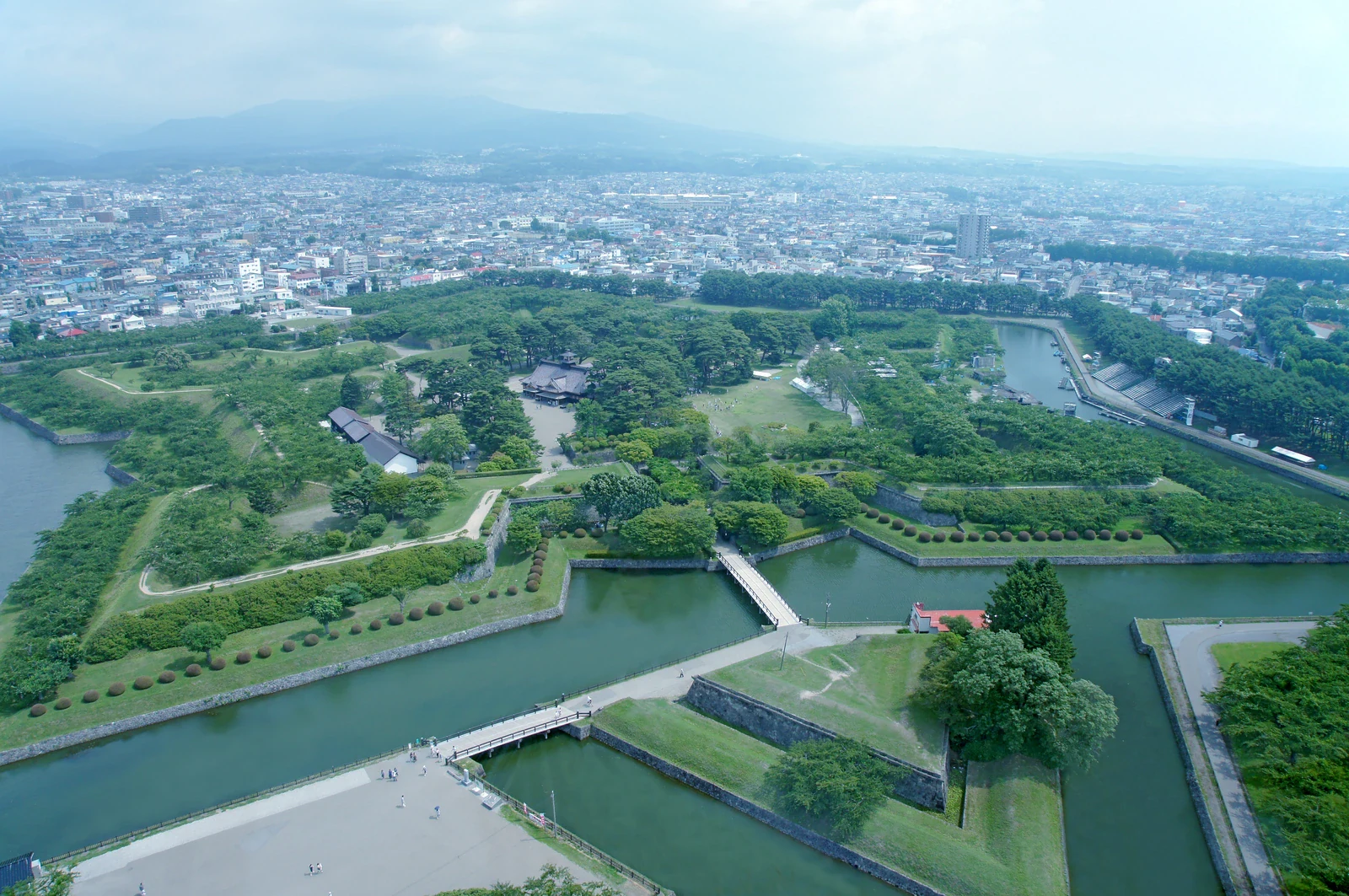
An elevated view of angular moats, stone-faced earthworks, green trees and the central reconstructed Magistrate’s Office, with Hakodate beyond.

Goryokaku Park seen from the separately ticketed Goryokaku Tower in July 2012.

Goryokaku Hakodate Hokkaido Japan02bss.jpg — 663highland, CC BY 2.5 (https://creativecommons.org/licenses/by/2.5/). Source: https://commons.wikimedia.org/wiki/File:Goryokaku_Hakodate_Hokkaido_Japan02bss.jpg. Proportionally reduced to a 1600-pixel long edge without upscaling; recompressed as WebP quality 92, method 6. No crop, retouching, added text or colour changes. EXIF omitted. · Creative Commons

Walks and routes

Across the main bridges to the heart of the fort

From the southwest approach beside the tower, cross Ichi-no-hashi and Ni-no-hashi, then use the main paths towards the Magistrate’s Office. Look at the water and stonework from the public path, pause in the central area, and return by the same bridges. Allow 45–75 minutes with stops; you can turn back earlier without needing to finish a circuit.

Keep to the lower main paths if stairs are difficult. Ask the park office which approach best suits your wheelchair, stroller or walking aid, especially during snow or repairs.

Across the main bridges to the heart of the fort

The outer-moat circuit

Add the roughly 1.8-kilometre promenade outside the moat when you want a longer walk. Follow it anticlockwise, leaving room for runners and other walkers. Compare the scene at successive bends: water, earthwork and trees overlap differently as you move. Allow 40–60 minutes including stops, or choose a shorter out-and-back if energy or weather changes.

Before committing to the full circuit, ask the park office about the surfaces, any diversion and the distance that would suit your mobility aid. A shorter out-and-back keeps the return flexible.

The outer-moat circuit

A park-first morning

Allow 1–1½ hours on site. Cross the main bridges, take a slow look around the central grounds, then decide whether to add a short moat-side stretch. Keep the full circuit optional. Finish with a break near the park before walking back to the tram.

A half day with history and a view

Allow 3–4 hours on site, plus transport. Start with the tower while visibility is good, walk into the park for the Magistrate’s Office, and leave time for lunch or tea. Add the outer circuit only if you still want more walking. If the office is closed, give the park more time instead of treating its ticket as essential.

Things to try

Find the star without climbing

Ask children to spot a sharp corner, a bridge and a reflection, then compare what they saw with the fort plan on a sign. The star is easier to understand in pieces first. Keep this as a looking game from the public paths, with an adult close beside children near the water.

Choose the tower for the big picture

If the sky is clear, go up before or after your walk and trace the outline you have just followed. The observation floors also offer a model and history displays, so there is more to do than take one photograph. Keep the tower as an optional extra rather than squeezing it into a short park-only stop.

Look closely at the reconstructed office

Inside the Magistrate’s Office, slow down for the timber structure and the long view across the tatami rooms. The building recreates only part of the original complex, which makes the surrounding open ground worth thinking about too. Shoes come off on entry; finish snacks and drinks before going in.

Give the flowers a second look

Choose one flowering tree or patch of water lilies and spend a few minutes noticing shape, colour and movement. Later-flowering weeping cherries can make a spring return visit feel different. Photograph plants where they grow and leave blossoms and branches in place.

Make it an indoor-led visit

In light rain, shorten the outdoor walk and choose the office for history or the tower for its displays and whatever view the weather allows. Neither is included in free park entry, and both close before the inner grounds in summer. In strong wind, heavy rain or icy conditions, postpone the longer circuit rather than pushing through exposed moat-side sections.

Wildlife and habitats

Weeping cherry: follow the shape

Near the Magistrate’s Office, look for cherry branches that hang in soft curves rather than forming an upright crown. The city’s spring guide says these planted weeping cherries flower later than the main Somei-Yoshino display. Enjoy the difference in habit without needing to choose a cultivar name.

Rose of Sharon: a late-summer flower

The park lists mukuge, or rose of Sharon, in its August flower calendar. Look for a shrub with broad hibiscus-like flowers and leaves that can have shallow lobes. Individual flowers are short-lived, while new ones can keep appearing. Garden forms vary in colour, so compare the leaves as well as the flowers.

Water lilies: a reason to pause beside the moat

The city’s nature feature describes pale pink and white water lilies, and the park calendar places their season from June into September. Look from a secure path for flowers and floating leaves, then notice how their shapes contrast with the sharp lines of the fort. Keep well back from the edge when taking photographs.

The park’s flower calendar is a good starting point for looking, but weather and maintenance change what is on show. Stay on the paths and enjoy the planted trees and water plants without picking or leaning over the moat. Three things to notice are below.

Stories and discoveries

The corners were part of the defence

The fort’s five projecting bastions give Goryokaku its name and distinctive outline. Earthworks, stone walls and water were designed together. Notice how the approach bends and screens the interior before you reach the open central ground.

The park’s trees have a human history

The cherry planting is traced to 1914, when the local Hakodate Mainichi newspaper marked its 10,000th issue with a large planting. Later generations of trees and ongoing care helped turn a former military site into a shared place for spring outings. The blossoms are part of the park’s later life, not a reconstruction of its original defences.

A bridge closure that has ended

The rear bridge was repaired and officially reopened at 05:00 on 27 March 2026. Old notices about its February–March closure may still appear in searches. Follow current signs on the day, particularly if you intend to enter from the north.

When to visit

Cherry season

Late April to early May is the usual window for the main Somei-Yoshino display. The exact week varies, and weeping cherries may follow later. Check live bloom updates before choosing a day, and leave more time for crowds. For a picnic, bring food ready to eat unless you have checked the current designated fire-use area and dates.

Late spring and summer

Wisteria is usually a late-May to June pleasure, with azaleas adding colour around the same part of the year. The park calendar lists water lilies from June into September and rose of Sharon in August. Treat the calendar as a guide and enjoy whichever plants are in flower when you arrive.

Autumn

Choose a dry interval for leaves and reflections, and bring an extra layer for a slow walk. Remember the inner grounds and Magistrate’s Office move to their earlier closing times from November. The 24 November 2026 maintenance closure also affects the inner toilets.

Winter

Snow can make the star especially clear from the tower, while ice makes ground-level walking slower. The seasonal Hoshi no Yume illumination has traditionally lit the moat in winter; check the current event dates, switch-off time and tower hours before planning an evening around it. Warm footwear with grip is more useful than trying to complete every metre of the circuit.

Getting there and practical advice

Free park, timed inner gates

The public park is free and has no regular weekly closing day. The grounds outside the moat remain distinct from the gated interior: inner access is 05:00–19:00 in April–October and 05:00–18:00 in November–March. Check signs for exceptions. Smoking is prohibited inside the moat.

Magistrate’s Office admission

Checked on 16 October 2026: general admission is ¥500, students and schoolchildren ¥250, and preschool children free. It opens 09:00–18:00 in April–October and 09:00–17:00 in November–March, with last admission 15 minutes before closing. It closes 31 December–3 January and on additional maintenance days. Check the latest notice before making it the centre of your day.

Tower admission

Checked on 16 October 2026: the observation floors cost ¥1,200 for adults, ¥900 for junior and senior high school students, and ¥600 for elementary school children; younger children enter free. Normal opening is 09:00–18:00, with last entry at 17:50. The tower’s admission is separate from the office.

Toilets and a place to pause

The park lists four toilet locations, with accessible provision near the historic-site information board, along Bijutsukan-dori outside the moat, and near the old provisions warehouse inside. Inner toilets follow the inner-gate hours. Itakura Yanagino, opposite the office, has a rest and eating area and lockers; its opening is separate from the park.

24 November 2026 maintenance closure

The office, Itakura Yanagino and every toilet inside the moat close for the whole day on Tuesday 24 November 2026. Plan to use toilets outside the moat. This notice concerns those facilities, so check park access separately rather than assuming the entire outdoor visit is cancelled.

By tram from Hakodate Station

Take the city tram towards Yunokawa and leave at Goryokaku-koen-mae (五稜郭公園前). The tourism office gives about 17 minutes for the tram ride and 13 minutes walking; allowing around 15 minutes for the walk is a more relaxed plan. Check your return service, particularly after an evening event.

By bus, or arriving at JR Goryokaku Station

A bus to Goryokaku Park Entrance (五稜郭公園入口) leaves a walk to the park; services stopping at Goryokaku Tower are closer to the southwest approach. Check Hakodate Bus for the route and timetable on your date. JR Goryokaku Station is elsewhere, about 2.5 kilometres from the tower, so do not treat it as the park gate.

By car or taxi

Use a named nearby paid car park, such as Hakodate Municipal Goryokaku Sightseeing Parking opposite the Central Library. There is no dedicated parking for private cars at the park or tower. For a taxi, name the tower-side park approach or your agreed accessible drop-off. Blossom-season traffic and parking queues can eat into a short visit.

Choose the main paths rather than the ramparts

The main paths have been adapted with small gravel aggregate surfacing and step-free passage. Raised-bank paths have stairs. Contact the park office on 0138-31-5505 to discuss the route from your arrival point, current snow or repair conditions, and the toilet you need.

Ask about the two indoor visits separately

The Magistrate’s Office has used a removable ramp with staff assistance to bridge the entrance step; call 0138-51-2864 to confirm arrangements for your chair. The city tourist information office lists elevator access to the tower observation deck. Ask tower staff about the suitable lift route between floors and any assistance needed.

Plan the journey as well as the park

Hakodate publishes low-floor tram timetables, but replacement vehicles can operate. Check the current list and contact the transport bureau on 0138-52-1273 if step-free boarding is important. Allow extra time for the walk from the tram stop, and consider a suitable taxi if snow or distance makes that approach difficult.

Sources and useful links

Wildlife you might spot

3

Each card links to a full Explore page with photos, traits, and fun facts.

We are still adding species preview cards for this place.

Snap map for this place

Start with the big picture, then zoom in to explore individual wildlife observations around this place.

Loading map…

Good to know before you go

Use Goryokaku-koen-mae tram stop, not JR Goryokaku Station, for the straightforward tram approach. Allow around 15 minutes on foot from the stop to the park.

The inner grounds open 05

00–19:00 in April–October and 05:00–18:00 in November–March. Plan the office and tower separately because their hours are shorter.

On 24 November 2026, the Magistrate’s Office, Itakura Yanagino rest house and all toilets inside the moat are closed for maintenance. Use toilets outside the moat.

Follow barriers around stonework. The operator has cancelled its 2026 bluegill-removal volunteering because of stonewall-collapse risk; stay on open public paths and keep off the walls.

When making a walking or running circuit, go anticlockwise as the park requests. Step aside before stopping for photographs.

Check the year’s hanami rules before bringing barbecue equipment. Permission to use fire applies only to designated areas and specified seasonal dates.

Leave large luggage at your accommodation or a suitable locker if visiting the Magistrate’s Office; it cannot be carried around the interior.

In winter, shorten the walk if the paths are slippery. Stay off the moat ice, and leave time to get back to your stop in daylight.

Frequently asked questions

No. Walking in the public park is free. Entry to the Magistrate’s Office and the tower observation floors is charged separately.
From the ground you see the moat’s corners and earthworks in sections. The adjacent tower is the straightforward option for a view of the complete five-pointed shape.
No. The railway station is about 2.5 kilometres from the tower. From central Hakodate, use the tram to Goryokaku-koen-mae and walk, or check a bus that serves the park area.
Yes. Weeping cherries can flower later than Somei-Yoshino, and wisteria, azaleas and water lilies follow in the warmer months. Autumn and winter change the scene again.
The inner grounds have gates and seasonal closing times. The outer promenade is distinct from this area; check event hours and the current notice rather than assuming an illumination keeps the inner gates open.
Plan around the main lower-level paths and ask about the current route from your arrival point. The raised banks are a different proposition. Confirm staff assistance at the office, accessible toilets and winter conditions before travelling.

Recent snaps at this place

Recent snaps will appear here as new observations are added.

View all ›

Take the discovery with you

Exploring Goryokaku Park?

Identify the wildlife you spot, learn as you go, and keep a collection of the adventure.

  1. 1Spot it
  2. 2Snap it
  3. 3Keep the discovery
