
Snappit logo
Snappit
Get App
Generic illustration, not a photograph of this venueIllustration
ParkKanagawa, Japan

Ikuta Ryokuchi

Ikuta Ryokuchi is a place to look up, look closely and take your time.

About

Ikuta Ryokuchi is a place to look up, look closely and take your time. A grove of dawn redwoods rises beside the central park, while wooded slopes lead toward Masugatayama’s lookout. Between them are places to picnic, learn about local nature and explore the houses of an earlier Japan. You can make a satisfying visit from a small part of it.

The landscape has more than one story. Oak woodland, springs and damp valley hollows preserve elements of the region’s satoyama, the countryside shaped by people working with woods and farmland. The impressive dawn redwoods belong to a cultivated grove. Museums add another layer, connecting local landscapes with rural life, science and art. It is worth noticing these differences rather than treating every green corner as the same kind of forest.

For a first visit, begin at the East Gate Visitor Center and choose one main interest. The central lawn and science museum suit a relaxed family outing; a hill walk or the folk-house museum gives the day more depth. Bring comfortable shoes and leave room to change plans. This is hilly ground, and conservation work sometimes closes individual paths. Enhance your adventure: download the Snappit app to identify the local species you encounter.

Ikuta Ryokuchi was designated in city planning in 1941. Its value comes partly from the survival of woodland and wet hollows within a growing city. Today, conservation and public enjoyment are managed together, with local people contributing to the care of the landscape.

What to do here

Pause beneath the dawn redwoods, explore the central plaza, visit one museum, or climb toward Masugatayama if the current route and your group’s energy allow.

Seasonal info

Seasonal displays depend on weather. The rose garden is currently closed for redevelopment; older spring-and-autumn opening descriptions do not apply.

Accessibility

Use the official barrier-free map to compare slopes, steps and facilities, then confirm current conditions with the visitor center. The map is older than current closures and does not make the whole park step-free.

Don't miss

1

Dawn-redwood canopy and Oku-no-ike pond

2

Central plaza and railway exhibits

3

Japan Open-Air Folk House Museum

4

Masugatayama’s panorama

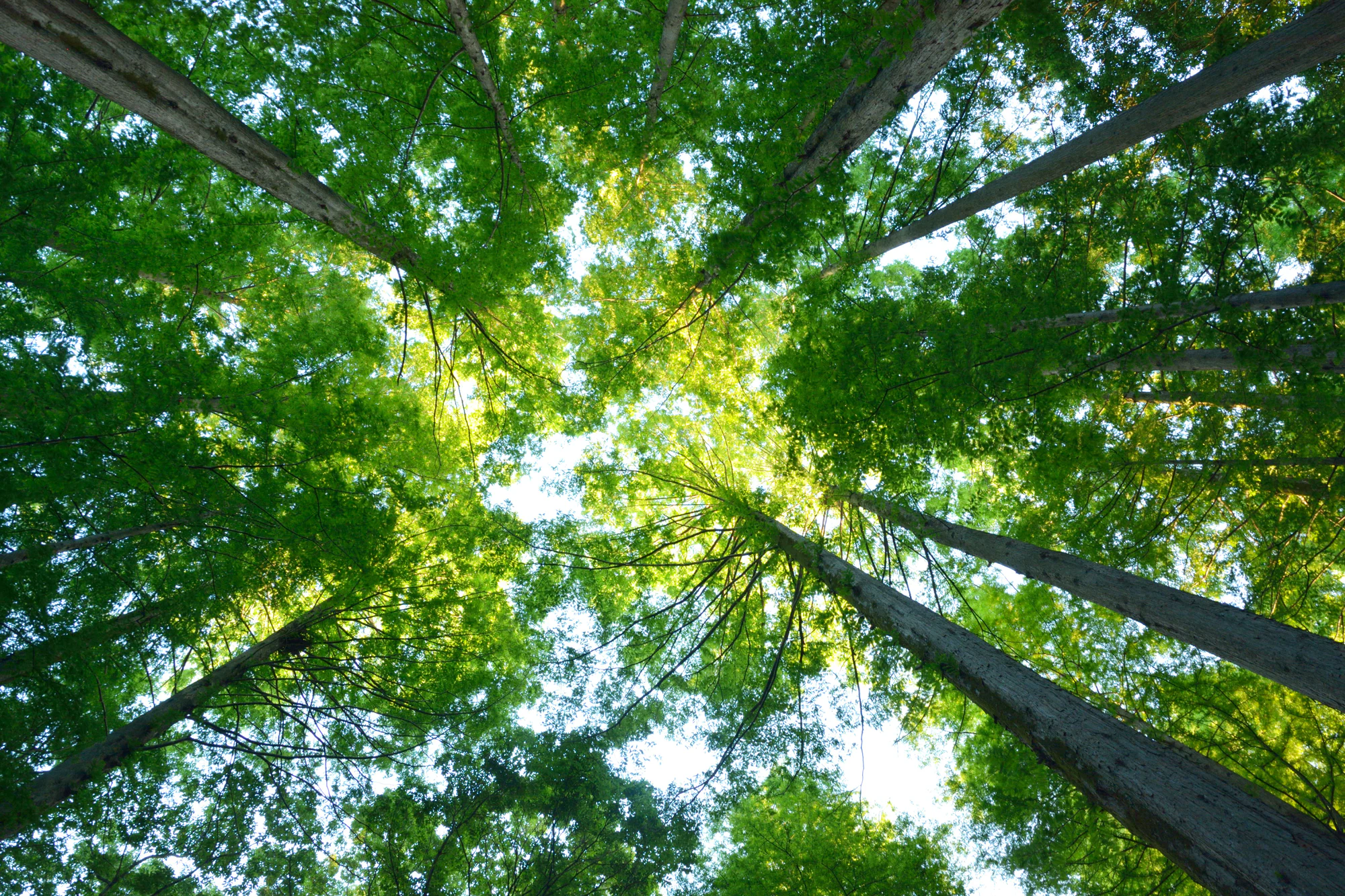
Tall tree trunks rise inward from the edges of the photograph toward a bright green canopy and patches of sky.

Looking up into Ikuta Ryokuchi’s dawn-redwood canopy, photographed on 17 May 2014. This historical image does not show current tree or path conditions.

Photo: Kawasaki City, “生田緑地 メタセコイア”, via OpenPhoto, CC BY 4.0. Original image unchanged. · Creative Commons

Walks and routes

A central-park discovery stroll

Start with current advice at the East Gate Visitor Center, then use the main paths toward the iris garden, science museum and central plaza. Continue toward the dawn-redwood grove and Oku-no-ike only where current signs permit. Return by a suitable open path rather than committing to a fixed loop. A picnic or one short indoor stop fits naturally here.

90 minutes to two hours, including pauses

A hill walk with room to rest

Ask at the visitor center which approach to Masugatayama is open and suits your group. Make the lookout and play area the main goal, then return before adding anything else. Longer woodland variants toward the northern paths need particular attention to the closure map. Skip a blocked branch rather than seeking a way around it.

Two to three hours with breaks; allow extra for a museum

One museum and a little fresh air

Choose the folk-house museum for architecture and rural life, or the science museum for nature and astronomy. Add the central lawn and canopy afterward. In wet weather, the science museum is the more useful indoor anchor; the folk-house museum still involves outdoor walking. Check the day’s calendar before leaving home.

Half a day, depending on your chosen museum or show

Things to try

Make a canopy sketch

Pick a permitted stopping place that leaves the path clear. Draw the shape made by three trunks and the gaps of sky between them. Children can compare a close-up leaf drawing with the whole-tree view.

Try a quiet listening minute

Stand still together and count different sounds without moving toward them. Then look for a bird’s direction of travel. You do not need to identify every call to enjoy the difference between the lawn and wooded paths.

Turn a museum visit into a question

Before going inside, let each person choose one thing to investigate: how a house stays dry, what lives in a woodland hollow, or why some trees lose their leaves. Share one discovery over a break.

Look for a guided activity

The park and science museum publish walks and workshops. Check the current event listing for age guidance, booking, meeting point and cancellation rules; a previous year’s program does not establish this year’s event.

Wildlife and habitats

Dawn redwood

Look at the tall trunks and fine foliage near Oku-no-ike. Autumn colour and winter leaf loss are part of this tree’s seasonal character. The accompanying photograph records the canopy in May 2014, not current conditions.

Sawtooth oak

The operator identifies sawtooth oak among the woodland’s characteristic trees. Observe leaves and acorns from the path, leaving them in place. Do not approach damaged trees to identify them.

Long-tailed tit

The operator includes this small, long-tailed bird among birds found in the park. Look patiently for movement in branches; a sighting is never guaranteed. A distant view is better than following a flock off the path.

Stories and discoveries

Dawn redwoods and Oku-no-ike

Let this be your unhurried stop. The grove surrounds the pond area between the central plaza and the art museum. Look at how the tall trunks frame the sky, then shift your attention to reflections and the smaller leaves nearby. Stay on permitted paths and leave working space around construction.

The central plaza and trains

The lawn is a useful place to pause between discoveries. Nearby are a preserved passenger carriage and a D51 steam locomotive. The carriage normally opens 09:30–16:30, with exterior-only viewing from 29 December to 3 January. The locomotive is for viewing: climbing or boarding it is prohibited.

Masugatayama

This wooded hill offers a lookout over the surrounding city and Tama River landscape. The tower normally opens 09:00–17:00. The hill’s quoted 84 metres is elevation above sea level, not the amount you climb. There are play equipment, toilets and vending machines in the square; views depend on weather.

Japan Open-Air Folk House Museum

Traditional buildings relocated from eastern Japan make the landscape’s human history tangible. Compare roofs and building materials rather than trying to see every detail at once. This is an outdoor museum with its own entrance fee, opening times and hilly paths.

Kawasaki Municipal Science Museum

The nature displays are a useful companion to a woodland walk: start with a question outdoors, then see what you can learn inside. Exhibition admission is free. The planetarium is separately ticketed and tied to scheduled shows, so choose a performance before committing the rest of your day.

Hatsuyama and Tonmori Yato

The southern part of the green space has its own quieter landscape of paths, water and satoyama activity. The official map marks the aquatic-plant viewing pond, Hatsuyama plaza and Tonmori Yato. Treat this as a separate outing if your group is already tired; it is more than a quick lap around the central lawn.

A conifer that changes colour

Dawn redwood is a deciduous conifer: its leaves colour and fall, unlike the evergreen image many people associate with conifers. Scientists knew it from fossils before living populations in China became known. The grove here is cultivated, not a surviving wild population.

Woods shaped by people

Sawtooth oak is one of the trees associated with Ikuta’s secondary woodland. Coppicing and charcoal production are part of this species’ wider history in Japan. Satoyama is a useful way to understand a landscape where human care and natural processes meet.

Water is part of the woodland story

The park’s springs and wet hollows support habitats different from the drier slopes. Its official introduction identifies Genji fireflies and hotoke-dojo loaches among its notable inhabitants. Their presence is a reason to protect the habitat, not a promise of an encounter.

When to visit

Spring

Plum blossom gives way to cherry blossom, especially around Masugatayama. The operator gives late March to early April as the usual cherry season; timing varies. The native-tree calendar offers smaller flowers to notice too.

Early summer

June brings the iris garden and hydrangea interest. Official pages differ on the exact iris peak, so check current reports rather than planning around one precise week. Carry water and take shade breaks.

Autumn

Look for fruits and changing leaves. The operator generally places foliage from late November, with dawn redwood colour around early December. These are seasonal guides, not a report that the trees are colouring today.

Winter

Leafless branches make tree structure easier to study, and a brief outdoor visit pairs well with an indoor museum stop. Check earlier seasonal closing times and give wet, frosty or muddy surfaces extra care.

Getting there and practical advice

For the East Gate, the operator gives about 13 minutes on foot from the south exit of Mukogaoka-yuen Station on the Odakyu Line, or about 25 minutes from Noborito Station’s Ikuta Ryokuchi exit. These are entrance walks, not times to every attraction.

Buses from Mukogaoka-yuen’s south side serve Ikuta Ryokuchi Iriguchi, about a three-minute walk from the East Gate. For the West Gate, a bus from the north side to Senshu Daigaku-mae leaves about five minutes on foot. Check current departures and destination signs.

Paid parking is available. Ordinary cars are listed at ¥300 for the first hour, then ¥150 per additional 30 minutes; the ¥1,000 daily cap applies on weekdays only. Vehicle entry is 05:00–22:00, with exit possible later. Weekends can be busy, so public transport is a good default.

The East Gate Visitor Center and West Gate Satellite normally open 08:30–17:00 and close over New Year. The East Gate center has a rest space and toilets; contact it on 044-933-2300 for park advice.

The folk-house museum normally opens 09:30–17:00 in March–October and 09:30–16:30 in November–February; last entry is 30 minutes before closing. Standard admission is ¥550, or ¥330 for high-school/university students and people 65 or over; junior-high-school age and younger enter free. Check evidence required for concessions.

The science museum normally opens 09:30–17:00. Standard planetarium tickets are ¥400, or ¥200 for high-school/university students and people 65 or over. Junior-high-school age and younger are free but still need a ticket. Arrive before the show; late entry is not allowed.

Museum closed days generally include Mondays, with holiday exceptions, days after public holidays and New Year. Consult each calendar. Café Hoshimeguri is beside the science museum, and picnics are welcome on the central lawn. Carry essentials rather than relying on every outlet being open.

Choose the approach as carefully as the destination

The official barrier-free map distinguishes broadly level paths, gentle slopes below roughly three degrees, steeper slopes, boardwalk and stairs. Its printed production date is March 2018, so use it for terrain orientation alongside current notices. The East Gate corridor toward the museum cluster is a sensible place to discuss a shorter outing with staff, not a blanket promise of level access.

Free wheelchair loans are listed at the East Gate Visitor Center, subject to availability. Ask before relying on one.

Accessible-toilet symbols appear at the visitor center and several park facilities. Opening hours and equipment differ; confirm the toilet needed for your visit.

Masugatayama’s lift serves the tower; approach gradients remain. The folk-house museum separately warns of slopes, steps and uneven or slippery ground.

For disability-related drop-off at a museum, contact that museum in advance. The park does not allow ordinary through-driving, and a drop-off arrangement does not permit a vehicle to wait beside the building.

Keep to paths and respect closure tape, barriers and work areas. Oak-wilt damage is a practical safety concern, including outside marked closures. Avoid woodland outings during strong wind or severe weather.

Wear shoes with grip. Allow extra time for steps and damp surfaces, and supervise children beside ponds and on slopes.

Do not feed, catch or remove wildlife, plants or soil. Keep voices low near birds and leave the path clear for other visitors.

Dismount and push bicycles where permitted; follow local signs. Drones, smoking and fire are prohibited.

Tents are generally restricted. A central-plaza pop-up-tent trial runs 1 April 2026–31 March 2027, 10:00–16:00, with additional conditions. Check the posted trial rules before bringing one; this is not camping permission.

Visitor information

Oak-wilt safety closures affect parts of the nature trail, the route toward the Togakushi Fudo remains and the prefectural-tree grove. The March 2026 map gives 31 March 2027 as the scheduled end, with extensions possible. Other dead trees may remain outside closed sections.

The rose garden remains closed for redevelopment.

Taro Museum construction affects galleries and some nearby circulation. The small free display “Chokotto TARO: Taro’s Cute Works” is scheduled through 6 December 2026, subject to its own closed days. It is not the normal full exhibition.

Sources and useful links

Wildlife you might spot

3

Each card links to a full Explore page with photos, traits, and fun facts.

We are still adding species preview cards for this place.

Snap map for this place

Start with the big picture, then zoom in to explore individual wildlife observations around this place.

Loading map…

Good to know before you go

Choose one museum rather than rushing between every attraction.

Read the closure map before a woodland walk and follow barriers on the ground.

Pack water and a small picnic; café hours follow their own schedules.

Bring binoculars or a sketchbook, and leave plants and animals where they are.

Frequently asked questions

No reservation is needed for ordinary use of the public green space. Museums, planetarium shows, workshops and nearby ticketed attractions have their own arrangements and charges.
As checked on 20 October 2026, it is closed for redevelopment, with no general public-opening schedule announced for the time being. Do not plan a rose-viewing detour based on an old poster.
Its regular exhibition galleries are closed from 30 March 2026 until the end of March 2029, provisionally. Limited free-space programs continue. Check the museum’s calendar and construction access before making a special trip.
The observation tower has a lift, but reaching it involves hilly park routes. A lift at the destination does not remove approach gradients. Ask staff to help choose a suitable route, or enjoy the central area instead.
Dogs may accompany you in the green space on a lead; take their waste home and check individual facility rules. Smoking, barbecues, fireworks and other use of fire are prohibited.
The park’s rules ask visitors not to remove plants or animals, bring in outside organisms or feed wildlife. Try photographing, drawing or counting what you notice instead.

Recent snaps at this place

Recent snaps will appear here as new observations are added.

View all ›

Take the discovery with you

Exploring Ikuta Ryokuchi?

Identify the wildlife you spot, learn as you go, and keep a collection of the adventure.

  1. 1Spot it
  2. 2Snap it
  3. 3Keep the discovery
